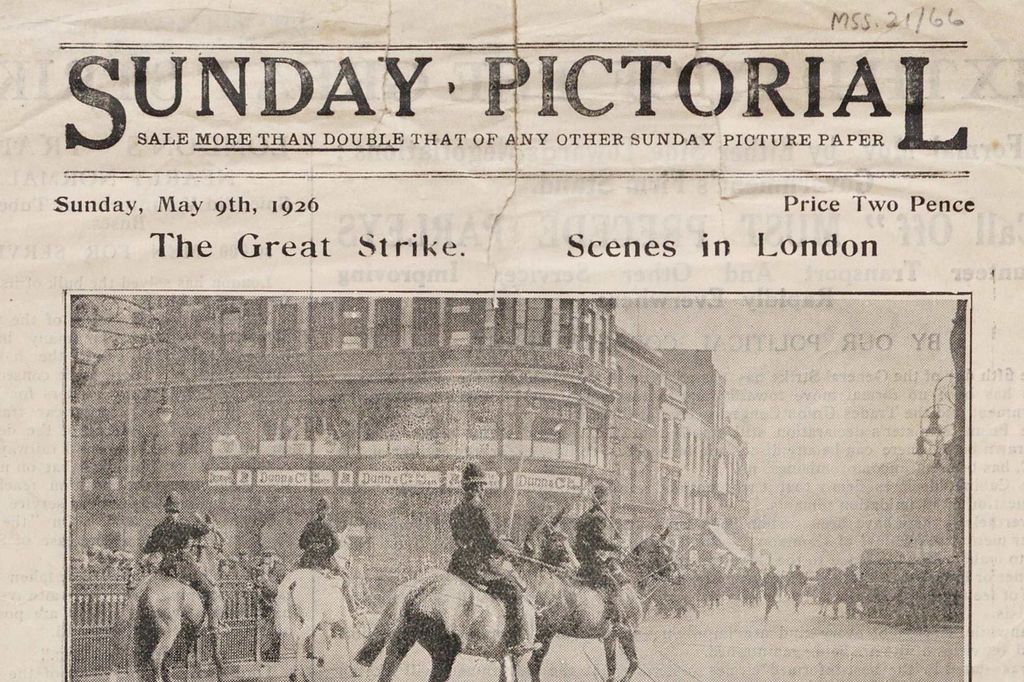
The 1926 General Strike around the Elephant & Castle
Amended text of a walk organised by past tense in May 2026 around the Elephant area, attended by some 60 people.
Start: The Obelisk, St George’s Circus
In the aftermath of World War 1, as the British war economy was returned to ‘peacetime’ working conditions, the early 1920s saw a mass economic slump, with mass unemployment and an onslaught of employers against workers, in a struggle to reduce wages and conditions.
In parallel with this, the mass slaughter and disillusion arising from the war, and the influence of the 1917 Russian Revolution, had created a militant generation which saw the possibility of positive social change and was prepared to strike en masse to try to achieve better lives.
1919-20 saw huge waves of strikes, while politically the Labour Party and the smaller Communist Party gained influence. Labour came to power in many local councils, and nationally in 1924, if briefly.
On May lst 1926 the main industrial dispute in the country was the battle between the miners and the coal-owners, and it was this battle which was to lead to the calling of the General Strike. This dispute was the focus of the power struggle between the owners and the workers. In the coal industry the owners had, for over a year prior to May 1926, been attempting to force reductions in wages and increases in hours worked. On July 31st 1925 the Tory government was forced, in return for industrial peace, to offer a nine month subsidy to the coal industry, a condition of which was the withdrawal by the coal-owners of notices of wage reductions. This subsidy ran out in April 1926 and immediately the coal-owners posted lock-out notices in the face of the total refusal by the miners to accept any reduction in wages or increase in hours worked: “Not a penny off the pay, not a minute on the day.”
By this time the masses of the workers were calling for a General Strike in support of the miners’ struggle, which they saw as their own. They forced this view on the General Council of the TUC, who proposed “coordinated action” – and this proposal was endorsed on May lst at Farringdon Hall by a conference of Trade Union Executives representing 4 million workers. The leaders of the Trades Union Congress were still intent on negotiating with the Government. The government, however, broke off negotiations on the morning of May 3rd on account of the action taken by the printers of the Daily Mail ~ who refused to print the editorial which attacked the steps taken by the Trade Unions. The leaders of the TUC were left with no alternative but to call a General Strike to begin on May 4th.
Southwark
Today’s London borough of Southwark was then divided into 3 older ‘Metropolitan boroughs’: Southwark, Camberwell and Bermondsey. Southwark, bordering on the river, was the smallest of the three, an old area south of the Thames that hosted poor housing, industry and disreputable areas, outside the City’s control for centuries. It had the worst and most densely populated housing of any metropolitan borough. Its population density was 160 people to the acre, compared with 77 for Bermondsey and a very low 59 for Camberwell.
Bermondsey, to the east of here, was a heavily industrialised area, with a large docks area and a mainly working class population. Bermondsey Borough Council was distinguished not only from the other two but also from the vast majority of the metropolitan boroughs by the fact that it had a Labour controlled council. lt was also distinguished by its policies, many of which ran counter to the London County Council, with which it was having a continual running battle.
Camberwell, larger and extending to the south, was more mixed – the northern part of this borough being working class housing, the south being more prosperous and housing middle class, professionals, clerks.
We’re going to concentrate on events in the 1926 General Strike in the Elephant & Castle/North Southwark area today – but there are lots more history/accounts of the ‘Nine Days’ all over this area/London/the country.
The major industries in the three boroughs then were the docks, transport services, engineering works and printing. The workers in these industries were well organised through trade unions, as shown by the example of Hoe & Co.
“Unemployment in the three boroughs around the national average of 12 per cent. The situation of the unemployed was hard. In 1926 unemployment benefit was about 15 shillings per week for a single man. This rate applied for 26 weeks only, after which unemployed received Poor Law Relief administered by the Board of Guardians for the Borough. After this was exhausted many of the unemployed in Southwark were sent to Labour Camps at Hollesey Bay and Belmont in Surrey, where they were forced to work under overseers.
A statement in the House of Commons (reported in the South London Observer, Wednesday March 24th, 1926) disclosed that one man in seven, and one woman in three were refused benefit at the Labour Exchange, and left to starve or apply for Poor Law Relief. The unemployed also had to sign on every day of the week.
The National Unemployed Workers Movement (NUWCM) was very active in the area in organising unemployed workers before and during May 1926. Membership was very high in Southwark and meetings were held outside the Labour Exchange, where speakers would address the people waiting to collect their money. Many members of the organised unemployed were sent to prison during the period 1925-6 because of their political activities.
We organised the Unemployed Workers Movement. I was active and we were well known. We were stopping evictions – people were being evicted for arrears of rent. The Unemployed Workers were a communist organisation. I was one of the founders, with Wal Hannington.
It was the only body fighting evictions. I was coming down to the Elephant and Castle one day and two women came out to me: “We’ve got some trouble”. It was a dirty November morning and they took me down to where two little kids were under a table in Maywood Street, shivering. I had a chat and they told me “This chap just down the road has evicted this family”. I knocked on the door to talk to the chap who had evicted them. No answer. I got in through a bedroom window after climbing up from the table. There was a lady in bed but I went straight on through to the top of the stairs and there was the chap and his son with big sticks. When I walked downstairs it took him by surprise – they put the family back.
We had that much control that the bailiffs would come and ask if we were defending a particular eviction – and if we were they wouldn’t come. We always barricaded up the door, and they had a bucket and rope to feed the defenders. The police would come and then there would be trouble. We told the owners – you’ll do so much damage to your property it won’t be worth it.
During those years we would also raid factories which were doing overtime. As the Unemployed Workers Movement was communist, they had nothing to do with the Trades Council, after the exclusion of communists from the Labour Party in 1924.”
(BERT EDWARDS)
The Immediate Pre-strike climate
“The attitude leading up to the General Strike was the build-up of agitation and this was centred on the issue of the miners. We had had Black Friday in 1921 – when the NUR and the TGWU and the miners agreed on joint action and then, on a Friday in 1921 when the Government attacked the miners, the agreement did not operate. It was the attitude in the Trades Union Movement that there was a possibility of a General Strike. The right wing members of the Movement said “As far as a General Strike is concerned the masses will come out in support of anybody but themselves. You won’t get a General Strike on the question of the miners.”
(Bert Edwards)
HOW THE THREE COUNCILS RESPONDED TO THE STRIKE
Obviously the political and economic structure of the boroughs coloured their response to the General Strike, and it is noticeable that the three boroughs had very contrasting attitudes during that period.
Southwark Council’s response was rather limited, not in intensity but certainly in its democratic base. The mayor was the subject of a special meeting called on May 19th “to consider the action of the Lord Mayor Alderman J.R.Want”, who’d called off all the council meetings, taking power into his own hands, and had sent threatening letters to all local authority workers warning them not to strike. A motion regretting this action as “thereby depriving the elected councillors of their right to share in the government of the borough” was defeated & an amendment expressing “entire confidence in the Lord Mayor” was passed by 49 votes to 14.
Camberwell Borough Council fully supported the Government against the strikers, it was cooperative with the Emergency Powers Act and its functionaries, and it appointed the Treasurer and Town Clerk as the officers in charge of food and fuel.
Of the three boroughs it is not surprising that Bermondsey showed the closest cooperation between Council and strikers. As soon as the strike was announced, “the Borough Council, being Labour, formed an emergency sub-committee which was in close touch with the Council of Action and both the Town Halls [ie Rotherhithe and Bermondsey] were passed over to the Trades Council during the strike, which were used for strike meetings and strike committees.”
In fact, the Council in effect suspended itself and delegated all its powers to this Emergency Committee, which consisted entirely of Labour members.
A comparison of the minutes of the London councils just before and after the strike shows very clearly how they responded to the situation.
Various local authorities passed motions and then circulated them to other local authorities to be endorsed. Of the many, two reflect their contrasting nature. Hackney requested all other Councils to join them in urging the Prime Minister to ensure that after the strike the local authorities would be able to discriminate against the strikers in favour of blacklegs. Southwark and Camberwell both agreed to endorse that Motion. However, the motion from Bethnal Green condemning the action of the government in breaking off negotiations with the TUC on May 2nd was consigned to the waste paper bin; whereas Bermondsey’s Emergency Committee seems to have passed a resolution in support of the Bethnal Green Trades Council motion. The Government had to appoint a retired Army Captain as its Food and Fuel Agent in Bermondsey, because cooperation was not forthcoming from the Council.
Government preparations
The tory government were well-prepared for the General Strike.
“Since the previous year they had been working to ensure that they would be the victors in any protracted industrial struggle. In September 1925 they formed the ‘Organisation for Maintenance of Supplies’ (OMS) composed of upstanding members of the middle class, run by retired army officers. Its function was to collect lists of volunteers who would be willing to run the country in the event of a General Strike. On May lst the Government declared a State of Emergency, which suspended civil liberties and allowed them greater freedom to arrest and imprison so-called ‘dissidents’.”
The government also passed Acts giving local councils power over local distribution of fuel distro and making interference with electricity supplies a particular offence.
Cops and Squaddies
Troops were used widely in the Strike, to guard convoys of supplies and strategically important buildings, and to intimidate strikers just by their appearance. The Secret Map of London, produced in 1926 for the Government, marked out military district boundaries, and shows territorial / army Units, barracks, electric power stations (which would be crucial battlegrounds in the Strike ) ‘vulnerable points, magazines etc’ and fire stations.
The map was drawn up to aid administration of the Strike, for use by the authorities, police, maybe OMS, and to enable the planning of movements of troops, police & specials. The map indicates that troops were stationed at the Territorial Army barracks at the end of Ambergate Street in Kennington.
On another note, it was mentioned by trade union intelligence gatherers that “Messrs. Lyons Police Supplies Contractors, Blackfriars, have had their supply of Ash Handles commandeered by the Police.”
(TUC Intelligence Dept report 8/5/1926)
Electricity Works: Bankside Power Station (now re-purposed as the Tate Modern Art gallery) supplied some the Southwark area with electricity.
But Southwark Vestry (precursor to the Borough Council) had also opened a power station at Penrose Street in 1898, which was probably been producing power (for lighting?) as it was rebuilt here in the 1940s after being bombed.
These were marked as strategic points to defend in the ‘Secret map’ and in other boroughs the electrical works were the focus of strikers attempts to shut down power and mass picketing.
Workers did strike at the Council’s municipal Electric Works:
“SOUTH LONDON ELECTRICAL WORKERS JOIN THE STRIKE.
Acting on instructions from the executive of the Electrical Trades Union, members of that organization have ceased to work at two large power stations in South London. The Cambria-rd., Loughborough Junction light and power works of the South London Corporation were
the first affected, but within a very short time of their quitting the building volunteers, most of them trained men, were installed in their positions. In similar circumstances the members of the union left work at the Southwark municipal power and light station. In this instance, too, volunteers were ready at hand and there need be no apprehension as to electric supply.”
(South London Press Bulletin 10/5/1926)
Some of these workers seem to have been sacked as a result of this action (see ‘End of the Strike’ below)
This strike is not to be won with half-bricks
At at least one point there was trouble outside Bankside Power Station:
“BRICK THROWN AT POLICE.
Disturbance at a Sumner Street Electric Light Station. William Jones (45), 3, Wagstaff Buildings, Sumner-St., Southwark was charged at Tower Bridge on Monday, with using insulting words and behaviour and further under the Emergency Powers Act, with being in the
neighbourhood of plant used for the production of heat, light or power, with intent to do injury thereto, by reason
of having two half-bricks in his possession.
Police evidence shewed that a lorry load of police were dispatched from Southwark Station to the London Electric Light Station, Sumner-st., Southwark. constables and some private persons, having dispersed a crowd, were busy moving some drums of electric cable and prisoner, standing just in front of the crowd, threw a half-brick at the police. He then raised his right arm again and a constable, jumping from the lorry, siezed him.
He had then a piece of brick, produced, in each band.
He was arrested and when charged, said, “I don’t know what made me do it,
Mr. Waddy: “This strike is not to be won with half-bricks and you and others had better understand that. Go to prison for three months, with hard labour.”
Was there more trouble at these power stations? We’re still investigating…
TUC attitude & preparations
“On the other hand, the organisation of the TUC was totally inadequate for the requirements of a General Strike, which could only mean that they thought, or indeed hoped, that the strike would be lost very quickly. At a local level, however, the Trades Councils responded by organising in an impromptu but efficient fashion. They formed themselves into Councils of Action and altogether there were 131 of these throughout the country. (52 in London)
Strikers were initially called out on strike in waves, so that not all workers were out straight away. Large numbers of people wanted to join the strike but were ordered by the TUC & the unions to continue working, the idea being they would join later if the strike dragged on – the TUC General Council of course hoped (and made sure) this would never happen.
But Trades Councils also kept on ordering people back to work when they weren’t “supposed” to be out (yet)… which caused even more confusion and bitterness.
The General feeling on the ground

Immediately before the Strike, the annual workers’ Mayday march took place through London, and ended at a special TUC congress. Sourth London contingents marched through Elephant and past the Obelisk.
“On May 1st 1926 there was a special conference of Union National Executives, called by the Trades Union Congress at the Memorial Hall, Farringdon Road, EC. Union members converged on this demonstration point from all parts of London. As was traditional, it was a very large contingent from the South East, going through Southwark. The demonstrators marched through St. George’s Circus, up Blackfriars Road, across Blackfriars Bridge to the Memorial Hall, rallying more people on the way.”
Declaration of the Strike
During the General Strike Southwark was an extremely important place, because the Elephant and Castle was a major junction of five main roads coming through Camberwell Green from Dover, and roads coming via the New Kent Road and Newington Causeway from the docks. Central to transport goods and people…
There was an immediate response to-the appeal that the Trades Council turn itself into a Council of Action. This rallied the Unions and many that usually didn’t take up the option of being represented on the Trades Council rallied to the strike centre, which was at 124 Walworth Road.
“The various functions taken over by the Councils of Action included: control of traffic, picketing factories that were on strike to ensure that the “volunteers” didn’t get in, picketing factories not on strike in an attempt to persuade the workers to join the stoppage, distribution of food and information, and alleviation of cases of great distress. In many places the Councils of Action became the only authority, the nearest thing to local control and autonomy in the history of modern Britain. And they had the support of the vast majority of workers in most cases. Their main headache was the constant need to convince workers who hadn’t yet officially been called out to go back to work.”
Scabs and Volunteers
There were many “posh” students in those days who had middle-class attitudes who would wear “plus-fours” (originally a golfers’ attire) to show that they were engaged in scabbing etc. and also engaged in militant action against the strikers, but they would mostly get the worst of it if it came to a show-down.
(Hutchins)
A large number of students volunteered from private Dulwich College.
Walk east down Borough Road to Rotary Street
Turn right into Rotary Street.
Hoe and Company Ltd, were a printing press manufacturers based here. They employed 900 men, and the printing engineering workers were amongst the best organised and the most militant in South London. There were three large engineering firms near the Elephant: Hoe’s, Waygood-Otis, and Durants (see Stan Hutchins’ account, below).
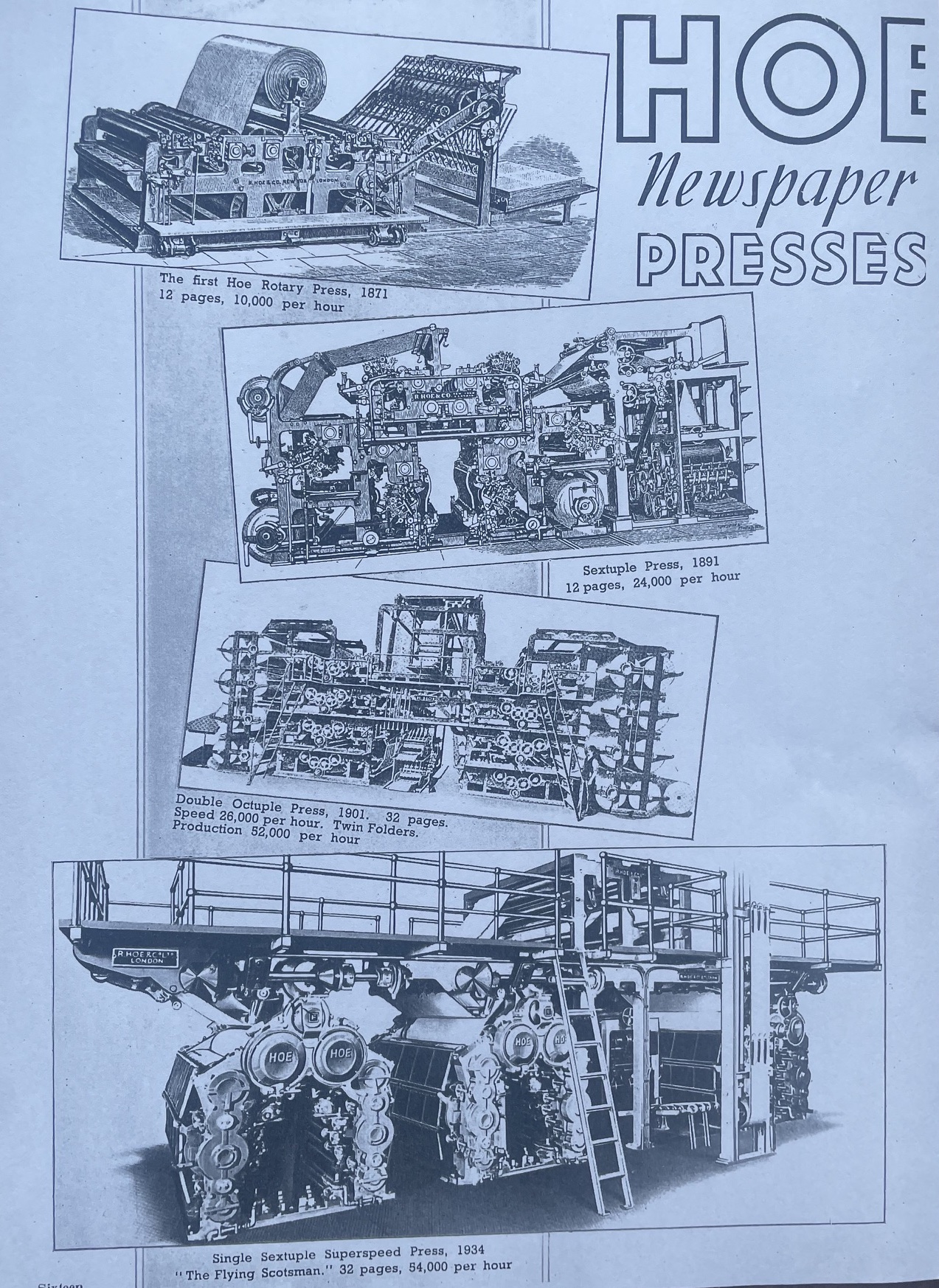
The Hoes workers had struck in the 1922 engineers lockout; from then until the General Strike workers here were said to be in “open revolt”. In 1925 Amalgamated Engineering Union members here began an overtime ban in a campaign for higher wages; as a result in January 1926 some were sacked and replaced by non-union labour. This led to both shifts starting a stay-in-strike: Hoe’s then locked out all 900 workers, who began an ‘unofficial’ 10 week strike to protest the hiring of non-union workers, and to demand a £1 per week pay increase.. Hoe’s went to the Employers Federation, who threatened a national lockout across the whole engineering industry involving 500,000 men, unless the Hoe’s men went back to work. (South London Press, March 26 ‘ 1926) Hoe’s workers marched to the Memorial Hall in Farringdon Street to protest against the threatened lockout, but the AEU ordered a return to work, saying the men had been morally right but technically wrong. Bah!
“As the 900 strikers at Messrs. Hoe’s printing machinery works in London had not returned to work, lock-out notices were posted in all the works throughout the country attached to the Engineering and Allied Employers’ National Federation. The notices applied to the seven unions to which the strikers at Messrs. Hoe’s works belonged, and affected some 400,000 men all told.” (R Hoes, 109-112 Borough Road, London, SE1)
(The Engineer 1926/03/12)
During the General Strike the workers were militant in their picketing of the firm. Stan Hutchins reports that only 20 apprentices remained at work and that they later contributed to a 100 per cent turn out.
“Three large engineering firms near the Elephant, Hoe’s, Waygood-Otis and Durants, were considered important because they had a workforce which included many apprentices and others with agreements. At Hoe’s twenty apprentices had remained at work. Southwark Council of Action organised a special meeting during a dinner hour, which successfully appealed to them and to which also hesitant lads from Waygood Otis had been invited to attend, achieving a 100 per cent turnout. Many out from Durant’s also joined the Union.” (Hutchins)
After the end of the General Strike, Hoe’s workers were forced to re-apply individually for their jobs. The firm considered they had sacked themselves.
“At Hoe’s engineering works, the employers refused to take the men back as a group “because they were no longer employees”, but agreed to take them back if they applied individually, at their former rate of payment and for their former jobs. Hoe’s said “They are being taken on as vacancies are available.”
Walk down Rotary Street to Thomas Doyle Street, turn right and walk to London Road
“On Thursday morning a crowd of men stopped a ’bus, manned by a volunteer driver and conductor, near the Elephant and Castle, and set fire to it. Mounted police arrived on the scene and soon had the situation in hand. Some distance away an attack was made on another ’bus and the driver and conductor were forced to leave the vehicle. Near Blackfriars a van was overturned.”
(The British Gazette. No. 4 , May 8th 1926)
Transport was key to the economy, and blocking public transport from running was a key element of the TUC’s plan to win tre General Strike. Transport workers in their powerful trade unions were the first called out. Most trains didn’t run.
Volunteers were recruited to drive trams and buses whose crews were on strike – usually under police protection.
Crowds of pickets and supporters tried to prevent trams, buses and later private cars from moving – often by force.
“No vehicle could proceed far without a permit issued by the Councils of Action. Main roads were barricaded and cars which did not have authorisation turned back. If a driver attempted to defy the strikers, his car would soon be lying on its side.”
Buses were physically attacked at the Elephant and in surrounding roads to try to paralyse transport.
“The crowd then moved towards London-rd. and about a quarter of an hour later the approach of a bus travelling towards the Elephant was a signal for another riotous outbreak on the part of the crowd. Stones were hurled through the windows, one
passenger being hurt, and the volunteer driver appearing to lose control of his bus, steered it direct for the Elephant and Castle Hotel. It knocked over a motor cycle and cyclist and crashed into a wagon and came to a standstill partly on the path. The motor cycle and wagon were wrecked. The police, who had now been greatly reinforced, both by foot and mounted officers, attacked the crowd with their batons, and the situation became decidedly ugly. There were numerous casualties and several were taken in an ambulance to hospital.”
(South London Press ?/5/1926)
Cross London Road, and walk down Garden Row through to St Georges Road
“Another bus… in St. George’s Road (just north of the Elephant & Castle) … a No.12 on its way to Dulwich was seized and burned.”
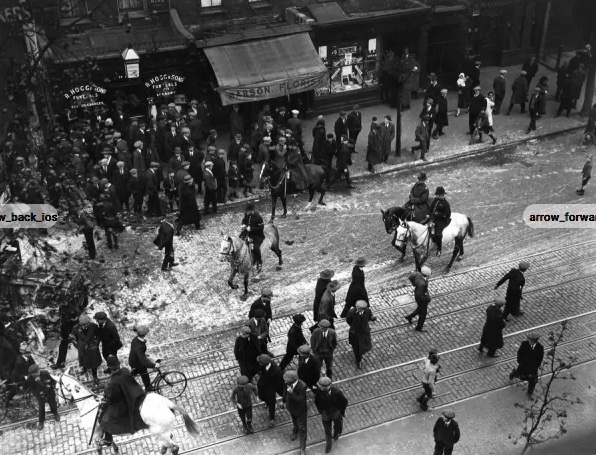
STREET DISORDERS. ROUGH SCENE AT ELEPHANT. BUS SET ON FIRE. Rowdyism broke out in the vicinity of the Elephant and Castle yesterday morning. A large crowd of roughs gathered in the neighbourhood, and one section of them stopped a bus which was going along St. George’s-road, ordered the passengers, driver, and conductor to get out and then set the vehicle on fire. The bus blazed furiously for some time, but the outbreak was eventually extinguished by the Fire Brigade. A large detachment of mounted police was rushed to the district, and the foot police were augmented.
(The Daily Telegraph, 7 May 1926)
Another account:
“BUS SET ON FIRE AT THE ELEPHANT.
BATON CHARGES BY POLICE.
A huge crowd assembled at the Elephant Circus early yesterday and increased as the morning advanced. About eleven o’clock when a Tilling’s Dulwich ‘bus (No.12), travelling along St. George’s-rd. approached Newington Butts a threatening crowd pursued it and the vehicle was brought to a standstill. The driver was pulled from his seat but was then protected by the police, who had to draw their truncheons. Stones were thrown at the windows. which were smashed, and a man released the petrol and set fire to the front portion of the vehicle. The flames spread rapidly and within a few minutes, a fire pump arrived and they were subdued after much difficulty. A detachment of mounted Police arrived and with batons drawn they charged the human mass, but it was with difficulty that the road was cleared.”
(South London Press, May 1926)
Walk down St George’s Road to the Elephant & Castle
Stop at old the old South London Press building, above the Bakerloo Line tube building
In common with almost all the press, national or local, the South London Press took a pro-government and anti-strike line.
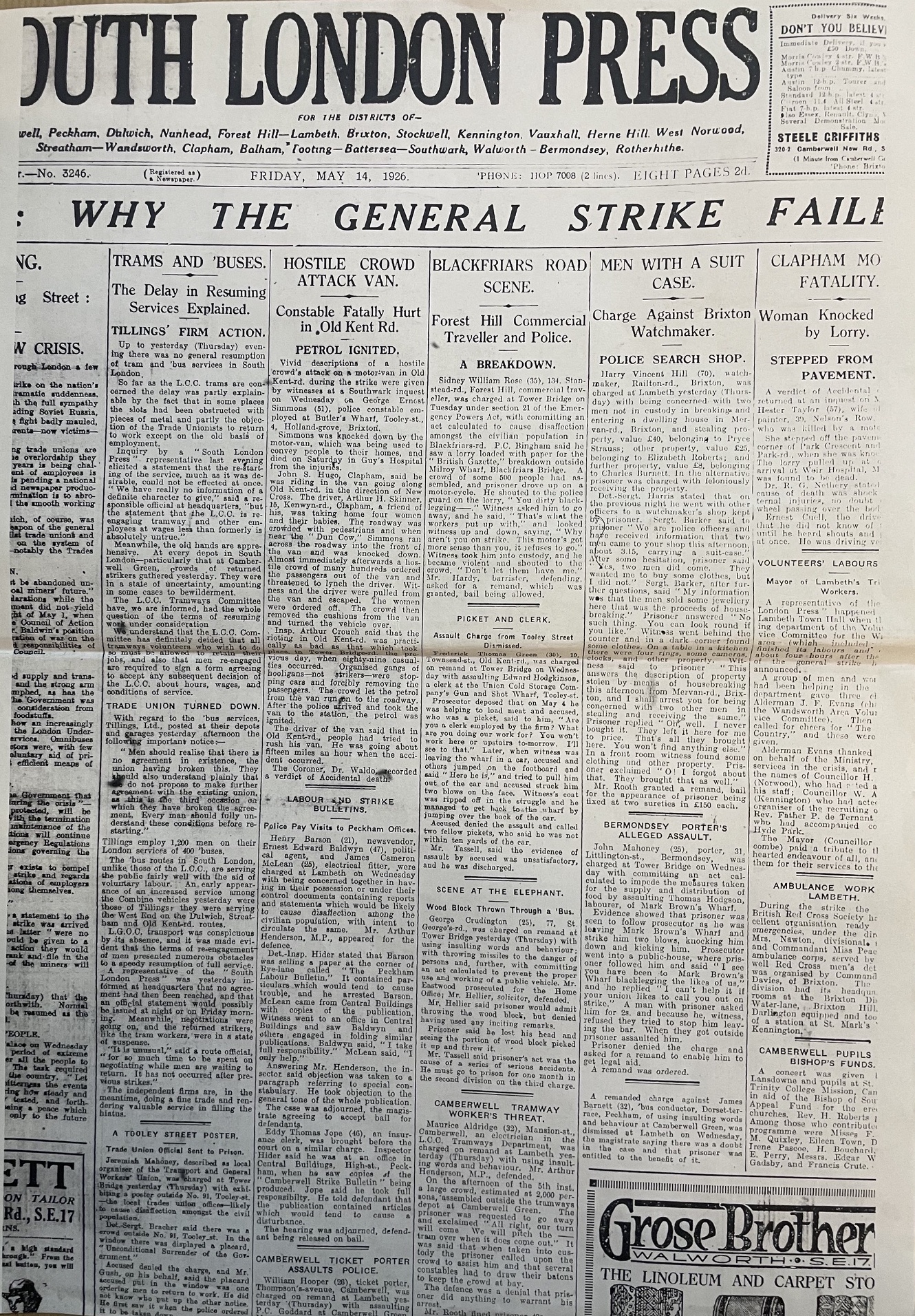 But as almost all printers ands typesetters, a radical workforce in a heavily unionised industry, went out on strike immediately, the paper struggled to appear.
“The local papers in South London were also opposed to the strike. The ‘South London Press’ (SLP) was the most widely distributed paper in the Southwark area. When it was unable to produce a full issue it came out with a single sheet ‘Strike Bulletin’.
The issue of Friday 21st carries an article on “The SLP in strike time – how it met the great blow against Liberty and Freedom”. The report states that by the night of Wednesday 5th all composing and mechanical staff of SLP were out “most of them unwillingly”. The following week the SLP was without linotype operators except one lion apprentice and two compositor apprentices. All nine members of the machine and stereotyping staff were on strike. So the directors and four of their sons, together with ‘volunteers’, produced the paper and distributed it by using disguised vans.”
On May 7th the SLP bulletin’s front page announced: “We offer no apology for issuing this week the South London Press at half its normal

size. The fact is, we are under a double obligation – firstly to our readers to give them as full a statement as possible in the circumstances which led to the country being plunged into a deplorable strike and unwarrantably involving this journal in the dispute, second to our Advertisers …”
The SLP constantly referred to pickets as “hooligans”, “gangs of ruffians” etc, reporting on May 7th that “A great deal of trouble was caused by women who, shouting hysterically, flung themselves into the fray”. SLP headlines on May 14th described “How Rowdyism was overcome by Police and Specials”, followed by praise of the cheerful way in which the uniformed forces restored order with their three-foot riot-sticks.
Walk into the middle of the ‘roundabout’
Note; the road layout here has changed utterly since 1926, more than once, most recently in the lst ten years, so describing events here is hampered by a difficulty in locating exactly older spots in the modern tangle of street and pavement, We’ll try.
The Elephant & Castle saw some of the heaviest fighting in London during the ‘Nine Days’.Partly this was due to its central and strategic location.
“Southwark’s significance lay in the Elephant and Castle, which was the meeting of six major roads which were used by many bus routes and by lorries coming in from the docks and the south… With the layout of the Elephant and Castle with the pub in the middle and at least six roads running in: New Kent Road, St.George’s, London Road, Newington Causeway, Walworth Road and Newington Butts, it was a central focus. That’s why things centred on the Elephant, because of the many bus routes that came through. The police wanted to make it into a battleground.”
(Edwards)
People gathered there because there was lots going on, and also as you could swap news and hear info there.
“Going to the Elephant and Castle became a habit. You could get information there you couldn’t get anywhere else, because everyone was talking.”
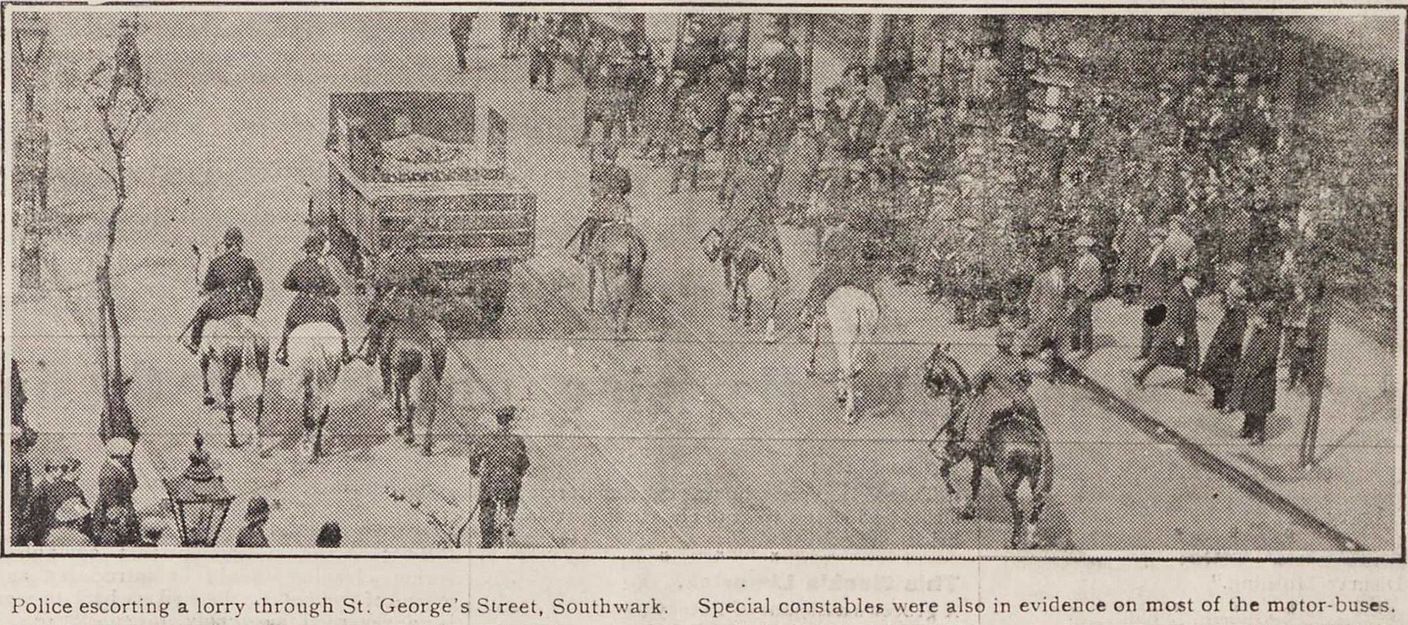
There were fierce battles between police and crowds of strikers and supporters around the Elephant over several days, as pickets tried to prevent trams and buses running to paralyse transport.
The huge Elephant & Castle Hotel stood in the middle of the two main roads running in from the south – Walworth Road continued up further north than it does today, on the east side, and Newington Butts did the same on the west side.
The police were out in force in large numbers constantly at the Elephant, chasing the people away, charging at crowds on horseback, swinging their long truncheons. However, the crowds would melt away, separate and reform again. According to Stan there were 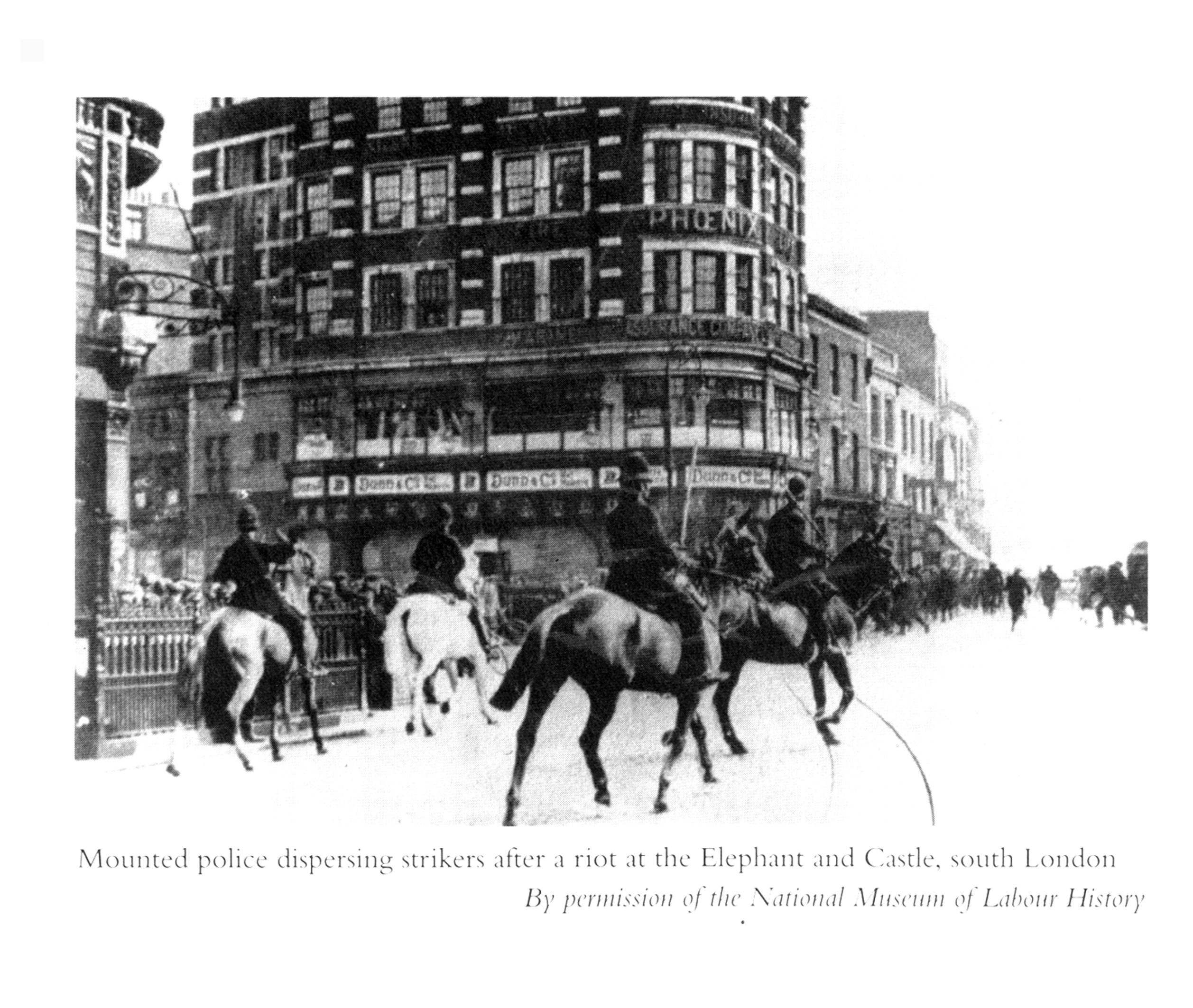 stewards from the Council of Action, distinguished by red arm bands, who tried to ensure that only traffic with permits from the TUC were allowed through, but many blacklegging volunteers would try to force their way through, and this led to several occasions of violence and even some instances of death.
“It’s difficult to realise the crowd of people there was at the Elephant and Castle. It was almost impossible to organise. They would come and go, there’d be a fight. The group would break up and they’d collect again. The police came down to the Trades Council office – they wanted to know if we were responsible for organising the disputes there. I told them it was all spontaneous. We had no control over the crowd. But the trouble was caused by the police action beating them up. In the first place, the buses came through without guards. The strikers came to talk to the drivers and the police started beating them up. A fight started on a small scale. The atmosphere became more tense, as instead of one man going to the bus a dozen or a crowd would [go up]. Then the trams wouldn’t be able to move, and the police waded in to move the crowd. Then the buses got guards and barbed wire over the engines to stop people breaking them up. But buses were turned over.”
(Bert Edwards)
The Sunday Worker on May 9th reported that a volunteer driver who panicked when the crowd tried to stop him, knocked down a motor cyclist and drove onto the pavement, killing two people.
This may have been the same incident which the Britsh Gazette blamed on a picket’s action:
“KILLED BY OMNIBUS. At the afternoon sitting at Tower Bridge Court on Thursday, a man was charged with using insulting words and with committing an act calculated to prevent proper working of a public vehicle. Detective Sergeant Peasley said he was keeping observation on the crowd at the Elephant and Castle that morning, and stood just behind the prisoner. A “Tilling’s” omnibus came from the London-road into Newington Butts. As it was turning the prisoner ran through the crowd and shouted “Come on boys turn the – over. Burn the -.” He then took half of a wooden paving brick from his pocket and hurled it at the omnibus, smashing the centre window on the lower deck. The omnibus came into collision with a motor cycle and a horsed vehicle, mounted the pavement and a man was killed in consequence. A week’s remand was ordered.”
(The British Gazette, No. 4, May 8th 1926)
The Daily Mail had more details:
“MAN IN COURT. Later at Tower Bridge Police Court, George Crudington (21), was remanded for a week on charges of using insulting words, throwing missiles to the public danger and committing an act calculated to prevent the proper working of a public vehicle. A detective said that Crudington incited the mob to attack the omnibus and threw a wooden paving block, smashing a window. There had been a death as a sequel and an inquest would be held. A few yard away in St. George’s-road, S.E., an omnibus was rushed by a large crowd and petrol was thrown over it and the omnibus was set on fire. The driver was unhurt and was taken away under police protection. For some time afterwards mounted and foot police were kept very busy controlling the mob. The Elephant and Castle Hotel and many public-houses in the district are remaining closed all day.”
(Daily Mail: continental edition, 7 May 1926)
On another occasion a bus, driven by a scab and escorted by police and special constables was stopped by the strikers, emptied of its passengers, and set on fire.
“WALWORTH RIOTING Again last night there was rioting at the Elephant. The Police were compelled to make baton charges. Pedestrians leaving the City for Southern Suburbs are advised to make a Detour and avoid the Elephant and under no circumstances to join crowds out of idle curiosity.
(The Investor: News Bulletin. No. 2, 2.30 edition)
“Tramcars in South London. Four tramcars were seen in the Walworth Road this afternoon, travelling towards the City; the drivers were greeted with cries of ‘traitor’. Three were driven by volunteers and one by a tram regulator: a strong police guard was aboard. Only one car contained passengers, there being only two of those. An attempt was made by a large crowd to stop one of the cars, but the driver refused to stop. Some stones were thrown, and two windows, of one of the cars, were smashed.”
(Summary of BBC news broadcast, 5 May 1926 : 5th bulletin, 9.30 p.m.)
“It is reported that 5 Trams came out to run in Walworth Rd. People pulled down railings and stonework and placed across the lines.”
(The Strand Gazette. No. 2 (Early edition) MAY 6th, 1926)
‘BUS ON PAVEMENT FIVE INJURED AS SEQUEL TO ATTACK ON DRIVER. In the Elephant and Castle area of London yesterday two motor-omnibuses were attacked by big crowd. Someone in the crowd threw a missile at the driver. The vehicle swerved and crashed on the pavement within a few inches of the windows of the Elephant and Castle Hotel, knocking down a motorcyclist and four other men. The motor-cycle was thrown beneath the omnibus and smashed. The omnibus ran into the railings of the subway, smashing them, and pinned a man to a post. In its course the omnibus also knocked over a horse and cart. Some windows of the omnibus were broken, but no passengers were hurt. The motor-cyclist had a remarkable escape. He jumped clear of the omnibus. There was a brisk baton fight with the mob. Five persons were taken to hospital, H. King (30), of Nelson-street, Blackfriars-road, succumbing to his injuries.
VOLUNTEERS ATTACKED. POLICE PROTECT TRAM CAR SERVICES. A service of London County Council tramways was begun last night. So great was the response to the call for volunteers that it was found possible at once to place three cars on the Camberwell green, Walworth-road, Elephant and Castle and Blackfriars route. One of the cars was attacked by strikers, and a man leaped on to the footboard and attempted to seize the driver. A policeman who travelled with the driver for his protection grappled with the striker, 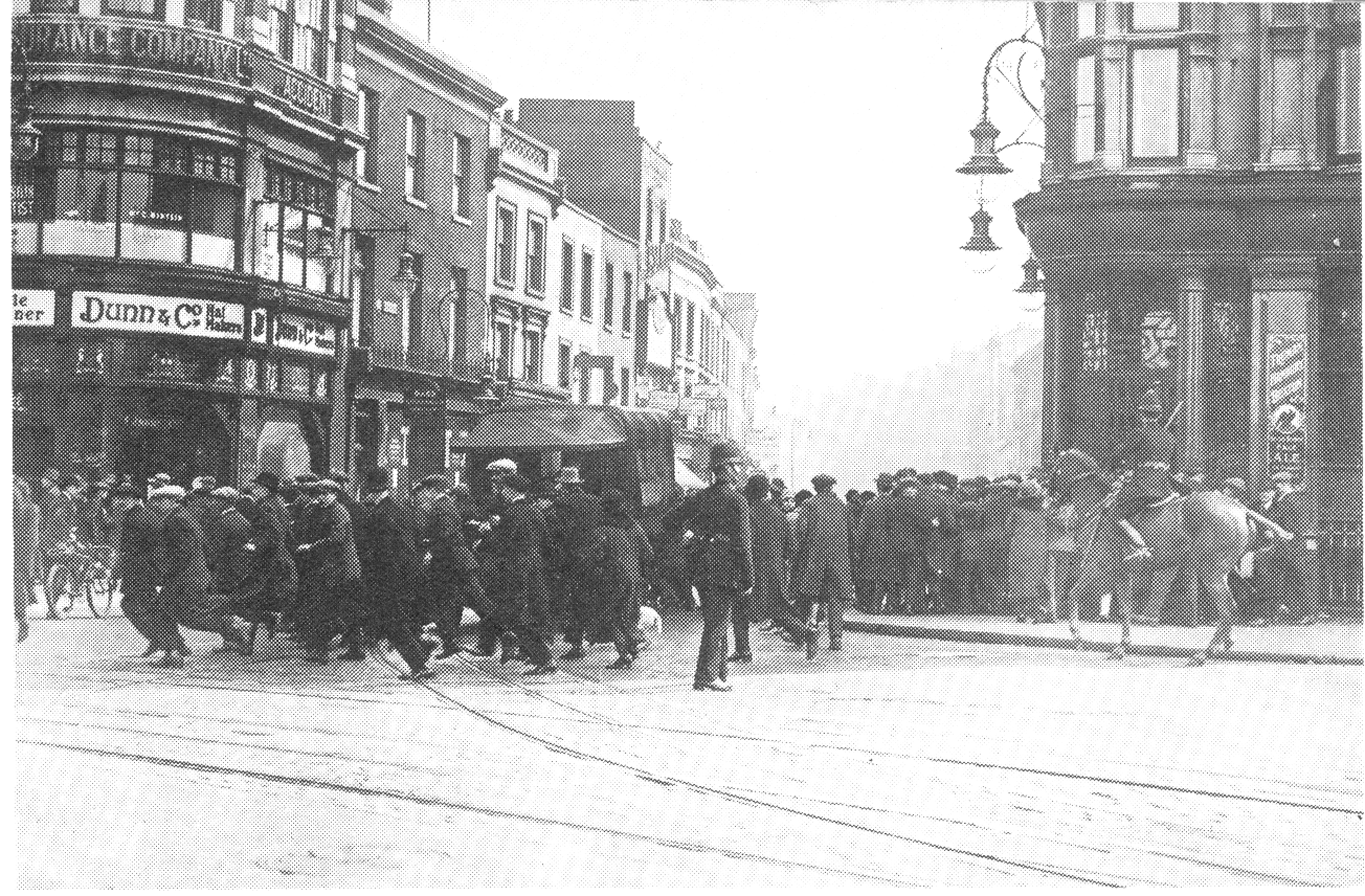 however, and threw him off the car.
(Daily Mail (6 May 1926)
“The Magistrates at Lambeth passed a sentence of three months hard labour each on Walter Southwell, 30, and Thomas Bishop, 24, who said they were members of the Executive Committee of the Southwark Trades’ Council, for attempting to prevent the proper working of tram cars in Walworth Road.”
(The Daily Telegraph, May 10th 1926):
The local Trades Council had no lawyer to defend people arrested in these street battles: cases were handed it over to the legal section of the TUC.
Walk down New Kent Road and stop at Ash Avenue
As mentioned, this area has been levelled at least twice in the last 100 years – buildings – whole estates – have been knocked down, and roads rerun.
In 1926 the Palatinate Estate stood on the side of New Kent Road, consisting of high Tenement blocks, housing the working class.
The area between Elephant and the Bricklayers Arms, where New Kent Road becomes Old Kent Road, was again a central battleground during the Strike.
Around the Bricklayers’ Arms, striking dockers and railwaymen gathered every day, the Bricklayers’ Arms rail Depot being an important centre of transport, solidly picketed throughout.
Once again, police made a point of attacking strikers. Revenge attacks were made on the police by locals:
“The young people would wait on the roofs of the tenements along New Kent Road in an opportunity to rain stones and bottles on the heads of the specials and strikebreakers in their protected vehicles below. The police would respond with waves of violence: there were ugly 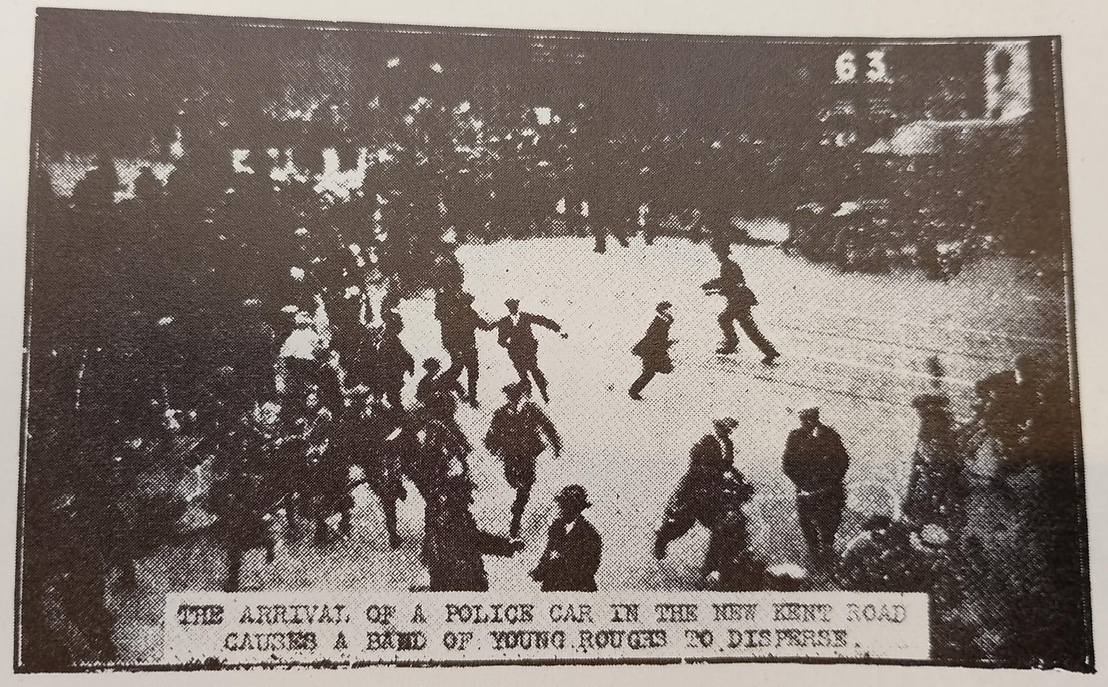 scenes day esp. around Bricklayers Arms where dockers and railwaymen gathered. A bus was stopped, emptied of passengers, turned over and burned in the face of the police and the specials. There were barriers everywhere and the Trades Council had control over vehicles passing through Southwark.. The atmosphere was magnetic, men and women and children determined to stand united. It was a family affair.” (Jack Dash)
Dash described elderly women being beaten in the street by the “cossacks” with their long sticks, and running fights between the police and the strikers.
“Marks on the New Kent Road showed where a tram had been overturned by a crowd on Wednesday night.”
(The Journal: special emergency edition of The Orpington Journal. No. 2 (7th May 1926)
Further down, in the Old Kent Road: according to anarcho-syndicalist Wilf McCartney, during the Strike the ‘Imperial Fascisti’, an early British Fascist group, organised a strikebreaking force, which despite regular army protection was routed here by dockers with hammers and catering workers (of whom McCartney, a longtime cook and organiser in the catering trade, was presumably one!) with carving knives! the fascist scabs took to their heels and legged it on spotting this ‘strikeforce’! (Apparently even the squaddies were pissing themselves!)
There was also rioting in Tower Bridge Road, in fact there seems to have been fighting here several times. 89 people were hurt in one police baton charge here.
It wasn’t only on the streets that the strikers were subjected to attacks from the police. On the 6th May police invaded the Bricklayers Arms, a pub on the Old Kent Road used as a meeting place by the National Union of Railwaymen members from the Bricklayers’ Arms Depot, and arrested strikers. On May 7th the police raided another pub nearby, the Queen’s Head, and it was reported to the House of Commons by Dr. 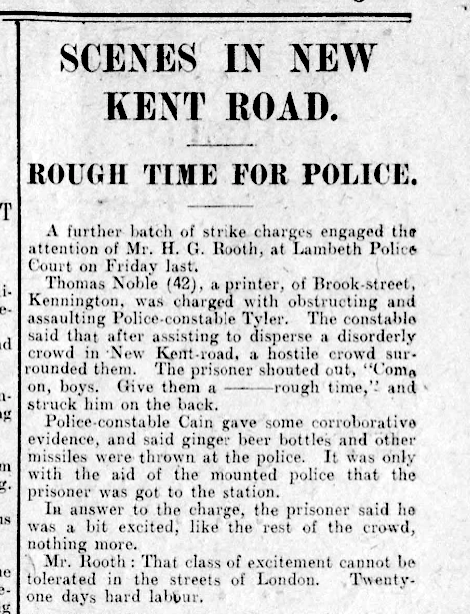 Haden-Guest, Labour MP for Southwark, that police had attacked people in the pub and had later chased and attacked women and children in the street.
“Parliamentary News and Notices: In the Commons to-night. An allegation was made by Dr. Haden Guest to the effect that the police entered a public house in Southwark last Friday evening and bludgeoned men who were peacefully playing cards, and also charged women and children. He complained that the police there had apparently adopted a policy of reprisals.
Sir W. Joynson Hicks in reply outlined the trouble prevailing in the neighbourhood during the past week. Motor vans convoying workers to the City were stopped and overturned, he said. The police were assaulted, nails were thrown into the road to puncture motors and bicycles…
The Home Secretary read extracts from the report of the Inspector of Special Constabulary who took a force to relieve a Special who had been assaulted. The rioters rushed into a public house, from which the police ejected them, the Inspector saw no women or children interfered with. The Home Secretary said he was convinced there had been no unnecessary violence, and there was no question of reprisals.”
(BBC news broadcast, 10 May 1926: 5th bulletin, 9.30 p.m.)
“Dr. Haydn Guest referred to an incident at Southwark criticising the action of the police as resulting in the people being terrified. The Home Secretary replied by referring to incidents that had occurred in the district. A good many lorry drivers had been assaulted and turned back; lorries had been overturned even when going to the docks for food, and in some cases attempts had been made to set fire to the lorries. Also, motor vans bringing men and women to their homes had been stopped in the Borough High-street, the people compelled to alight, and the vans overturned; and when the police interfered they had been assaulted. Nails had been thrown into the roadway, to puncture motor car tyres and tintacks to puncture cycle tyres. Police protection had to be afforded all last week to protect the traffic going to the riverside and only on Sunday a police superintendent received a request from the Mayor of Southwark for police protection to 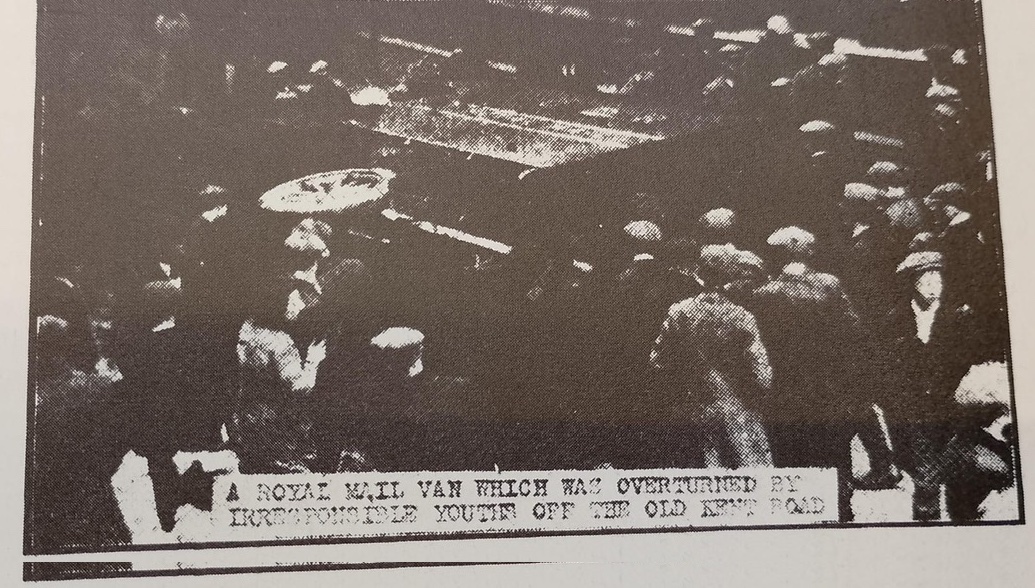 enable coal to be taken to houses where there was illness.”
(The News Daily. No. 4 , 11th May 1926)
Haden Guest replied to this, denying honest trade unionists would be involved in aggro (which was slightly blurry in reality):
“Dr. HADEN GUEST said that incidents such as those to which the hon. gentleman had referred were organized not by the Labour Party but by hooligans who were the product of the appalling [appalling] slums of the neighbourhood. He was going round his constituency that evening to appeal to the people to keep quiet, to keep steady and avoid acts of aggression. (Cheers.)”
(The Times, 8 May 1926)
“POLICE ATTACKED WITH BOTTLES.
At Tower Bridge Court, yesterday, Charles Clements (20), Margaret’s Court, Borough, and Frank Sault (18), of the same address, were charged with insulting behaviour and with assaulting the police with bottles. The evidence shewed that when a mineral water van drew up in Rodney Place on Thursday afternoon, prisoners and others pulled off a number of crates of ginger beer and drank the contents. They were chased by two mounted policemen and some 50 of them ran away, using empty bottles as missiles. Two constables were injured. Prisoners, who denied the charges, were sent to prison for two months each.”
(Times, 8/5/1926)
At one point, fighting in New Kent Road involved some impromptu missile technology:
“GINGER BEER BOTTLES AS MISSILES IN NEW KENT ROAD
Thomas Noble (42), printer, of Brook-st., Kennington, was charged at Lambeth on Friday with obstructing and assaulting P.C. Tyler. The constable said he arrested a man in New Kent Rd. With another officer, he was conveying the man to the station when a crowd surrounded them. Prisoner shouted out, “Come on give them a .,…… rough time,” and struck him in the back.
The man they had in custody escaped, but Noble was arrested. P.C. Cain said said ginger beer bottles and other missiles were thrown at the police.
Mr Rooth passed sentence of twenty-one days’ with hard labour.”
(South London Press, May 1926)
Walk down Ash Avenue to new Elephant Park and through the park to Heygate Street
Heygate Street was another arena which saw street fighting:
“When I arrived at the strike headquarters in the Walworth Road one day I found that Dick Beech, a militant member of the Trades Council, had his head bandaged. It seemed that the police had tried to detain some men in Heygate Street, which was near the strike headquarters. (The police were always evident in this area. watching the people coming and going.) A large crowd had gathered around the police to stop them making the arrest, and in order to break up the crowd the police had made a baton charge and in doing so had injured several men, including Dick, who seemed quite badly hurt. Of course, some of the police were injured, too, because the crowds were very large and very militant.”
(Stan Hutchins)
Walk west down Heygate Street to Walworth Road and stop at the end of Heygate Street
“Walworth Road shops were shuttered and closed for business yesterday while the windows of many others were protected by stout boards.
Although the main thoroughfare has been the scene of some rowdyism during the past week it presented its normal aspect yesterday,”
(News Daily, 11/5/1926)
The Council of Action
No 124 Walworth Road stood roughly where the Oriental Supermarket is now. This was Central Southwark Labour Party rooms, where the Trades Council had offices
This became the organising Centre for the Council of Action locally during the General Strike.
Bert Edwards described the Trades Council before 1926:
“You can’t compare the Trades and Labour Council today with those then. We were just a group of interested men. In the first place it was a small council – men from the Labour Party and the Communist Party. There were two members of the British Socialist Party on it, who had been Labour Borough Councillors, and when the Communist Party was set up these two kept their posts.”
There were two rooms on the ground floor of no 124, and the Trades Council used the back one as an Executive Committee meeting place. During the Strike, the large room saw many people coming in with enquiries.
“We made a rule that the Executive would meet at 9 o’clock and we’d stay in action as long as there was work to do. You didn’t know when you were finishing. It is difficult to describe the atmosphere. There were groups of people involved who were industrially and politically ignorant.”
(BERT EDWARDS)
The Council of Action was a constant hive of industry, with people coming and going all the time, offering their services, whether to help produce something or take messages etc.
“When I arrived on that Monday of the strike, I saw to my amazement that there was quite a crowd of people wanting advice. Nobody knew what they had to do. But it was decided we should set up sub-committees: press and propaganda; finance; a contact committee for keeping in touch with the General Council of the TUC and the London Trades Council; an enquiry and disputes committee which was difficult to work, because of the number of people coming in and out of the room asking advice and asking permission to join the strike, and requesting travel passes. We decided we would co-opt onto the executive of the Trades Council any Labour or Trades Union members we knew were interested and by that means we extended our operating committee.
I think the most interesting was the propaganda committee. We decided this should be a functional committee. One of the people on it was Tommy Strudwick of the NUR and a member of the Communist Party. Another was a chap called Dick Beech. He was a travelling salesman and had married one of James Connelly’s daughters. He had good contacts, being a travelling salesman. Straightaway he produced a small leaflet for sale. He became a distribution centre. Also we thought the committee should contact the other action committees in London – to coordinate strike news for distribution. Dick Beech must have had a small car at the time, as he was a salesman, and he would go to markets to put up a stand. We got him registered with the TUC to get a petrol allowance.”
(Bert Edwards)
Most of the couriers of the Council of Action were motor-cyclists, with arm bands, running messages.
For any lorries to be able to move around without harassment by strikers, they had to display a permit from the Council of Action pickets, who wore a red ribbon so that they could be distinguished from the ordinary strikers.
“Of course, we did not want to starve ourselves out, so we would let food lorries through. Unfortunately, the authorities tried to get through by pretending that they were carrying food when they weren’t, and this would sometimes lead to angry scenes and violence.”
The Council of Action was in session most of the time: the meetings were called when anything needed to be discussed, such as which transport should be permitted through the pickets etc. At large firms with organised workers, workers could organise their own pickets, but in some workplaces the workers were not so organised and to these places the Council of Action would send pickets. Many people automatically went to work, “not necessarily because they wanted to blackleg, they may not have been up-to-date with what was happening, or may not have been interested in politics, and the Council of Action saw that they had a responsibility to make sure that the workers knew what was happening and didn’t continue to blackleg. So we would send pickets to the site to talk with the workers.”
The Council of Action invited along any active men and called them shop stewards, whether they were officially or not. “This gave them standing. We only had our own contacts and anyone who came forward. Anyone who was interested in the dispute – a lot of people came in like this. We had no organisation.
There were a lot of people who came in with enquiries to the Council, people working in the distribution of food, hospitals, electricians who had been told to stay in work, and wanting to come out. They would come to ask if they should come out on strike, and workers with no organisation too. You can’t appreciate it now. This is the part that frightened the top leadership. They said you’d never get the working class to come out in support.
On the Council of Action we had men from the T&GWU, the NUR and the engineers and all the unions who had active men – some of them would come once or twice, then they wouldn’t come again. The individual unions organised the pickets and if we got anyone prepared to help, they were allocated by a sub-committee. We tried to have a rota.”
(Bert Edwards)
Some members of the Council of Action:
BERT EDWARDS – Southwark Council of Action President – 1926
STANLEY G. HUTCHINS was 19 years of age at the time of the General Strike and was elected Assistant Secretary of the C of A when the strike was called. He was then a shop assistant in the City, so was not called out on strike, but in order to carry on with the TC work he used the excuse that he was unable to get transport. This was a common excuse that many workers used when they didn’t want to be victimised but wanted to support the strike, and be active in it.
Two other members of the EC of the local C-of-A were sent to prison. They were Walter (Wally) Southwell and Thomas Bishop, both unemployed (and prominent NUWM activists). It was alleged that they, with a group of strikers, had pulled up garden railings and laid them across the road to stop unauthorised lorries and passenger traffic passing through, and for this they received a sentence of three months hard labour each.
TOMMY STRUDWICK – a member of the NUR (Covent Garden branch, which was the one for the Underground railmen) and also a member of the Central Committee of the National Minority Movement
One issue that came up for the CoA was that of food and financial hardship among strikers and their families:
“Then there was the question of getting credit with the shops… For food we decided to contact the co-op shop in Walworth Road by the Westmoreland Arms. I went to the Poor Law officers, but they weren’t helpful. They said they were under instructions… Women came into the Trades Council – they wanted to know about food and the question of rent. We set up a special committee but there were very few distress cases brought to us. I had little to do with this. My job was coordinating work outside. We had no difficulty – I don’t remember having to get any grants from the co-op. The arrangement was they would give out tickets, which could be settled when things were over.”
(Bert Edwards)
Getting out Strike News
Southwark Council of Action also produced a news sheet but this was done with some difficulty. To start with they had no duplicator or typewriter, but Tommy Strudwick, a member of the Council Of Action from the National Union of Railwaymen managed to provide this equipment. It was hidden away in a recess in one of his room but after only a few issues the police raided his house and found it. He was arrested and sentenced to two months’ hard labour for spreading disaffection. Strudwick was also involved with two other publications, called ‘Juice’ and ‘The Young Striker’.
“We had no machinery set up, we didn’t have a typewriter or a duplicator. That is where Tommy Strudwick was useful. He had both. He lived in Swan Street backing onto a factory, he had small rooms, and in the front one he had all the material: typewriter., duplicator and so on, to produce the strike news. He had disguised it in a recess with a similar wall, paper pasted onto a hardback covering it up. I had to pass the house on my way to the Trades Council and would pick up the papers. The police must have followed me, as it was shortly after at one time that he was raided. They rooted around and accidentally knocked the paper cover that was disguising the duplicator. He was arrested and charged with incitement to disaffection and he received two months hard labour.”
(Bert Edwards)
600 copies of the strike news were printed, rhe police came round to 124 Walworth Road wanting information about its production.
An example of a CoA meeting:
On the fourth day Thursday May 6th the executive committee met again in the small room, although the doorkeeper was instructed not to let anyone in. We discussed:
1) Finance 2) The British Gazette and British Worker. We had copies of both and Brother Tommy Strudwick suggested putting sections from each production in the next issue of the strike news for the following day. 3) We had no direct contact with the London Trades Council. 4) On the press, Dick Beech reported contacting a number of Councils of Action for collecting information. 5) There were no hardship cases reported. 6) There was a discussion about how to control the crowds at the Elephant and Castle.
The room was very busy all day. The police arrived asked for the officials and they were informed that they were not on the premises.
At the executive meeting of the Council of Action on Friday, the fifth day of the strike, there was a general review of conditions and organisation. We arranged to obtain the Sunday Worker if it was published. A deputation of workers from a food depot in Stamford Street was received they wanted to know if they should come out.
The End of the Strike
Mass support for the strike was growing in the three boroughs throughout the time it lasted. Bermondsey reported to the Labour Research Department that on May 12th there was no sign of weakening whatever. The workers were more solid the last day than on the first. The spirit of the workers, both men and women, could not have been better.
The mood of the people was solid. There were little arguments, but on the whole people were stronger after a week, because on the first day it was something new. More people came out – there must have been a gradual increase from the Monday. This was the effect of discussion between neighbours and workers. What would you do if You came home and your wife said: “George, they’re calling you a blackleg.”
“On Tuesday May 11th there was depression in the committee at the news of the judgment against the National Sailors and Firemen’s Union, and the report from the London Trades Council that the General Council of the TUC would meet the Government at 10 Downing Street.”
When the “sell-out” was announced on Wednesday May 12th, “there was a feeling of complete shock and disappointment in Southwark.” There was “confusion at the Council of Action’s office. Angry discussion between the committee men. “We have been sold down the river… Is this the ‘line of J.H.Thomas, Henderson and Clynes?” “Will we get our jobs on Monday?” “Will the shop stewards and the shop floor leaders be victimised?”
Southwark Labour Party passed a message through the Council of Action to the TUC urging them to continue the strike. “Then everything collapsed, it collapsed as suddenly as it started. The Council of Action went back to the original small organisation. The employers said on account of the stoppage, they couldn’t take everyone back.”
Local protests were received by the Trades Council against the calling off the General Strike, including workers at Walker, Bros. Hoe & Co., Chambons, Waygood Otis – Lift Makers and Engineers, of 33 Falmouth Road, Ostlers, Molan, Barclay Perkins, Beck & Co, Hydraulic engineers and meter makers, of 130 Great Suffolk Street (At Becks there was a meeting of 1,000 workers)
A sample resolution ran:
“Call upon the T.U.C. to call for a resumption of the General Strike until such time that we obtain a definite guarantee that there will be no more victimisation and no change in working conditions and that the miners lockout notices be withdrawn.”
At Hoe’s engineering works, which we visited earlier, the employers refused to take the men back as a group “because they were no longer employees”, but agreed to take them back if they applied individually, at their former rate of payment and for their former jobs. Hoe’s said “They are being taken on as vacancies are available.”
The Labour Exchanges received instructions that those who withdrew their labour were disqualified from benefit on the ground that they left their employment without just cause. Sections of the workers were luckier and/or stronger – for instance, the dockers and railwaymen held out for agreements against victimisation.
Within a week of the ending of the strike, only the miners were still left out. They remained out until November when the employers finally starved them into submission and forced them to accept their conditions of less pay for longer hours.
Council of Action president Bert Edwards himself was victimised, and did not get a job for six months. He was “blackbooked” in the industry for decades because of his trade union activities in setting up shop committees.
Electrical Workers
As noted above, workers at Southwark’s Municipal Power Station had walked out on strike. Records are scanty, but some look to have losy their jobs as a result.
On May 19th, a Council Special meeting minute records
“The MAYOR reported that, arising out of the recent strike and the action of the employees at the Electric Light Station in withdrawing their labour, a letter had been received from Mr. A. Winfield, of the National Union of General and Municipal Workers, asking the Council to receive a deputation.
Moved by Councillor WESTCOTT, seconded by Alderman WARD, and Resolved-
That the letter be referred to the Electric Light Committee.”
At further meetings in June and July, letters were read out that had been received from the Southwark Branch of the National Union of General and Municipal Workers, the Branch Secretary of the Workers’ Union, the National Union of Vehicle Builders, the Walworth Branch of the Union of Post Office Workers, and the Secretary, Trade Union side of the Electricity Supply Industry District Council, protesting the Council’s refusal to reinstate the sacked men. On 28/7/1926, “A deputation consisting of five members appeared before the Council, and Mr. W. G. Collins, who acted as spokesman, detailed the circumstances leading up to the withdrawal of their labour by the men at the Electric Light Station and appealed to the Council to reinstate the whole of the men, and if work could not at the moment be found for them at the Station, that they should, until such time as a vacancy occurred, be found employment in the Works or some other Department of the
Council.
The deputation, having been thanked by the Mayor for their attendance, retired. It was thereupon
Moved by Councillor HINKINS, seconded by Councillor WESTCOTT, and Resolved-
That the request of the deputation, together with letters Nos. 11, 12, 13 and 14, be referred to the Electric Light Committee for early and sympathetic consideration.”
124 Walworth Road
We’re not quite sure how long no 124 Walworth Road was the local Labour Party /Trades Council HQ [at some point did they move down the road? Or was that national LP HQ?] More research is needed.
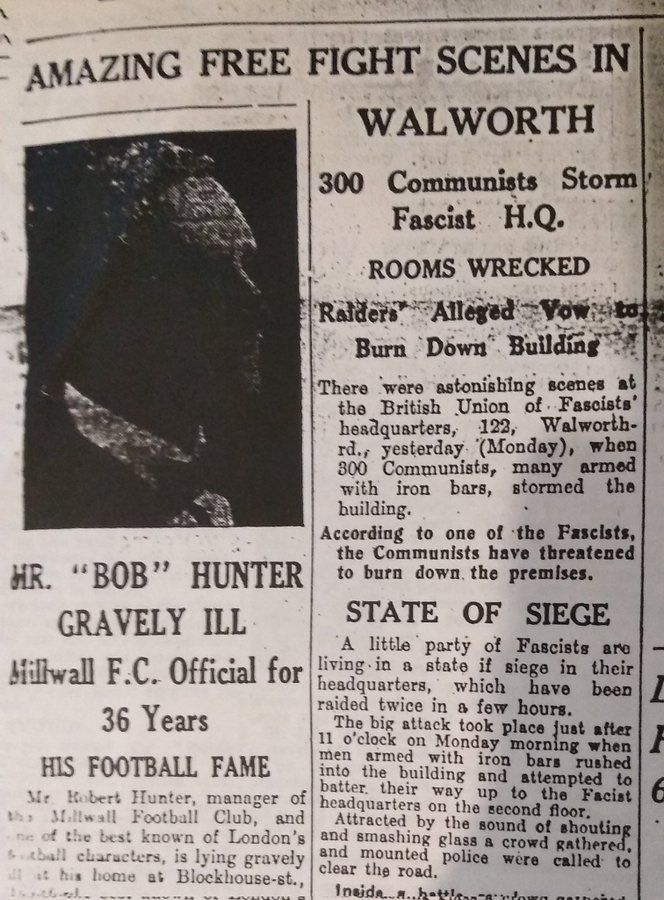
But ironically, no 122, next door was later at the centre of another struggle locally, as the building became the HQ of the British Union of Fascists. As such it was targeted by anti-fascists, and in 1933 was stormed, trashed, and nearly set on fire.
But that’s another story…
In an optional diversion, you could wander south down Walworth Road and turn left into Browning Street, and go down to where Browning Hall used to stand.
The Hall was used by the Trades Council in its early years, and during the General Strike, strike meetings were organised there by the local Communist Party.
Thanks to LB Southwark Archives for some of the material reproduced above.
@@@@@@@@@@@@@@@@
All of the above and much more can also be read in our reprinted pamphlet, ‘Nine Days in May’, about b the General Strike in all three of the boroughs now contained by Southwark.
Available to buy in our online shop


Leave a Reply