
Saving Tooting’s Commons
After a struggle lasting a number of years, an attempt to enclose and build over a large part of Tooting’s Commons was defeated in 1871, when a court blocked the enclosures. Over the next four years later the Commons were bought for the public.
But the road by which public access for this lovely open space was saved was rocky and involved some skullduggery, sabotage and tangled legal negotiations…
What is now known as Tooting Common consists of two older commons, 144-acre Tooting Bec Common and 63-acre Tooting Graveney Common.
Falling inside two different medieval Manors, they were managed separately and had distinct histories. Although in reality, no more barrier or boundary marked the border between the two than parish boundary posts, natural features marked the border, such as the York Ditch watercourse, which ran alongside the eastern side of The Avenue and which served historically as the division between the Streatham and Tooting Graveney parishes.
The name Tooting Graveney originates from the De Gravenell family who were awarded the land in the wake of the Norman conquest of 1066, while the manor of Tooting Bec was originally owned by Tooting Bec Priory, an offshoot of the Benedictine abbey of Bec in Normandy. When the priory was dissolved in 1315, the land was granted to Eton College in 1440. Travelling south west from London, you could travel an almost continuous route through common land – Clapham Common, into Wandsworth Common, then into the Tooting Commons.
Between the thirteenth and nineteenth centuries, the manors of Tooting Bec and Tooting Graveney changed ownership, and the spaces evolved, part were enclosed, shaved off; but also, local residents and tenants of the manors fought for common rights: rights to cut wood and furze (gorse) for fuel in winter and building materials, rights to graze animals, rights to collect foodstuffs growing for food or animal feed. And a succession of landowners of each manor also attempted to exploit the commons for profit: to sell wood largescale, to quarry gravel and building materials, and to enclose land and restrict access to it, to allow for more intensive agriculture or pasturage. The struggle between the landowners’ desire for profit and the subsistence of their tenants generally resulted in compromises and uneasy co-existence, with a consistent undertone of offences against the manorial rules and breaches of common rights.
Manor courts record the regular offences – tenants cutting brushwood without permission (1415), illegal removal of gravel from the pits (during the reign on Elizabeth I), and the theft of eels from the pond on Tooting Bec (1569). Fines issued by the Keeper c.1660 included:
“For every beast within the manor and parish to be found trespassing upon the Common after the first of November as followeth. For every horse, mare, gelding or cow 4d, and for the same cattle of every stranger 1s; for every hog unringed 4d, and for every hog ringed 2d, if they be taken upon the Common or elsewhere. For every sore of sheep 6d, and so after the same rate for fewer, and double to strangers. And that the same field keep and common keep shall have the power and liberty from time to time to impound the same cattle which are there to remain until the same penalties be paid and the parties trespassed satisfied for the wrongs done to them.”
Stick to your own Manor
Common rights were complex, specific to tenancies and bound by the calendar, local borders, and regualted amounts and allowances. It was easy to break the evolved rules, and tempting to avoid the proscriptions and severe fines by a bit of moonlighting. That Tooting Graveney and Tooting Bec adjoined each other led to attempts to duck and dive…
Over-exploitation of the commons’ resource could deplete them, so rules were sometimes imposed to limit what resources could be harvested on the Commons.
However, this was often less about ecological necessity or even ensuring a fair share for all, as from the desire of the lords of the manor to restrict the rights of the plebs on the land. It became more complicated as some local residents with common rights might be increasingly well to do or seek to over-exploit the resources themselves.
In 1668 it was forbidden to cut the furze for three years on Tooting Graveney Common. In 1790 the use of carts for the gathering of furze was banned and it was ordered that nobody should gather more than they could carry on their shoulder. The removal of large quantities of gravel (usually carried out by the lord, or under their licence) often threatened to devastate the commons, and could destabilise the ground. In 1818 gravel diggers were accused of endangering those travelling by Tooting by digging too near to the highway and footpaths.
And wanderers, travellers, itinerants were always a feature of commons and open space, as places they could stop, camp, without being immediately subject to being moved on, arrested, confiscated. ‘Vagrants’ and ‘gypsy encampments’ faced constant complaint and harassment on the Tooting Commons, as elsewhere.
But the Commons also became places to stick institutions not wanted in the city, town or village: two poor houses were later built on or near the two Tooting Commons, each serving a different parish.
Enclosure, resistance, riot were an inevitable process on all commons, and Tooting was no different.
Enclosure began early in Tooting. One fifth of ‘Tooting Common’ was enclosed in 1569… apparently the person responsible was given a ‘mild rebuke’ (by who?)
Further enclosures of parts of Tooting Graveney Common took place in the eighteenth century, apparently with little resistance.
1794 saw “local troubles” in Tooting: residents reportedly rioted when landowner Lady Jane Pitches fenced in the Village Green. Lady Pitches was the widow of Sir Abraham Pitches, a wealthy City brandy merchant who died in 1792. Pitches had bought some common land from the Dukes of Bedford, traditional Lords of the Manor of Tooting Bec.
This estate may have been sold to the Borradaile family, who later sold it for railways run across the common.
It’s not clear whether or not the Village Green was ever officially part of either Common.
Trouble was rife in the area in 1794. By then the Dukes of Bedford also owned the manor of Tooting Bec, which adjoined Streatham… In May 1794, either Streatham or Tooting Bec Common was the site of a riot in response to the Duke of Bedford instructing his agent, Macnamara, to enclose the land and sell the furze, which had previously been subject to Common rights.
The Duke wasn’t only concerned with enclosing his rural possessions; he was also already probably planning the gates that would shortly be erected around his exclusive Bloomsbury estate to keep the riffraff out.
Grave Developments
By the early-mid 1860s, enclosures of commons around London was becoming a major political and social issue. Residents around Hampstead Heath were embroiled in a long struggle against development; anger at increasing enclosures in Epping Forest were coming to a head; the awkward plan of Earl Spencer to adapt Wimbledon Common into a park sparked opposition in 1864. All across the capital and its environs open space was a battleground.
Tooting’s Commons were under threat. Like many open spaces, pressure was on, for railways to be run across them (open space was easier and often cheaper to buy up than more developed land…) – and for profit that could be made from possible development, generally for house building.
Like nearby Wandsworth Common, the Tooting Commons were crisscrossed and divided by railways between 1853 and 1863. Railway construction by both the West End of London and Crystal Palace Railway and the London Brighton and South Coast Railway companies 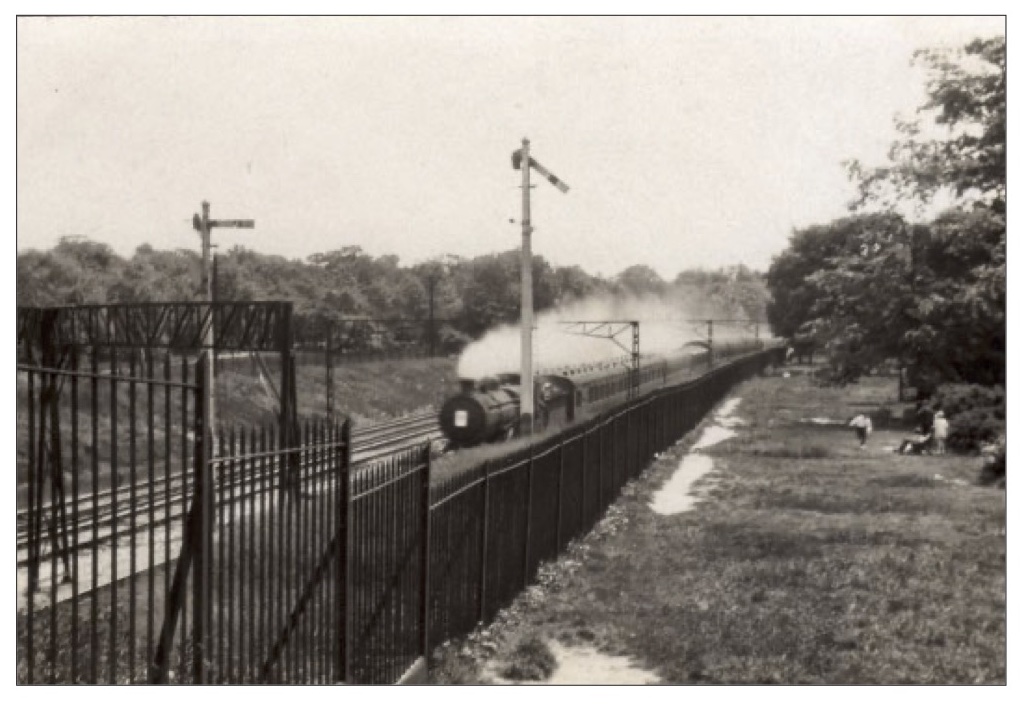 over this short time brought huge changes, both to the Commons themselves and to the surrounding area and occupants. The Commons were sliced into three segments. The WECPR line separated the northern edge from the body of Tooting Bec common as it drove from east to west. The LBSCR line then cut through both the Commons, across from the northwest to southeast, again separating a large triangular slice of the Commons land, this time on the eastern side. Some local landowners at the time of construction – the Drews, Borradailes, Kymers, Hudsons and Tredwells – made good profits from the Companies’ line constructions, both from flogging off land and from selling timber to the Companies; others like Henry Doulton, Thomas Macquoid and many local users of the open spaces fought a losing battle against the railways and their ongoing effect on the whole area.
In the longer term, the railways opened up the district, and led the way to the complete urbanisation of the surrounding areas; Telford Park, Drewstead Road and the Mortimer Estate, Bedford Hill and the Heaver Estate on the northern fringes and, to the south, first Streatham Manor, then Furzedown, built in the early 1900s. The area east of the Commons was developed from the 1880s, while to the west of the Commons, Tooting Bec Asylum was built, then the Totterdown development launched by the LCC in the 1900s.
Time was ripe for speculation. In 1861 the Manor of Tooting Graveney was put up for sale by public auction,
The Daily News of 26 November 1863 reported that the Commons were ‘one of the most secluded and picturesque of all the commons in Surrey…there is little about this common to suggest the existence of a great and crowded metropolis within six miles. At all seasons it is beautiful… this irregularly shaped piece of land, formed of Tooting Beck and Tooting Graveney, which latter comprises only about 60 acres’. The paper appealed: ’… prevent Tooting Graveney being desecrated’.
Opinions differed on the beauty of the Commons though – an 1868 article in the South London Press claimed ‘at present Tooting Graveney is a mere undrained swamp’ (11 April 1868, p. 9).
On 26 December 1863, Bell’s Weekly ran a piece discussing enclosure and headed ‘Tooting Common’ it reports that:
“[the] manor of Tooting Graveney, which comprehends a considerable portion of Tooting Common, has just been purchased for the sum of 3650l.”
A large portion along with the Tooting Graveney Manorial rights, had indeed been bought by local man, William J. Thompson; this included and ‘seven copyhold messuages (which brought in an annual rental of £100’ .
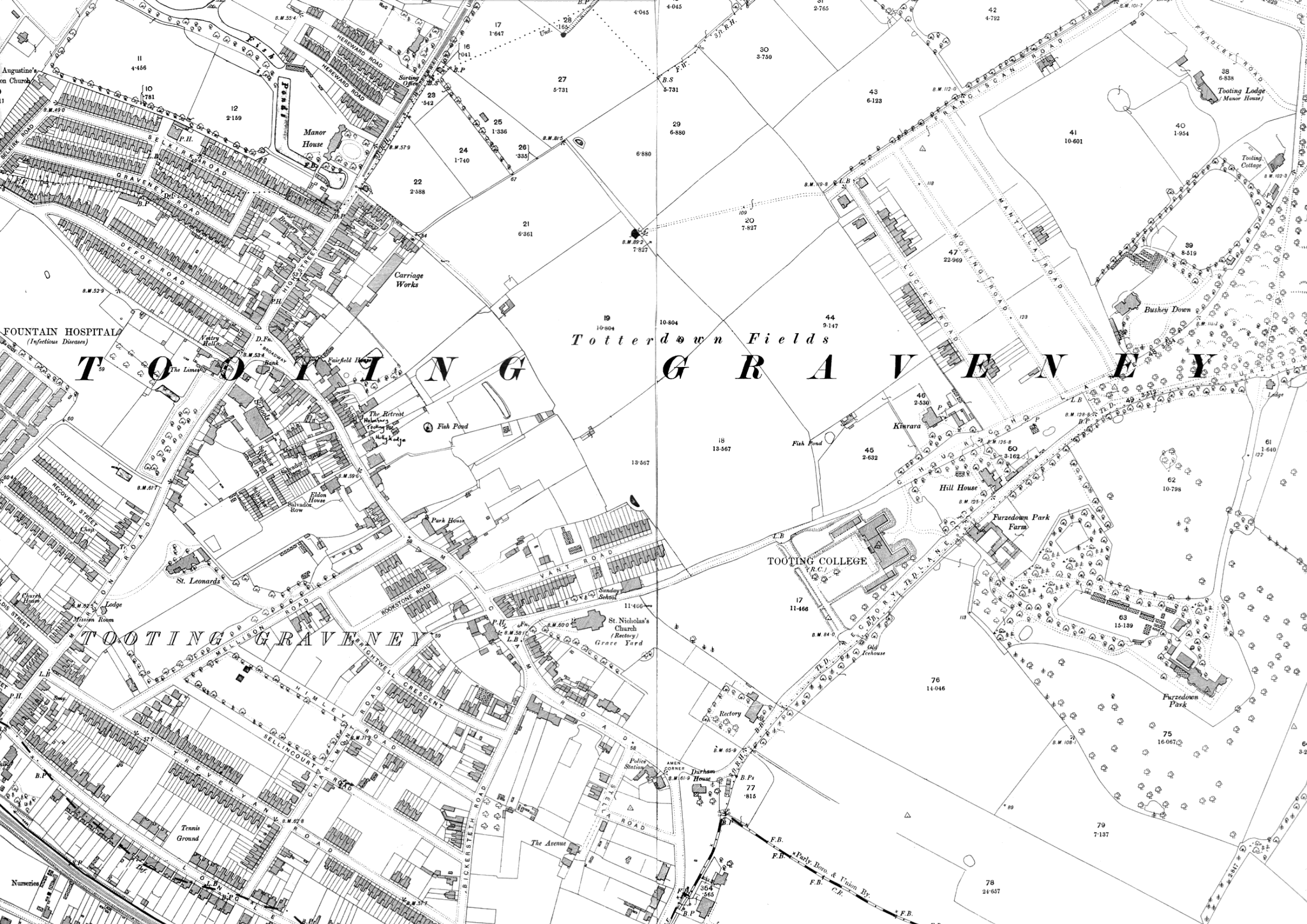
According to some reports, Mr Thompson was originally thought locally to have opposed enclosure, leading other anti-enclosure residents not to bid against him at the sale. But Thompson soon “made an application to the Enclosure Commissioners for leave to enclose about 63 acres, with the intention of converting it into building land“ (Bell’s Weekly, 26 December 1863.)
However, the general national mood was turning against enclosure, and feeling was strong against Thompson. Local residents formed a committee, raised money and tried to buy the manor back. When this failed they appealed to the Metropolitan Board of Works. Henry Doulton (founder of the Lambeth Doulton Pottery) a prominent Tooting Common resident, was one of the local leaders in this campaign (supported by his his brother Frederick, MP for Lambeth and a member of the Metropolitan Board of Works, who was also at that time involved in the Parliamentary debates that eventually ensured the protection of Wimbledon Common from enclosure).
A meeting was held between the landowner and local people but Thompson refused to withdraw his application for enclosure and in July 1863 the Inclosure Commissioner held a meeting at the Mitre Tavern to consider the case. At that meeting Thompson declared the Common a ‘nuisance’ on account of the gypsies who camped there. But sensitive to opposition in the locality, and to Parliament’s growing reluctance to sanction enclosures, the Enclosure Commissioners refused Thompson’s application, urging that another solution be tried. They suggested that Thompson might keep twenty-five acres of the common and leave the rest open; he rejected this.
On 26 November 1863, an opinion piece appeared in the Daily News, praising the natural character of Tooting Common and the necessity to protect it from enclosure:
“Among the tracts of wild open land in the vicinity of the metropolis which it is most desirable should not be allowed to become the spoil of the builder there are large commons and there are small. It is important that the latter as well as the former should be preserved for the recreation and health of the toiling millions of London. Indeed they require to be specially looked after, because inclosures which at Wandsworth and Wimbledon may termed only encroachments, when practised on the smaller commons destroy these altogether, and leave us, instead of a delightful little piece of gorse and heather shadowed with elms, a melancholy circle of eligible villas, with nothing but prosaic ‘green’ in the centre.
Tooting Common is now threatened with this kind of improvement, though it has been accessible to the public from time immemorial, and is one of the most charming spots in the neighbourhood of the metropolis… the seclusion of such a spot is the very thing which brains overworked in the whirl of London want to have within easy reach…It is important, then, to the public to know that their interest and, we may say, their right in this common is endangered. A vigorous effort is required to prevent Tooting Graveney being desecrated, and in fact absorbed by a circle of villa residencies… If Parliament should now give its sanction to the scheme for the building of this beautiful common, Parliament will simply give the proprietor power to make a profit of 1,000 or 1,5000 per cent upon his investment, at the cost of depriving the public of a right they have always had, but which they will never be able to recover if they once allow it to be wrested from them (‘Tooting Common’, Daily News, 26 November 1863, p. 4).
Thompson maintained no-one had exercised common rights for years, and that there were no freehold rights, so he could enclose whatever he liked. Blocked in his immediate aim, he took a more aggressive approach to managing the Common. A copyholder and five parishioners were charged with trespass for turning out animals on common land.
The committee which had formed earlier to protect the common, prepared to protest by further grazing their animals. This was put on hold when an agreement with Thompson was reached at a Tooting inn in, June 1865, tentatively dividing the common, with half to be dedicated to the public and be used to satisfy any common rights, and the other half, to the north, was to become Thompson’s freehold. However, Thompson was to refrain from building on it for twenty-one years. This left open the possibility that the northern section might be purchased in time and added to the public land.
This agreement, however, left it vague what powers Thompson could exercise over his chunk of the common: he wanted to prevent any access. Some commoners demanded that persons with rights of common, and residents, be allowed to walk across. Both sides refused to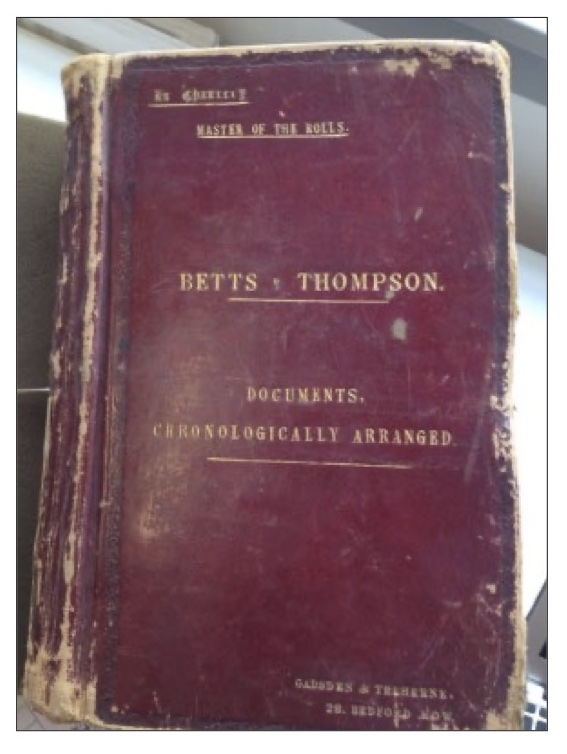 back down over this.
In 1866 the Metropolitan Commons Act stated explicitly that any remaining metropolitan commons should be protected.
The Commons Preservation Society took particular interest and assisted the local community in their battle against Thompson.
Thompson had already erected a fence around his portion, at a cost of Ê500. This fence remained standing until June 1868, when it was broken down by a group of commoners, who doubted the legality of the fence. A resolution to tear down the fence had been passed at a protest meeting held in the Infant School, Tooting Broadway. Thompson launched actions of trespass against the fence-breakers, but was counter-sued by Thomas Betts and two other commoners, attempting to nail down common rights and win an injunction against the enclosure.
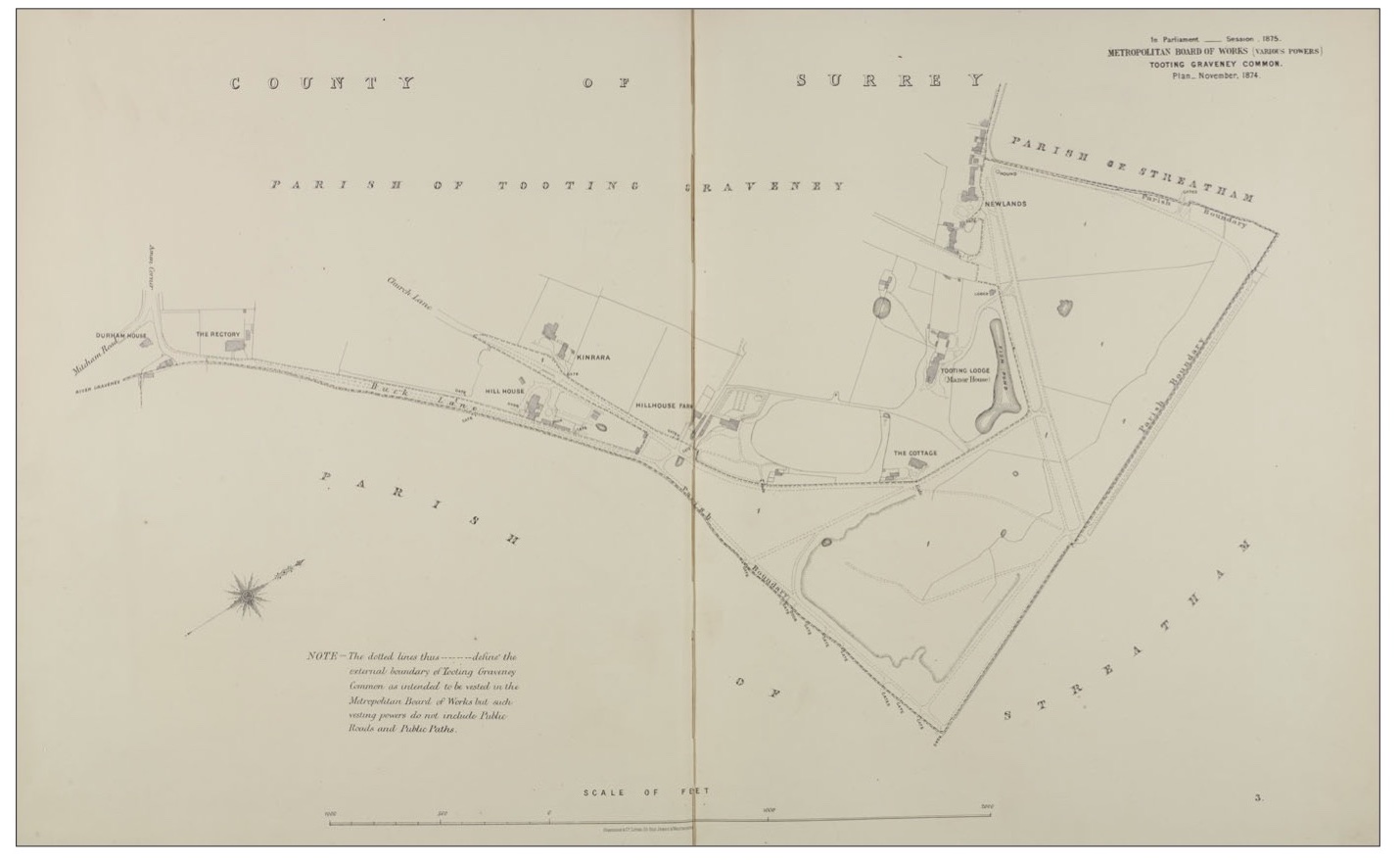
When the Tooting Graveney case came to court in July 1870, the Master of the Rolls, Lord Romilly, ruled in favour of Betts and the commoners. The judgment prohibited Thompson from maintaining the fence if it interfered with the rights of the plaintiffs to turn out cattle or take gorse, turf, and gravel. However, the case went to appeal and was only finally settled on 2nd August 1871 (with some sense of timing, the day after Lammas Day – the day each year when traditionally commoners could begin to graze animals on ‘Lammas’ land). The Lord Chancellor found in favour of Mr Betts. Thwarted in the courts, facing considerable legal expenses, and given clear evidence of political will in favour of protecting common land, Thompson finally gave up his battle to enclose Tooting Graveney Common. In 1875 an Act of Parliament was passed confirming the ownership and management of Tooting Graveney Common by the Metropolitan Board of Works.
A Different Future Beckons
By 1873, the MBW had also acquired fully the manorial rights to neighbouring Tooting Bec Common, at that point comprising 144 acres. Tooting Bec Common came under the Board’s control before Tooting Graveney, despite efforts to secure it having begun later. The preservation of this Common hinged less on local collective action, and focussed on legal shenanigans.
A scheme for Tooting Bec was certified under the Metropolitan Commons Act, but in the end differed from the model the Metropolitan Board of Works wanted to pursue. The Board wanted to ensure value for money by selling off portions of commons as building land, to raise money for the Common’s upkeep, also thinking that this could raise some of the money needed to pay landowners and buy out common rights. Tooting Bec was one of the earliest Commons the Board began the process of acquiring control over, and members felt this approach could be extended for future ventures – if cash was need to fund buying out lords or owners of land to ensure public access, some at least could be raised by partial sales of the land. The rocky progress of the Board in gaining control over Tooting Bec Common was in fact to derail this approach.
At first it appeared that the acquisition of the common would be straightforward: it was announced in 1866 that “Three Gentlemen, inhabitants of Streatham, have secured Tooting-common, which comprises 144 acres, as a place of public recreation for the inhabitants of the metropolis, at a cost of £10,000. The Metropolitan Board of Works have resolved that a contract be prepared for the payment of £10,200 on a proper title being shown to the land.”
Two local gentlemen, Beriah Drew and Philip W. Flower, acting with the support of other inhabitants of Streatham, proposed to purchase the manor for £10,000, then sell it to the Metropolitan Board at the same price. The Board would then turn the common into a public open space. The plan was presented to the Board in November 1866 to an encouraging response. The Board intended to sell some of the outlying portions of the common to recover its costs.
It was nearly two years later in April 1868 that the Board, with expressions of gratitude towards Drew and Flower, began to prepare a scheme under the Metropolitan Commons Act. At this point Drew and Flower had in fact not yet bought the manor from its two current owners, but they did conclude a purchase agreement with them in July. However, this agreement included a clause stating that the entire common had to be dedicated to the public and that no building could take place, apart from any needed for maintenance, without permission from one Charles Telford and others who had interests in half of the Common. Also, if the common was not turned over to the public within five years, these people were entitled to buy portions of it for a fixed price. The reason for this proviso was that Telford owned, and had partially laid out for building, land adjoining the common. He feared depreciation of his property if the Board sold that section of the common for building.
This clause in fact kyboshed the Metropolitan Board’s intention to sell portions of the common; its solicitor cautioned that the Metropolitan Commons Act might prevent any such sale and advised the use of a private act if powers to sell were to be required in the future. ln February 1869 the Board approved a draft memorial to the Enclosure Commissioners (the officials appointed by Parliament to oversee any enclosure of Common land) and a draft contract to purchase the interests of Drew and Flower. Neither document mentioned the sale of land.
However, following this draft, an actual memorial submitted to the Commissioners then DID ask that the scheme include powers to sell. The memorial recognised very few people as having any common rights with regard to Tooting Bec Common, and expected these would have their rights bought out and be compensated under the terms spelled out in section fifteen of the Metropolitan Commons Act.
This was the first application by the. Metropolitan Board of Works under this Act, and both they and the Enclosure Commissioners were to 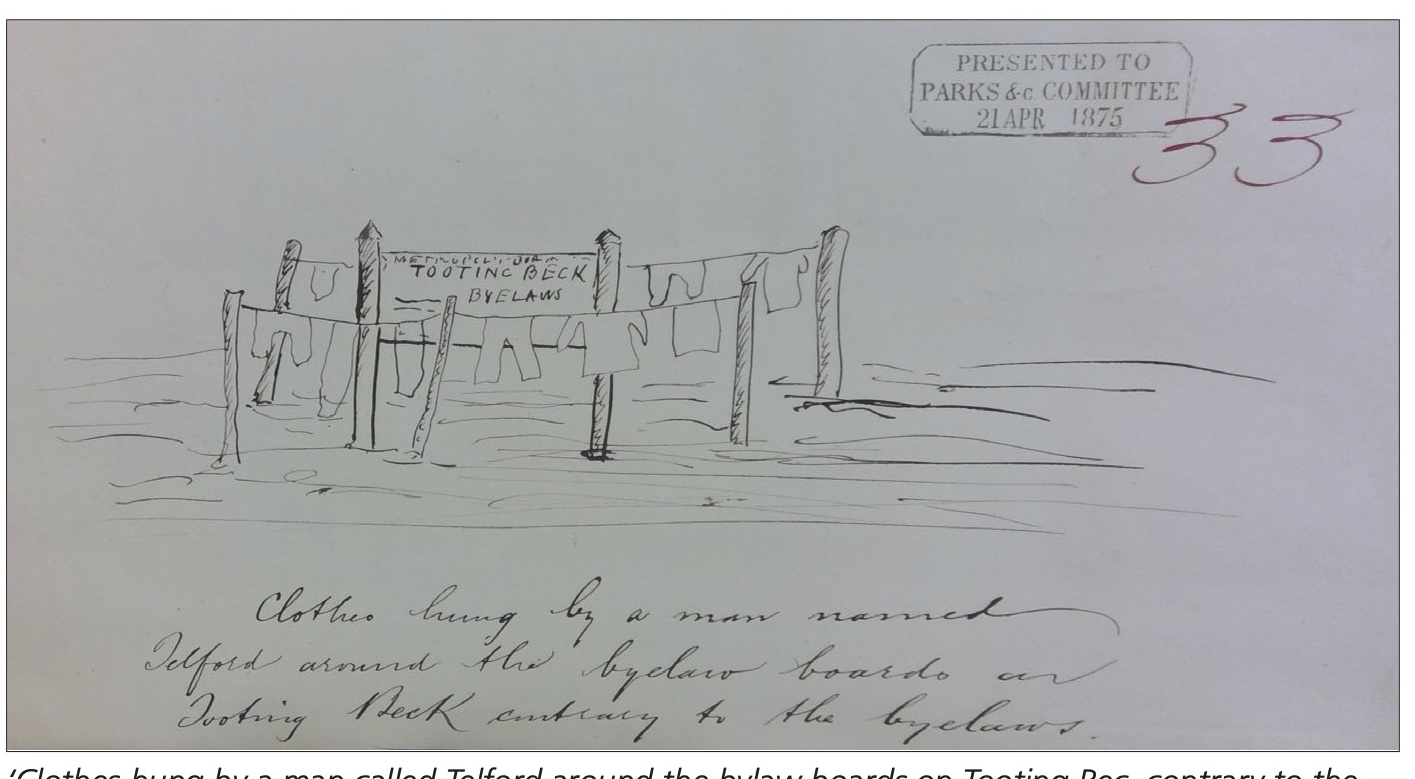 some extent finding their way tentatively. What happened in the process at Tooting Bec could set precedents, serve as a model for the management and ‘public’ takeover of commons, but it was trial and error at this point.
There was a general expectation that existing common rights could coexist into the future with public use of commons. But at Tooting Bec, the Board had come to believe that public access would be compromised unless all landowners’ rights were bought out. The Board didn’t necessarily expect this approach – purchasing the interests of the lords of the manor – to be one it would follow in every subsequent case.
The Enclosure Commissioners published the Tooting Bec scheme for consideration in May 1870, taking not of the agreement with Telford and the others and proposing that the Board should “purchase and acquire such rights of pre-emption, first making compensation for the same”.
However, Charles Telford now objected to the proposals, launching a legal suit in Chancery against the Board (with Drew and Flower as co-defendants) in an attempt to prvent the Board pursuing any scheme that involved selling any part of the common. This seems ot have been because he himself was no offered land for sale (whether or not this was the land he had already set out for building or other parts of the Common, I am not clear on). Since first Drew and Flower and then the Board seemed to have agreed to sell land to Telford in earlier agreements, he may have felt short-changed somehow…
The Board stuck to its guns, refusing to revert to a scheme omitting the power to sell land, and asserting that it had public responsibilities which over-rode any earlier agreements, and also that Telford had previously supported the sale of land (possibly thinking it would be sold to him).
However, the Court ruled that the agreement with Telford was still valid – the Board had inherited Drew and Flower’s agreement and were bound by it. The Court also took a dim view of the Board’s insistence on selling portions of the land, labelling a naked attempt “to make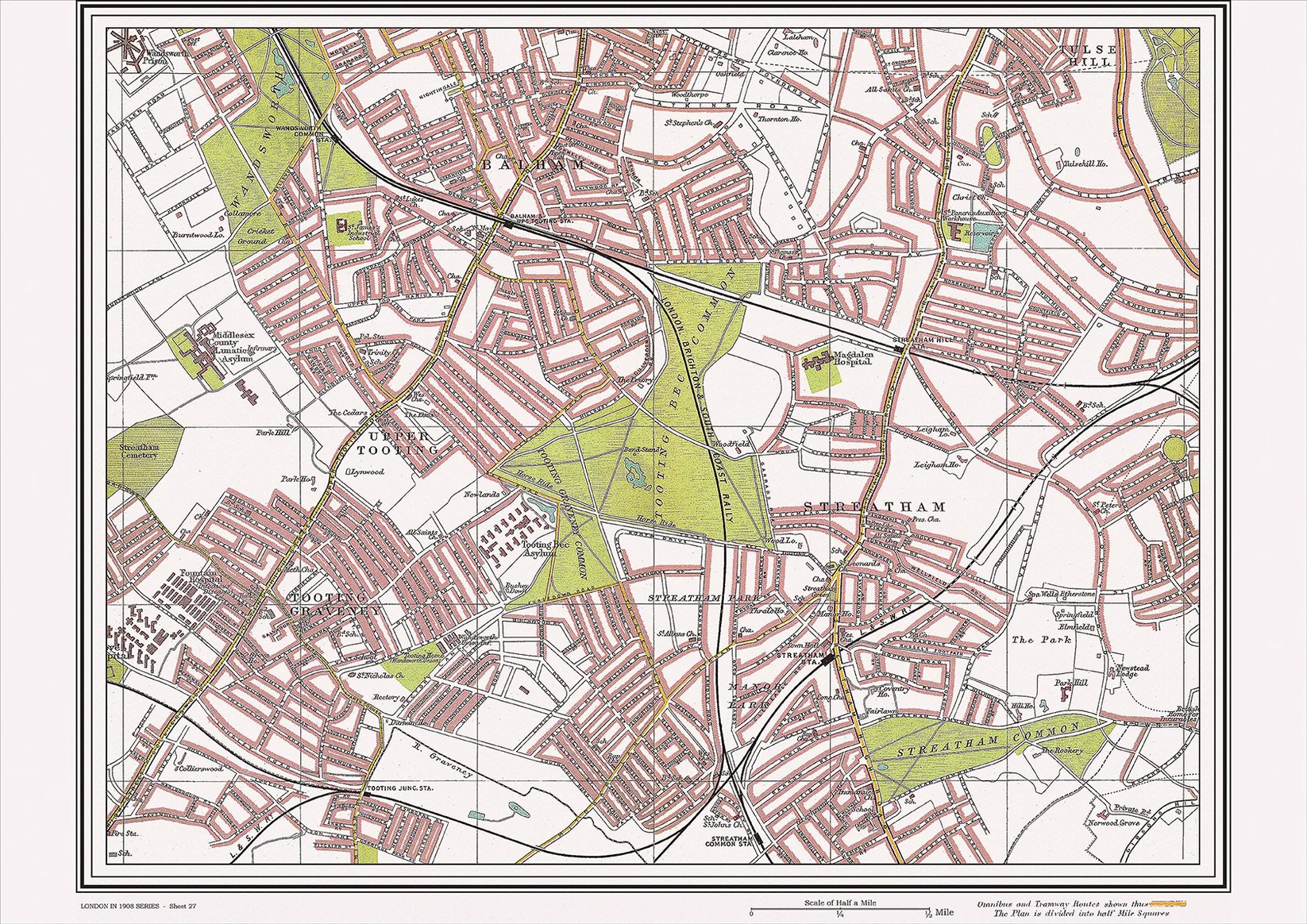 money”. No scheme could now be brought in that involved selling parts of the common without Telford’s consent, unless he was guaranteed a right to re-purchase the sections of land in question.
The Board decided to push forward with their scheme but leaving out any proposals about selling land (incidentally, the Tooting setback caused them to permanently abandon their plan to pay for purchase and management of other commons by selling off portions of land). An Act for Tooting Bec Common passed into law in July 1873. This did not yet give the Metropolitan Board control of the common though – it just marked the completion of the agreement made with Drew and Flower in 1869 for the purchase of the manor. By November this purchase was completed, and the preparation of bylaws, the appointment of a keeper, and the planning and execution of improvements could begin.
So by the mid-1870s, both Tooting Bec and Tooting Graveney Commons had been preserved from the threat of development and partial or complete disappearance – finally united in ownership and management under the protection and management of a public body.
Postscript
This was not however, the end of disputes over land around the Tooting Commons.
Not Seeking Asylum
In 1887, the Metropolitan Asylum Board bought 27 acres of land with the attention of building of a fever hospital to accommodate paupers. Building on or near the Tooting Commons was viewed as a healthy option, as tuberculosis and other respiratory diseases were aggravated by the air pollution produced by the growing city, and open green space could help relive symptoms.
However, local people objected to the plan:
“The common has been secured to the public for ever and it has been the aim of the authorities to make it as attractive as possible. Some thousands of pounds have recently been expended … additional land and a fine belt of old trees have been acquired… Now a body of men… are attempting to undo the good work that has been done by placing a fever hospital on the side of a road right in the middle of the common… To attempt to establish such an institution on one of the lungs of London is an outrage on common sense that could only be perpetrated by such an irresponsible body as the Metropolitan Asylum Board.” (The Times, 3 February 1893).
The objectors succeeded: the fever hospital was eventually built further to the southwest.
In 1891 Mr Thomas Macquoid, who lived in Lucien Road at ‘The Edge, Tooting Common’ wrote in The Daily News:
“At the present time there are six acres of land with some fine old trees upon them adjoining Tooting Bec Common… Tooting Bec Common is a favourite resort on a holiday for the Londoner… open spaces in the neighbourhood of London are yearly becoming less.” (6 Nov 1891, p. 5)
The land in question has not been identified. It, could be a strip of land which the railway had cut off from the main Common area in 1862 or 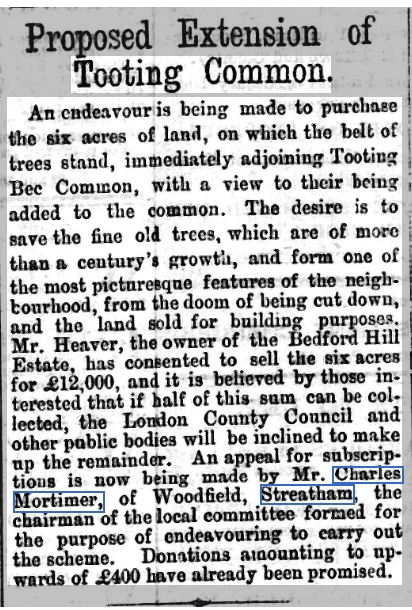 a piece on the edge of Tooting Graveney woods. Macquoid had apparently been involved in earlier campaigns, and was appealing for £12,000 to add the land to the Common, because locals’ efforts to raise money had failed. Macquoid was an artist, his wife Katharine, a successful novelist, and their son Percy “the foremost historian of English furniture”.
It is uncertain whether or not Macquoid ever managed to secure these six acres as public land.
Occasional threats to Tooting’s open space cropped up in successive decades.
In the 1920s and 1930s, housing was rapidly filling up land on nearly every side of the Common; this led to numerous proposals to widen highways and junctions to improve road transport. Proposals to widen Elmbourne and Hillbury Roads in 1929, and Church Lane and Furzedown Drive (1939), were, however, strenuously opposed by local residents, suported by organisations such as the Metropolitan Public Gardens Association (MPGA). In July 1935, Basil Holmes of the MPGA wrote to the Clerk of the London County Council challenging proposals made under the heading of ‘street widening’, which Holmes claimed were in fact proposals to develop new roads within the footprint of the Common.
Holmes wrote, ‘These roads cannot be termed “widenings” of any existing road or highway as none exists, they merely follow the route of tracks, which have been set aside for horse riding by the Council or its predecessor, and they have never been treated as roads… The Association is desirous of pointing out that these two new roads, which are termed “widenings” would, if made, be highly detrimental to the Common. They would, owing to freedom from buildings and side turnings, rapidly become mere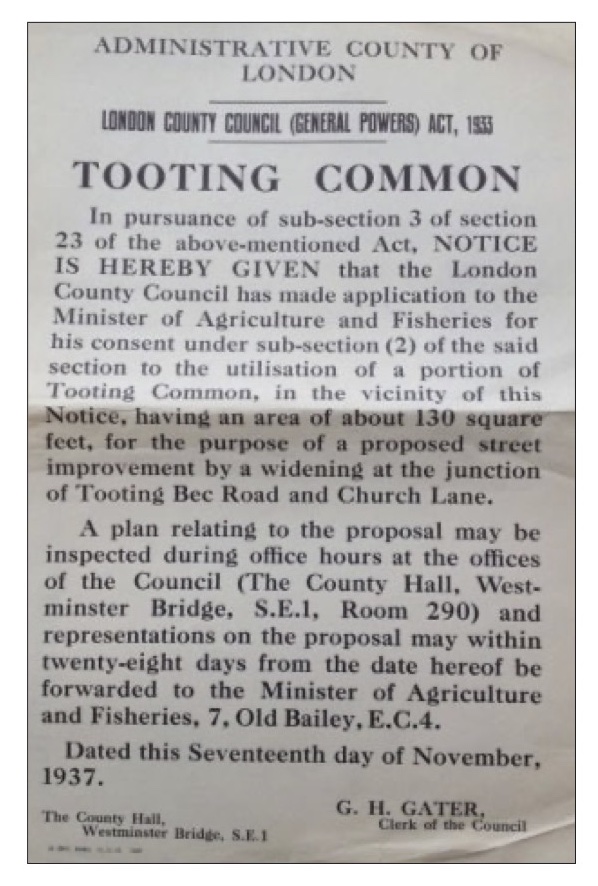 speedways for motor traffic’.
Later, during World War 2, Tooting’s Commons, like many other open spaces, hosted prefabs for army camps and anti-aircraft gun emplacements. After the war, these were used to house returning soldiers.
In 1946, two families were reported to have taken up residence as squatters in disused huts. The Thomas family and the Hill family had both moved into the huts following the men’s demobilisation. Both families claimed that the Council could not rehouse them at that time, forcing them to find their own accommodation.
This took place during a post-war wave of squatting of first army camps and then other buildings. Initially this was clamped down on by government, but, in practice accommodations were often made (out of necessity) and many squatters were allowed to remain, in some cases for some years.
Four years later, in 1950, the local newspapers reported that families were still living in the disused gun site huts in Tooting, despite promises by the LCC to rehouse them.
Their actions suggest that despite the large number of prefabs introduced to the Common, there were still not enough to provide for every returning veteran. The huts were finally demolished later in 1950.
No Astroturfing
In more recent times, local residents fought off plans to create a commercial football facility on Tooting Common.
Developers planned to fence off and enclose the existing football pitch on Tooting Common’s Triangle Field and build five pay-to-play astroturf pitches. The proposal was originally approved by Wandsworth Council during the Covid-19 lockdown.
But residents fought back. Over 10,000 people signed protest petitions, and there were 1,000 official objections. The proposal went to a Public Inquiry which led to a ruling against the plans on in November 2022.
After almost six months of deliberation, Planning Inspector Richard Perrins ruled the development would be an ‘alien feature in the landscape’ which would prevent informal recreation. He agreed that the existing site was ‘a much-needed and well-used communal, informal recreation playground and social space’.
Fencing would seal off parts of the common which are open today, he said. He added the site had ‘an almost village green like ambience’ and the new elements ‘would not be consistent with the more natural and open surrounding landscape.’
 LONDON RADICAL HISTORIES
Leave a comment