The text of a talk given by Alex Hodson of Past Tense, at Sydenham Library, Southeast London, in May 2026, hosted by Calico Libraries – part of Lewisham’s Borough of Sanctuary events.
Mayday and the Rights of Common
“Thou art here indicted by the name of Flora, of the City of Rome, in the County of Babylon, for that thou, contrary to the peace of our Soveraign Lord, his Crown and Dignity, hast brought in a pack of practical Fanaticks, viz. Ignorants, Atheists, Papists, Drunkards, Swearers, Swash∣bucklers, Maid-marrions, Morrice-dancers, Maskers, Mummers, May pole-stealers, Health-drinkers, together with a rascalian rout of Fidlers, Fools, Fighters, Gamesters, Whoremasters, Lewd-men, Light-women, Contemners of Magistracy, affronters of Ministery, rebellious to Masters, disobedient to Parents, mis-spenders of time, abusers of the creature….”
(Thomas Hall, Funebria Florae, Or the Downfall of the May Games, 1661).
Mayday – a the celebration of the green world, growth and renewal – but also an incarnation of the power and potential of the working class. But Mayday also links in our relationship to land, green space, migration & belonging.
Our environment, urban environment, OR rural landscape, were shaped, created, built, altered, by people. By the rich and powerful, trying to make profit and control how people live. And by others from below, trying to duck and dive, make a living, establish a foothold, love, dance and build freer lives – sometimes at the edge, clinging on, scrabbling for resources. Sometimes uniting in mass movements and overturning the world.
Much of what you see, live in, walk in, work in, is both product of AND arena for past and ongoing collective and individual battles. Not just the physical space, buildings, parks, bricks and mortar, but the mindset, time for pleasure and how we use it, how we relate to each other, how we share the world and the resources. Who we see as human, having the right to inhabit places. Who we are willing to share with, to love.
The struggle between humanity acting as humans versus humans treating other humans – and the earth – as property
The story of Mayday – of green space – of the wider society we live in – is part of that story.
The green, spring, fertility & renewal
For countless centuries people have been celebrating the height of Spring, and the first signs of Summer, at the beginning of May.
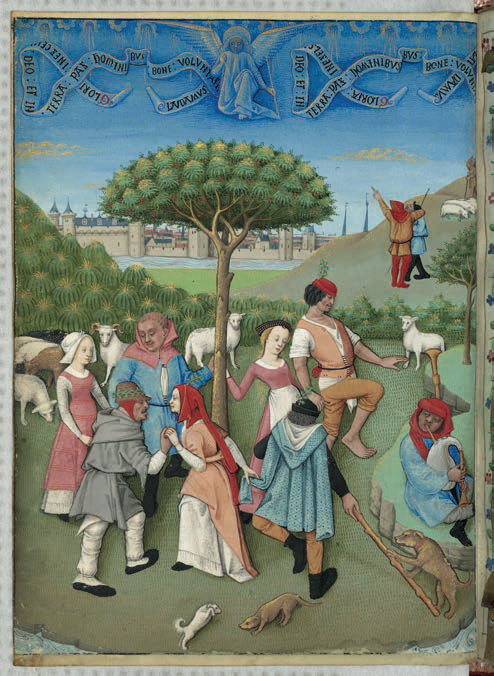 It’s a great time for a big party – part ritual, part celebration.
All across Europe there are records of communities lighting fires at the beginning of May; eg the Irish Beltane, when cattle were driven between fires to give them magical protection.
In Germanic countries, the night before, Walpurgisnacht, was also a time said to be sacred to witches. Were witches wise women, rooted in the green, skilled grassroots healers learned in the use of herbal medicines, mystics linking human experience to nature, scapegoats for the imposition of vicious male religious and class control, strong females in their communities dispossessed as enclosure narrowed landownership? All of the above? (Check out Burning Women to learn more)
The Romans festival of Floralia from 28 April to 3 May honoured Flora, goddess of flowers and greenery (also associated with license, indecency and prostitution!) The festival included theatrical performances and public games, and was also associated with the wearing of garlands of flowers or bringing the renewed greenery in to the home, such as hanging rowan branches around doorways. and this has remained a common feature of May Day celebrations through the ages. Later Medieval custom, going out to collect flowers and greenery on May Day, was known as ‘Maying’ or simply ‘The May’.
By the Middle Ages the whole ‘merry month of May’ ‘conveniently between the heavy work of ploughing and sowing, and that of hay making, was associated with communal celebrations in England, the holidays of May Day and Whitsun – including games, fairs, communal feasts (often known as ‘ales’), music, dancing and sports.
Better weather enables outdoor parties: ‘Commoners, unlike royalty and the aristocracy, lacked large buildings in which communal festivities could comfortably be held in bad weather’.
Philip Stubbes in his The Anatomie of Abuses, published 1 May 1583: ‘Against May, Whitsunday, or other time, all the young men and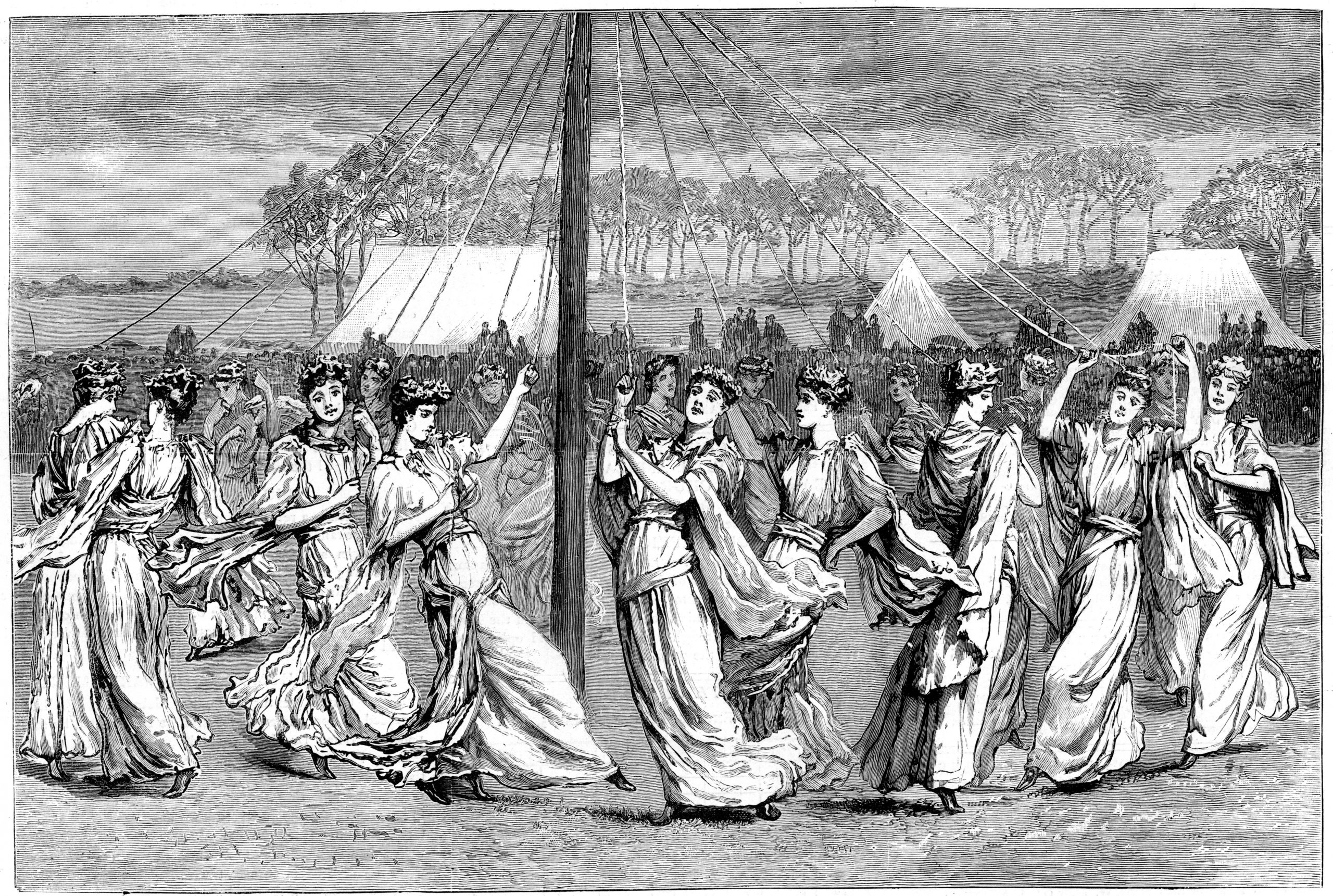 maids, old men and wives, run gadding overnight to the woods, groves, hills, and mountains, where they spend all the night in pleasant pastimes; and in the morning they return, bring with them birch and branches of trees, to deck their assemblies withal.”
Early Protestant miserablist Stubbes took a dim view of that sort of thing:
“And no marvel; for there is a great lord present amongst them, as superintendant and lord over their pastimes and sports, namely Satan, Prince of Hell’.
May kings and queens
A feature of the May festivities was sometimes the crowning of a mock-king. Once again, Stubbes again provides the most colourful 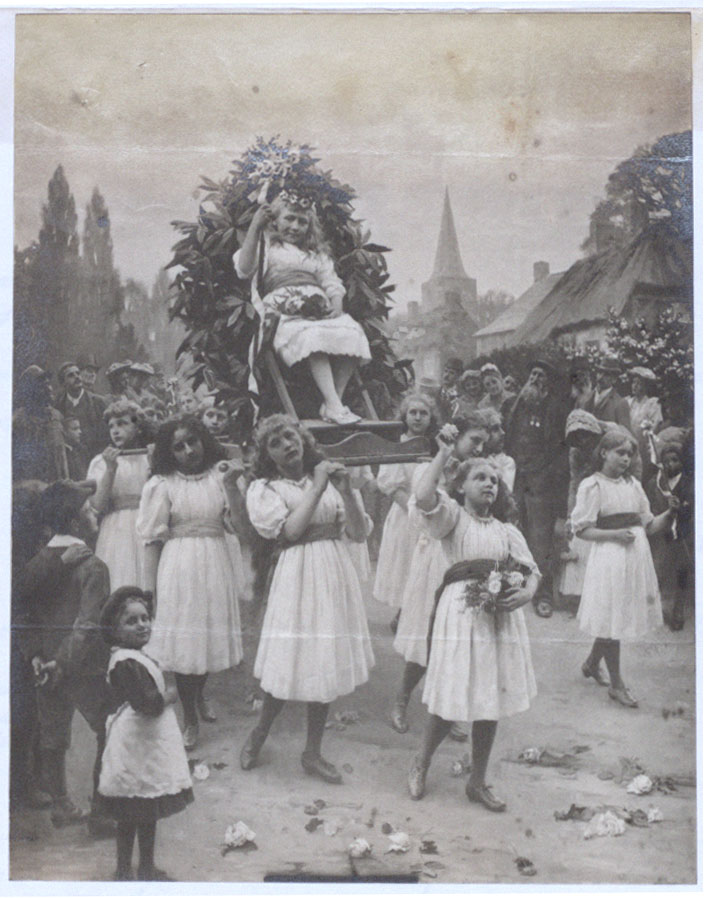 description of this: ‘the wild heads of the parish conventing together, chose themselves a grand captain (of mischief) whom they ennoble with the title of my Lord of Misrule…” Like other holidays Mayday had an element of turning the world upside down, inverting and subverting the usual hierarchies.
The authorities feared Mayday, like other big festival days, because mock inversion could so easily turn into genuine disorder and rebellion – sometimes overflowing with radical potential, other times channeled into hate, xenophobia and bigotry.
Robin Hood and his entourage were also sometimes associated with May festivities, which is appropriate, what with the rebel tales of Robin Hood and outlaws, dressed in Lincoln Green, these tales which emphasise the forest as a haven, a sanctuary from the harsh class based Norman laws to punish the poor from trying to survive – forest law, game laws – which made the countryside a playground for the powerful while most people worked the land in feudal servitude
Mayday revellers danced around Maypoles that were part phallic fertility symbols and part ritual pretend trees.
Beating the bounds
Another May tradition was Beating the Bounds, a procession around the parish border on the Rogation or ‘Gang’ Days – an annual event
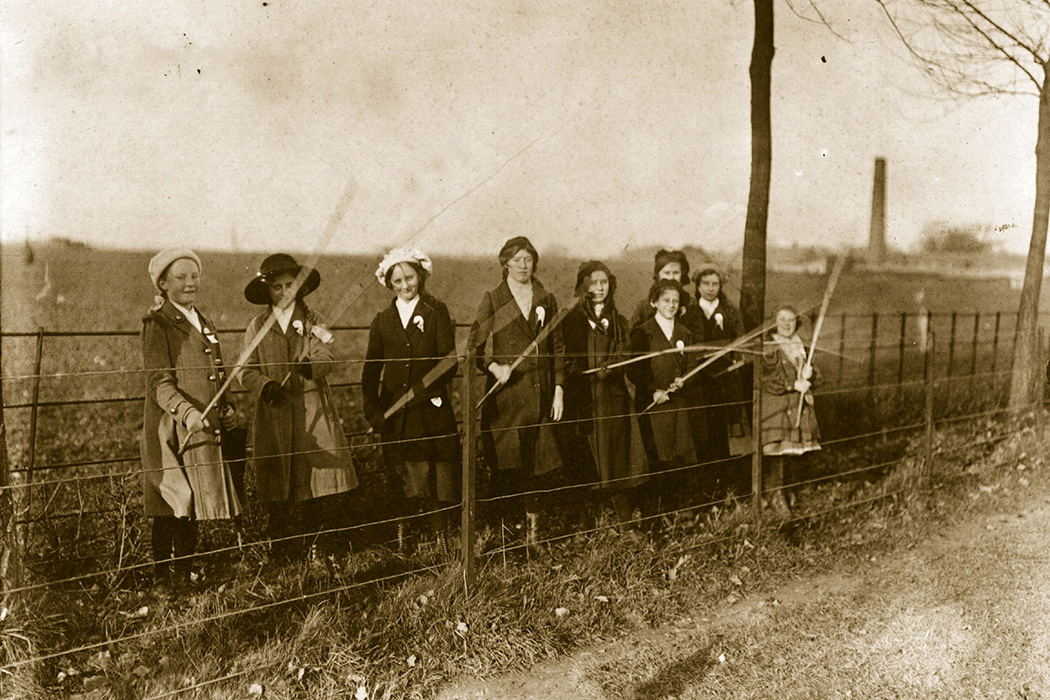
of marking borders, of parish solidarity… part fertility ritual, memory marker, part social cohesion team building exercise – used to establish or restate
common land so to reverse enclosure, but also to keep out outsiders (a mess of contradictions!)
So May Day is not just about spring, flowers and shagging.
It’s a story too of subversion and conflicts with the authorities: May Day has often been a focus of religious and political contention, and continues to be so down to the present day.
Dance Yourself into a New World
Mayday, dancing round the maypole, the festival, excess and party – you could dance yourself into a new world.
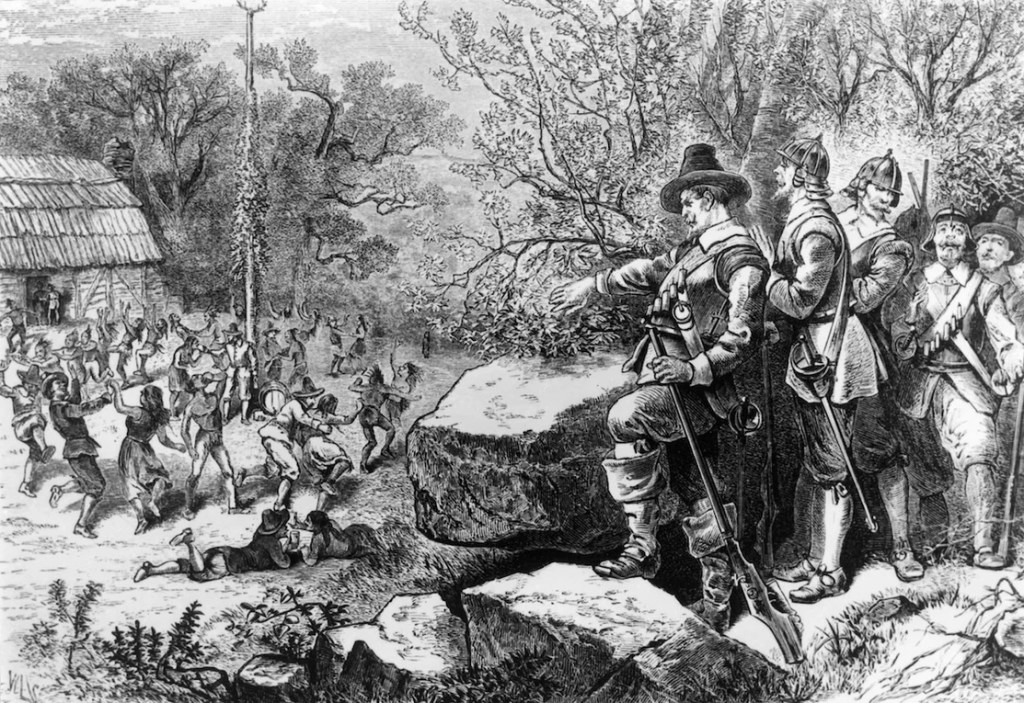
For example – the Utopian community built in the New England wilderness on May Day 1627, at Merry Mount, Massachusetts; a short-lived commune founded by Thomas Morton, where settlers, runaway slaves and servants and native americans lived together communally,
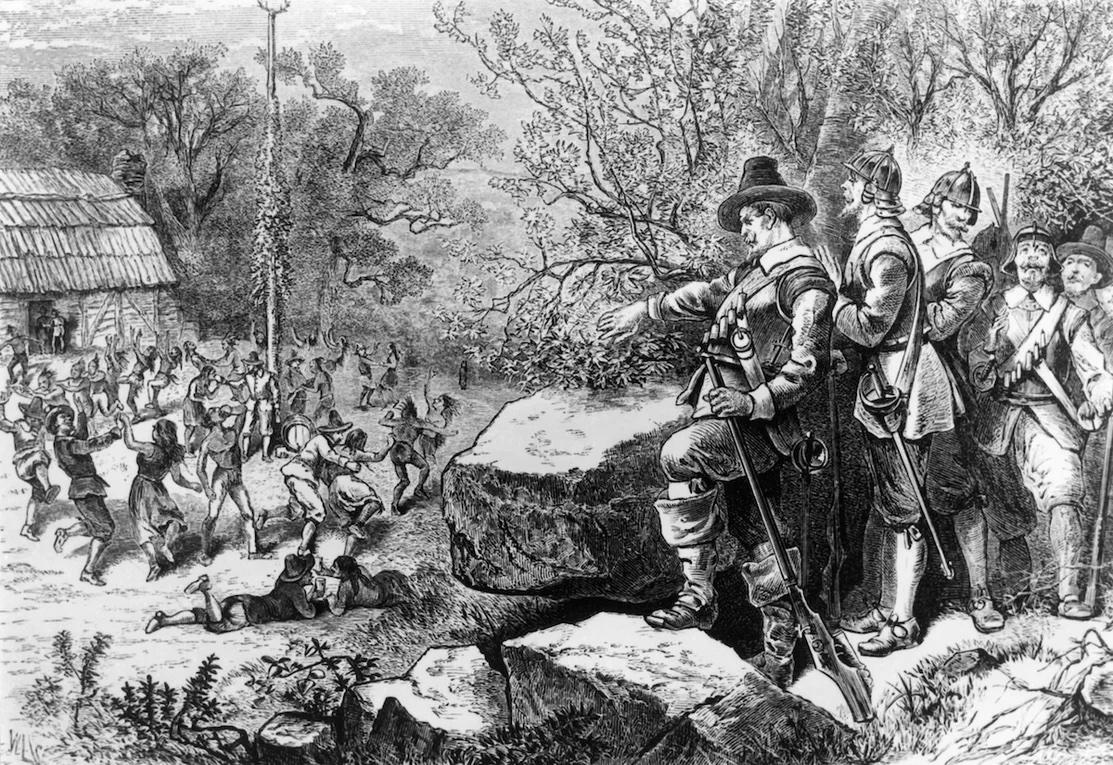
brewing “excellent beere”, and on May Day 1627, danced around an eighty-foot Maypole.
This attempt to blend old world carnival fun with practical race-mixing and egalitarianism was denounced by puritan pilgrims living nearby, who “feared and hated everything wild and free”, (Hal Rammel). They rightly saw a commune where what the governor called “all the scume of the countrie” engaged in “dancing and frisking together (like so many fairies, or furies rather) and worse practise”, as an open threat to their own elitist, racist and hierarchical vision of America’s future. The puritans jailed Morton, deported him back to England, dispersed his commune, and burned the buildings; much as the True Levellers or ‘Diggers’ in England would be dealt with two decades later.
As Hal Rammel movingly put it, “Morton’s spirit has haunted the American dream ever since…” In song, commune and revolt, the dance of Merry Mount continues.
Stealing the Commons
‘A celebration of all that is free and life-giving in the world… it was not a time to work. Therefore, it was attacked by the authorities… ‘ (Peter Linebaugh)
From the middle ages the festive spirit of Mayday & the open space it was linked to were under threat.
The powerful mounted an attack on festivals and popular culture, repressing carnival and holiday, part of a gradual imposition of a ‘work harder’ ethic, especially with the rise of Protestantism & then capitalism. Festivals and holidays like Mayday were also closed down because they were often days of revolt and disorder.
We’ll return to Mayday – International Workers’ Day – later
In parallel and allied with the puritanising of culture went enclosure, the privatisation of the green landscape.
As the old rhyme runs
“The law condemns the man or woman
Who steals the goose from off the common,
But lets the greater villain loose
Who steals the common from the goose.”
From the 15th century, England was subject to rapid social change, the breaking down of the complex vertical bonds of feudal society, and the introduction of new relations based on cash only.
For centuries the wealthy fought to fence off woods, commons, fields, to keep most of us from accessing them, so they could make more profit from them. This ‘enclosure’ massively changed how land could be used, who could benefit from its resources. Millions who used ‘common land’ – for grazing animals (crucial for many people’s survival) , collecting food and wood to burn to keep warm, to live on – even just to hang out and have fun – all lost out so that a few could get much richer.
Accelerated by cataclysmic changes in land ownership like the dissolution of monasteries – this all led to massive social dislocation & displacement, people forced off lands they had lived on or pushed into new ways of surviving.
Enclosure and the associated changes in land use led to gradual but increased pressure on what land remained accessible – over three centuries…. So on what marginal land was left, hosted refugees from enclosure: internal migration, thousands wandering the roads.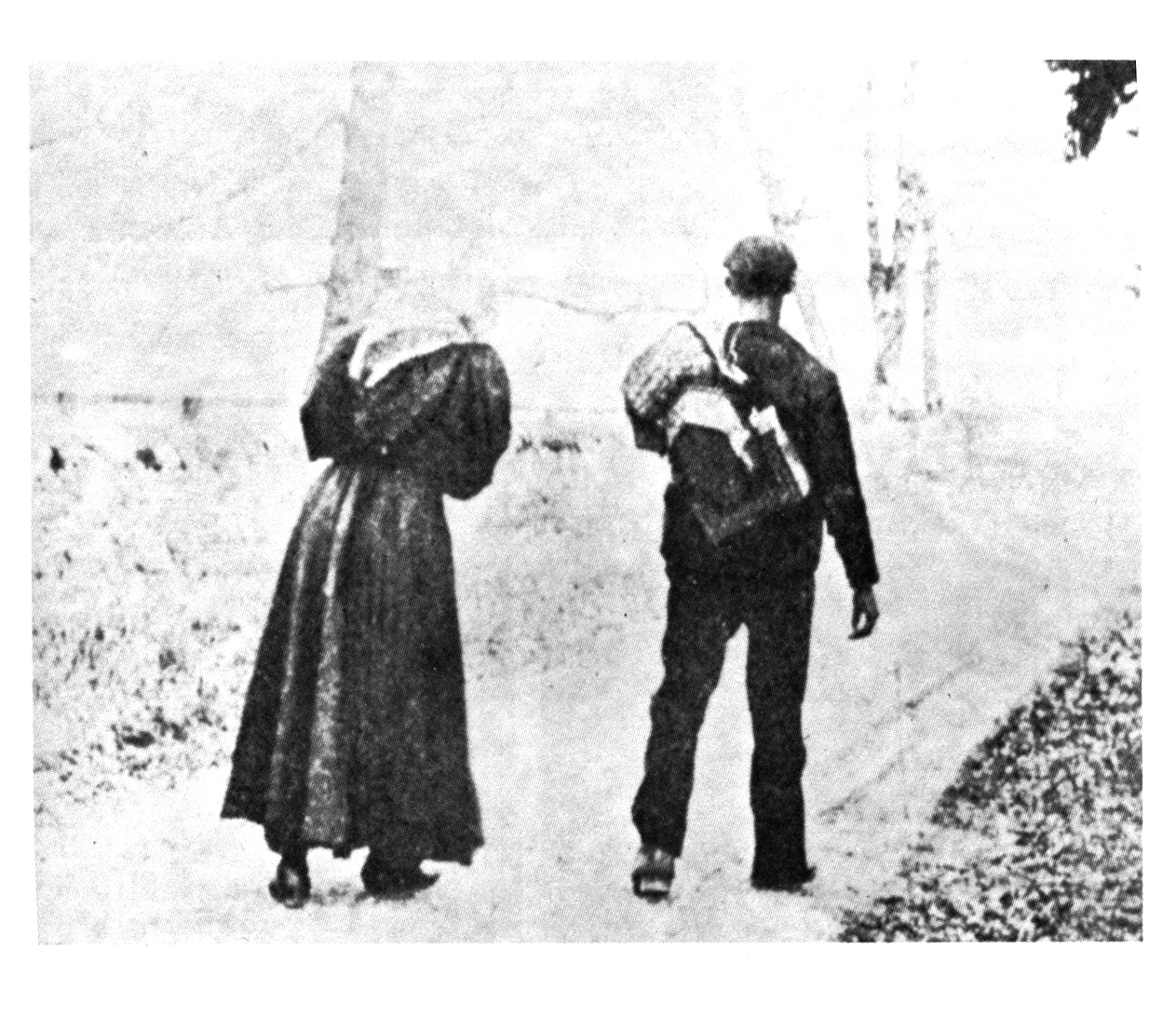
In response authorities created a welfare system where repression of the poor was encoded: laws against vagrancy, poor laws, laws banning travellers…
Many commons had been places of sanctuary – like outlaws had sought out the forests and woods. But thousands of others took sanctuary in the growing cities – where you could live relatively anonymous, find new ways to work, free from claustrophobic rural hierarchies, offering new ideas, freer exchange of thought.
Trespass itself is a sanctuary – protecting yourselves from exploitation and persecution by fighting back and taking the space the rich want to take from you
300 years later in squatting we trespassed to build our own sanctuaries, for ourselves, extending the hand also to those in need of refuge. Women’s refuges from violent men began in squatted houses. Black communities fighting racism launched squatting movements. Migrants facing bigoted violence and appalling housing conditions in the 1970s squatted East End streets and built resistance. Young people fleeing war zones and conscription merged into the anonymity and mutual aid of squatting scenes. In Hackney in the 1990s squatters helped create Autonomous Refugees Centres in squatted law courts and council buildings to house refugees denied public housing…
Resistance to Enclosure – Down With the Fences!
Enclosure was resisted – through legal, moderate campaigning and through sabotage, direct action and riot.
Let’s focus down some local green space and its history of enclosure & resistance.
Sydenham Common
The Great North Wood once spread across the South London hills from Deptford to Streatham – a landscape of woods and commons, worked over centuries for its timber for ship building, tannin extraction and charcoal burning.
As the Wood became broken up and divided, from the middle ages, several Commons emerged on the slopes of the hills – Penge Common, Sydenham Common, Dulwich Common being just three.
Sydenham Common once covered the area between modern Sydenham and Forest Hill, bounded in the Southwest by the modern Westwood Hill/Crystal Palace Park, in the Southeast by Mayow Park and Sydenham Road, in the north it reached up to the edge of where Honor Oak Park and Forest Hill Road are now. For 100s of years it was split between coppices of farmed timber (to the profit of the Lords of the Manor – the Abbots of Ghent & Priors of Shene) & open tracts where villagers could graze cattle & gather fuel.
After Henry VIII grabbed the Common in the dissolution of the monasteries, the coppice system was abandoned to allow more mature woods to grow for use by the navy. These were felled wholesale later in the 16th century, leaving a stripped common apart from 2 areas, Coleson’s Coppice and Coopers Wood.
The open land was a strong temptation to potential enclosers. The battle against enclosure here began in 1605, when a Lewisham gentleman, Henry Newport persuaded king James I to lease him 500-600 acres to him & attempted to fence a large part of the common off for ‘improvement’. Many inhabitants of Lewisham were small farmers or husbandmen who relied heavily on the free pasture available on the common. There were also large numbers of squatters on the common, encouraged by the lack of restrictions on grazing of animals. They supported themselves almost entirely by raising pigs, cows and sheep: it was said that “above 500 poore householders with wives and manye children greatly relieved by sayde Common and would be utterly undone yf yt should be unjustly taken from them.”.
After years of legal wrangling, Newport and his allies Innocent Lanier and Robert Raynes, tried to violently evict the poor and enclose the land around 1614, “to make ditches about the common and inclosed it and drave out and killed sundry of the cattell of the inhabitants.” Locals led by the vicar of Lewisham, Abraham Colfe, challenged this in court; 100 of them marched to petition the king in 1614. But although the court ruled the enclosure illegal, Newport wouldn’t budge. Some of the more unruly locals took up direct action, tearing down the fences and filling in his ditches. Every time the enclosers men put fences up again crowds gathered to break them down.
The locals fought pitched battles & successfully prevented the enclosure taking root.
Legal and violent tactics ran in parallel. Eventually the Privy Council ruled that the enclosures were illegal & put a stop to them in 1615.
The context for this was turbulent: the early 17th century saw mass open warfare against enclosing landowners: most famously in the midlands in 1607, where 1000s of the land- less poor fought the militia, destroying fences, & breaking open enclosures. This revolt was where the names of Levellers & Diggers were seemingly first adopted to describe these poor rebels. Later of course these names would assume political significance in the English Civil War.
This defeat held off enclosure in Sydenham for a century. But in the 1750s, trouble broke out in Coopers Wood, (south of modern Westwood Hill, between the railway line and Lawrie Park Avenue). Cooper’s Wood had first been detached from the Common & enclosed around 1540, though this was disputed locally for 200 years – many locals never accepted the shutting off of the wood. In 1754 “persons claiming right of common” several times threw down fences surrounding the Wood and asserted rights of access and gathering fuel etc. George Thornton, landlord of the still extant Greyhound Inn, Sydenham, at the junction of Kirkdale/Westwood Road, & tenant of the western part of Coopers Wood, was among those whose fences were “thrown down and prostrated”.
In 1755, in a legal case involving the denial of rights to collect wood in Colson’s Wood or Colson’s Coppice, the area north of the old Common (now an area bounded by Ewelme Road, Horniman Gardens, Devonshire Road, and Dunoon Road, in modern Honor Oak) – John Anderson sued the owner Thomas Hodsdon, claiming he had prevented him from exercising his common rights in the Coppice. Anderson was a merchant living in Sydenham Road, acting as the representative of a group of residents in a test case. However, Colson’s Coppice was gradually sold off as freehold land.
40 years later, Samuel Atkinson, a Tooley Street cheese merchant, bought this estate, & between 1787 & 1789 created the present Honor Oak Road, a new route from Sydenham to Peckham Rye, opening up the wood for building; selling plots for development. But those who still maintained that the wood was common land didn’t take this tamely. In October 1792, Michael Bradley & others from Sydenham broke in to Colson’s Wood to assert their traditional rights to cut wood, which they claimed had been held for over 200 years. Atkinson blocked their way, asked them their business, to which they said there was a footway across that their forefathers had used and so would they. Atkinson threatened to shoot anyone who stepped forward, apparently Michael Bradley stepped forward & Atkinson then shot him; Bradley died a few hours later.
The Coroner’s Inquest brought in a verdict of manslaughter against Atkinson, but he doesn’t seem to have been convicted of anything, since he continued to own the estate and develop it.
Although the case caused uproar, it seems to have marked almost the end of a near-200 year struggle for common rights here: the whole of what remained of Sydenham Common was enclosed finally in 1810. Even after 200 years of building and clearance, there were still 500 acres to be developed. The only remaining part of the old common is Sydenham Wells Park, which had become a popular spa of sorts in the 18th century.
Sydenham Common was also the site of a popular fair, which was resented by the gentry & posher residents (the same people usually doing the enclosing) for the ‘lowlife’ it attracted. This is a regular theme with proposals to enclose in the 18th-19th centuries, not only profit but control of open spaces which often could be used for unruly gatherings of the poor, not only fairs and makeshift dwellings, but also political rallies and demonstrations… In 1766 the fair was moved much further south to Kent House Fields. It was later suppressed in 1836 – part of the repression of popular culture as the capitalists and their religious allies imposed work discipline and self-denying moralism on an often unwilling plebeian class.
Enclosing the Mind
If Enclosure created an actual process of migration from countryside to city, it also helped build a mindset – one that saw land and people as commodities & sources of money & power only – not as people to be taken into account or a landscape to be shared. This mindset evolved, fuelling & funding first the internal conquest of England’s own people, then of neighbouring countries, then imperialism, colonialism, the empire spreading across the world, the slave trade … Processes that created vast profits of their own for the already wealthy and enriched those who were on the make; profits invested into land, trade, titles, and further fuelling more enclosure and then the Industrial Revolution
Colonialism and the imposition of British culture and power – allied to other powerful nations and the now even more powerful global corporations – still produces migration the other way – people coming here because their lands are devastated by war, exploitation, poverty, because the wealth the empire stole is here, the resources have been hoarded here.
Into 19th Century, the growth of the City of London as the hub of Empire sparked the rapid expansion of its suburbs… one cause of which was the vast army of clerks, administrators, admin workers and others needed to run a vast military and economic hegemony – and the working classes needed to service them and make the products that were beginning to launch consumer capitalism.
The City expansion increased the threat to green space, open space. As cities grew pressure to develop land for housing increased… But people fought to save many beloved places from disappearing, especially in the later 19th century.
Mayday is Workers’ Day
Through the 1800s industrialisation, the vast and urgent explosion of capitalist enterprises, took advantage of the millions of landless forced to seek work in towns and cities, building thousands of factories where people were set to toil in terrible conditions, often living in slums, working long hours for low pay.
But the growth of factories and wage labour also gave birth to its opposite – mass class struggle: people got together to fight for better lives.Workers getting together – through unions or outside them – to push collectively for more pay, better conditions, shorter hours – has shaped actual space and how we live in it. The weekend off – they fought for that. Sick pay, holiday pay, pensions, protection from employers’ arbitrary control… all battled for, hard-won. Workers pushing health and safety changes made workplaces safer spaces to be in.
One battlefield that dominated the 19th century in the industrialising nations – the fight for a shorter working day. Unions pressed,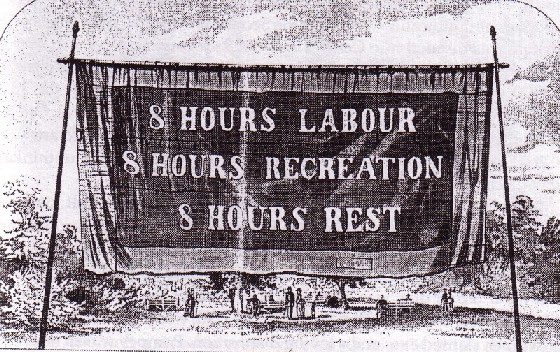 marched, demanded, went on strike, to drive the hours workers were forced to labour, down, to 10 hours a day, to 9, to 8.
The movement for shorter hours was to give birth to Mayday as International Workers Day, a bloody and infamous nativity: dynamite and state murder were its midwives.
Factory workers in Chicago in the USA, fighting for a shorter 8-hour working day, tiok part in a national strike to demand the reduction in hours, on 1st May 1886. In Chicago police killed two people when they opened fire on Monday 3 May during clashes outside the McCormack Reaper Works, where workers had been on strike since February. The following day a policeman was killed by a bomb thrown at a protest meeting in Haymarket square in the city. Eight anarchists who had been in the forefront of the 8-hour-day agitation in Chicago were 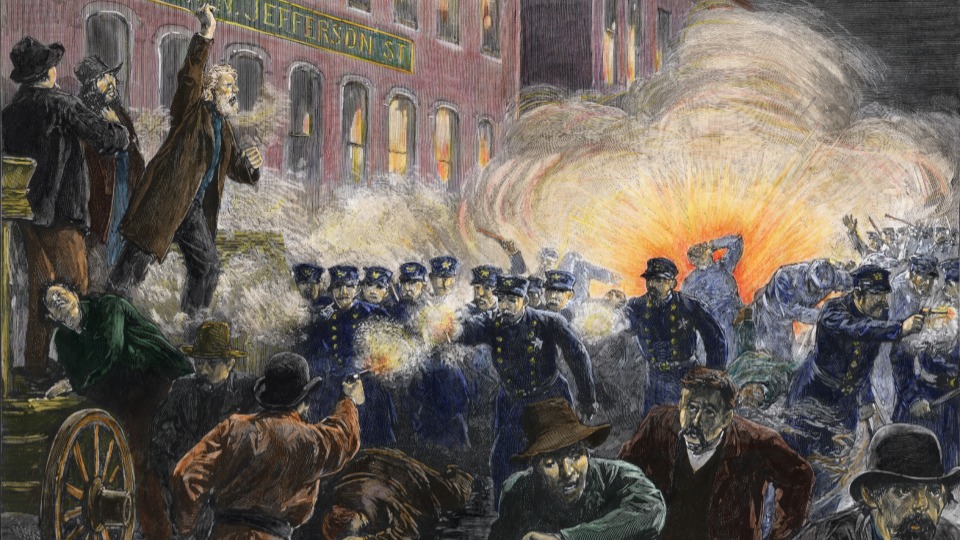 framed up and convicted of murder, of whom seven were sentenced to death, though none was accused of actually throwing the bomb!
There was an international outcry against the trial and the sentences. London radicals, trade unionists and socialists protested the sentences. If this seems a long way from Sydenham, remember that those speaking out included many luminaries living in Southeast London: Annie Besant (who had lived in Colby Road, Upper Norwood), anarchist theorist Peter Kropotkin (then living at 6 Crescent Road, Bromley), E. Nesbit (then living in Lewisham), Eleanor Marx (who later lived in Sydenham), as well as William Morris, Oscar Wilde, Edward Carpenter, Ford Madox Brown, Walter Crane…
A meeting on the case was held at the Peckham Reform Club (Freedom, November 1897).
Nevertheless, four of the accused were hanged. The deaths in Chicago had a powerful impact across the world, not least on Jim Connell who was inspired to write ‘The Red Flag’ anthem in 1889 on a train to New Cross – he was living at 22a Stondon Park in Honor Oak at the time.
The movement for a shorter working day did not die with those who became known as the Chicago Martyrs. In December 1888 the American Federation of Labour called for a national day of demonstrations and strikes on 1 May 1890, and this call was echoed in July 1889 by the international socialist conference in Paris.
So it was that from 1890 May Day became an annual international festival of working class solidarity. May Day marches were held in London from 1890 and continue today…
Back to the Land?
As throughout the century, trade union struggles forced factory reform and economic growth reduced working hours, ‘leisure’ time for working and middle classes became an issue. Particularly in the rapidly expanding city, green space for people’s after work activities became important.
The industrial revolution and the rise of capitalism helped to create a radical working class movement, a self-organised self-conscious social and political reaction to the evolving exploitative conditions working people were experiencing. As well as challenging the day to day expropriation of their lives, and fighting for change in the political systems that enabled class inequality, these radicals also looked at how they had got to where they were. How land was controlled, who owned it, and enclosure, how they had been dispossessed of it, many thought, were crucial questions.
If industrial workers were divorced from the land, deprived of access to it, forced to sell their labour as they owned nothing else, was taking back ownership of the land the key to social justice?
The radicals of the English Revolution had identified land as a crucial battleground. Their late eighteenth/early nineteenth century successors felt the same. Influential agitator Thomas Spence put forward a program proposing the end of aristocracy and landlords, for land to be publicly owned by democratic self-governing parishes, and rents of land in parishes to be shared equally amongst parishioners.
Through the 19th century other radicals proposed nationalisation of land. Parts of the Chartist mass movement tried to build a Land Company that could buy up land and parcel it out to industrial workers, envisaging the re-creation of a self-sufficient rural cottage-dwelling artisan or labouring class. Other radicals raised money to fund emigration to the US where they could access land, (though ironically stolen by force from indigenous occupiers); where some built utopian communes and others sought individual self-sufficiency.
In tune with their interest in land and who controlled it, the organised labour movement was to play increasingly important roles in the struggles over urban Commons in the late nineteenth century.
One Tree Hill
Another local green open space faced with enclosure saw a concerted campaign which drew on some of the movements that had grown up with industrialisation.
One Tree Hill in Honor Oak stood in open land until the mid-20th century but was woodland on the north-western slopes up until the 1840s.
One Tree Hill had long been an open space, a traditional gathering spot for locals, more recently for recreation. A number of old footpaths ran across the hill, from Forest Hill to the Brockley Road and Peckham Rye, considered to be rights of way.
In Autumn 1896 One Tree Hill was suddenly enclosed by Honor Oak & Forest Hill golf club, who had leased it from the landowners, and erected a six-foot fence around it.
Open space was becoming scarce in London at the time, although this area was relatively open, people from further in had seen massive development of city out to slopes of the hills in their lifetimes
The rights of way over the hill were held in great importance – don’t forget how vital paths were, in an age where public transport was limited or expensive, & wages were low; walking might be your only way to work; the way to walk over to see family or go courting in nearby villages. Walking, leisure, walking for pleasure was just coming into mass fashion as well then – as noted above, the factory acts meant working people had more time off.
Paths had resonance locally. In 1867, wealthy silk warehouse owner Richard Beall had tried to block off Taylor’s Lane, Sydenham, to increase the privacy of his posh home, Longton Hall. Enraged locals smashed the walls & fences down with axes & hammers! Eventually Beall gave up.
Back to One Tree Hill: Many Locals, were understandably annoyed by the golf clubs actions. An ‘Enclosure of Honor Oak Hill Protest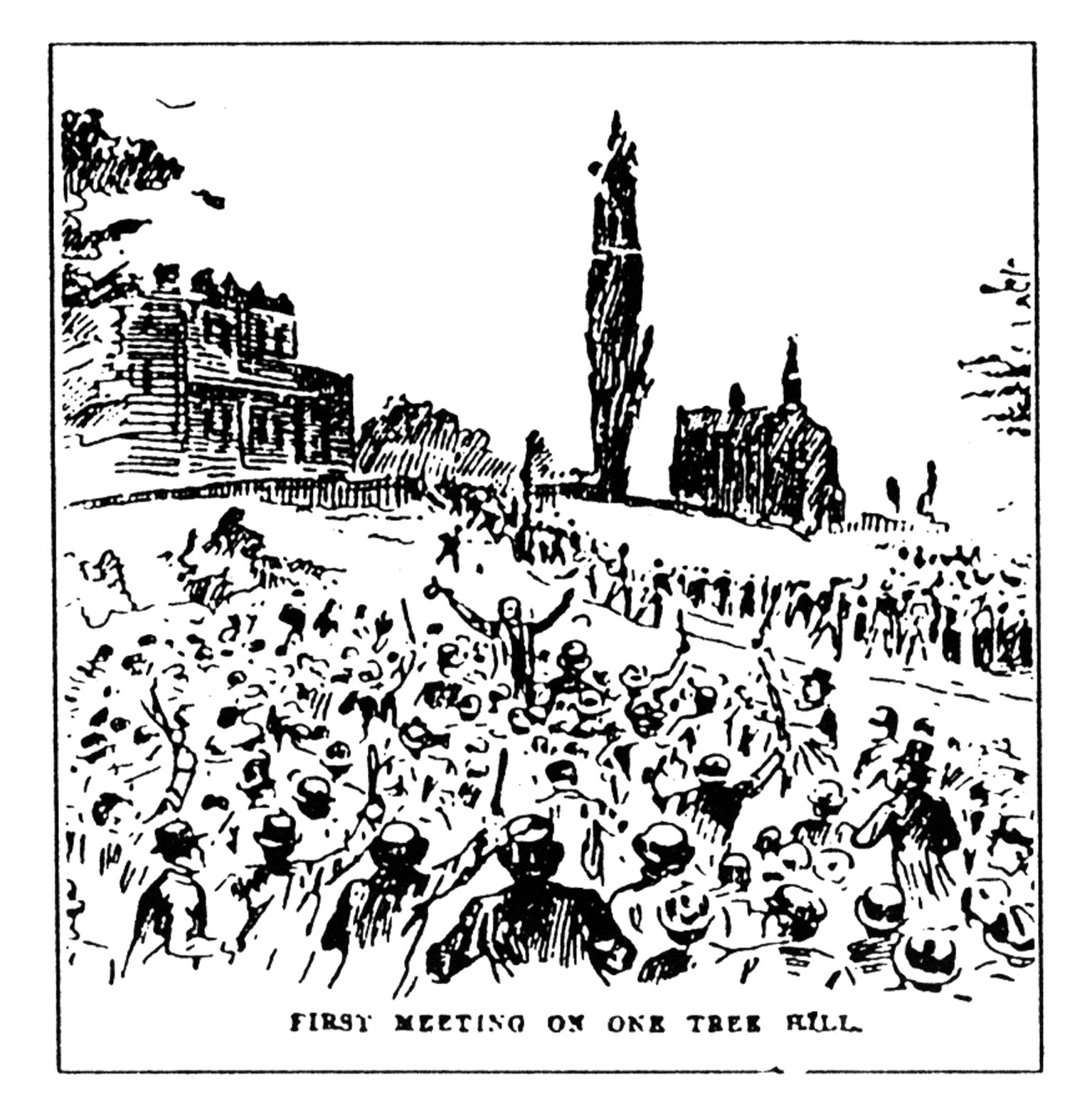 Committee’ was formed in summer 1897, including residents of Honor Oak, Peckham, Forest Hill and Brockley,
The committee held regular public protest meetings were held in Spring-Summer 1897, many taking place in the open air on Peckham Rye. Committee members spent time trying to determine whether there were any traditional common rights, or if the old paths across the Hill constituted Rights of Way for the public, which might contain legal implications for a right of access.
But despite what was widely claimed, One Tree Hill had never been part of Sydenham Common, kyboshing any claim for common rights there. Meanwhile “ a spirit of unrest, at what was termed the slow methods of the Executive, began to show itself amongst a small section of the members…”
Most of the Committee were resolved to use constitutional methods only: At a meeting of the Committee, at the end of August 1897, a resolution to re-open the hill by pulling down the fences was defeated,
But the Golf Club prosecuted two lads who had allegedly broken down part of the fence and ‘trespassed’ on the hill, and some children who wandered through a broken section to pick flowers were attacked by a fierce guard dog belonging to a security guard watching the enclosed grounds,
These incidents ratcheted up the tension surrounding the ‘enclosure’.
This led to further attempts by elements dissatisfied with the slow progress of the campaign, and a mass meeting on October 3rd on Peckham Rye voted for the forcible removal of the fence the following Sunday. (the official Protest Committee immediately wrote to the press disassociating themselves from any such action).
On the following Sunday, October 10th, a crowd estimated at as many as 15,000 people assembled at One Tree Hill; the crowd in Honor Oak Park pulled down parts of the fence and rushed onto the hill from Honor Oak Park and Honor Oak Rise. “The hill was soon covered with a disorderly multitude, and it was quickly found necessary to reinforce the police who had been posted to keep order.”
A week later, on Sunday October 17th, a very large crowd gathered, obviously expecting more trouble. Estimates vary from 50,000 to 100,000 people present, which may be slightly exaggerated. They were faced by 500-odd police, some on foot and some mounted, patrolling the hill, who fought off several attempts by sections of the crowd to demolish the fence and rush onto the hill.
Much of the activity that day was on the south side, overlooking Honor Oak Park. At least 12,000 people were said to be hemmed in here, “mostly of the respectable class” but clearly including a fair number who threw stones at the coppers, charging at them several times and being charged in return.
“Late in the day a furze or gorse bush was set on fire, and this cast a lurid glare upon the upturned faces of the packed mass of onlookers.” Ten people were arrested, including the alleged arsonist, who all appeared in Greenwich Police Court the following Monday, when two got sent to prison for a month, three for fourteen days and the rest were fined.
The following Sunday, the 24th, thousands again gathered at the Hill, though there was little trouble. More peaceful mass meetings continued on Peckham Rye.
One tree Hill rioters had examples of large riots and direct action to prevent development or building on commons in late 19th century London, including successful direct action at Wanstead Flats, Plumstead Common, Wandsworth Common, Hackney Downs, Eelbrook Common, and West End Green, Hampstead, in the previous 25 years alone. In the 1890s successful anti-enclosure sabotage at Ham Common, Leyton Marsh Lammas Lands would have been in the minds of the crowds.
Again, the tension of direct action / preparedness to use violence versus moderate and legal constitutionalism was present – as old as enclosure is the resistance, taking many forms; both moral and physical forced in parallel succeed!
Although the official Protest Committee condemned the rioting, and there were no more riots on the Hill, the campaign continued, and the Lewisham and Camberwell Vestries negotiating for a sale of the Hill so it could be re-opened to the public; leading to the Hill being bought from the landowners in 1904, and re-opened to the public.
Today it is returning to woodland having been largely managed through non-intervention, bar access works and hedge planting, by the Friends of One Tree Hill and Southwark Council.
It’s crucial to remember that this was NEVER common land, that the intense investigation into rights of way even didn’t prove decisive here; in contrast to many other spaces where common rights or rights of way were vital to defence.
What it important is that people locally felt that this was their space, and defended it, and that feeling of ownership was crucial, though it flew in the face of actual legal reality.
Current struggles for resources – a new commons
Just as aristocratic landowners enclosed common land for profit, in our own time enclosure continues – a fight over who benefits from resources. As the rich once tried to exclude us from ways of making a living from land, now the powers that be restrict and close off our access to EVERYTHING – cuts to basic services – social care and healthcare, cutting benefits and our rights at work, squeezing out council housing, raising rents, shutting libraries, clubs where we can meet.
We need to be redefining what is ours, collectively, in opposition and defiance of the laws and fences built to exclude us; and not just when it comes to space, but for the whole world.
People fought to defend access to common land and sometimes won – because they saw these places to be theirs, to belong to them as communities, even when that stood in opposition to the laws of property. A shared inheritance.
We need a new commons. Let’s take control of the world around us.
@@@@@@@@@@@@@@@@@@@@@
Further Reading
The incomplete, true, authentic and wonderful history of May Day, Peter Linebaugh
Mayday in South London, A History, Neil Transpontine.
Rights of Common: The Fight Against the Theft of Sydenham Common and One Tree Hill… and other open spaces in the Great North Wood
The Haymarket Affair – The 1886 Chicago bomb, the trial and execution of the Chicago anarchists.


Leave a Reply