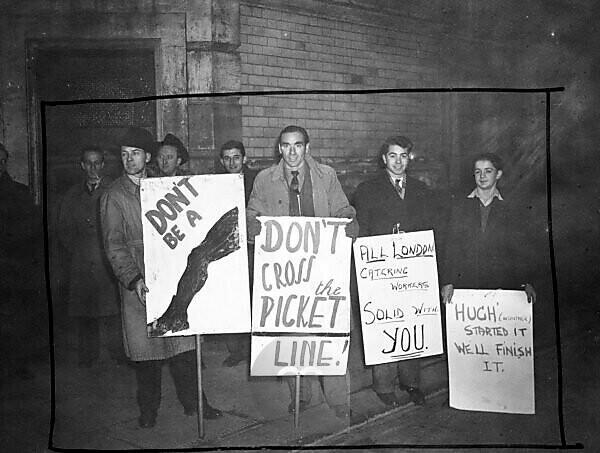
The Savoy Hotel Strikes, 1946-7
“When the hotel workers in London, starting with the Savoy Hotel, came out on strike in 1947 I think there was still a good bit of the war-time spirit among them, the esprit de corps developed among people during the Blitz. A lot of them had been in the forces and this had given them confidence. They needed it, for there had never been such a strike in the catering industry, nor has there since.”
(Arthur Lewis)
During 1946-47, the ultra-posh Savoy Hotel in London’s West End was hit by a series of strikes by its workers; the ramifications of these disputes went beyond day to day working relations to affect royal occasions and involved suspicions of communist conspiracy.
The catering industry was regarded (and still is) regarded as a difficult arena to organise collective action among workers; the posh hotels of the West End no less than elsewhere.
Arthus Lewis describing the working conditions in the West End catering trade in the 1940s:
“A good deal of the industry was casual labour, including men who came in off the streets to do washing up for a bite of food and a warm. There were men of all races, colours and creeds, many unable to read or write English, unorganised and not knowing the first thing about trade unions. Some were very poorly paid, most were very shabbily treated. A minority did well: there were hotel head porters on £1,000 to £1,500 a year, [worth maybe £70,000 in 2025?], mainly from tips, and chefs de cuisine, pastry chefs on £800 to £900. There were in fact both rich and poor and to cope with them trade union organisation had to be different, using unorthodox means and methods….
In fact the catering workers were considered impossible to organise. Ernie Bevin said to me at the time that he had tried for years and it couldn’t be done. There was some arrogance about that – what he had tried and failed at, no one else could do. So I determined to do my best. I was then the youngest trade union official in the country, as well as one of the youngest MPs. I took over a small branch of the Municipal and General Workers Union. I’d worked in all sorts of trade and industry, but this one was completely different…”
(Lewis)
It is worth reading Wilf McCartney’s descriptions of working in West End hotel and restaurant catering some 30 years earlier:
“First let me draw a picture of the scene. One entered the great glass and polished doors, flung open by a smartly uniformed doorkeeper, and passed on to a beautifully carpeted floor, splendidly polished tables, mirrors, hat-racks, umbrella stands, ashtrays, with spotlessly dressed waiters. This was the dining floor, seating over a hundred persons. There was a beautiful basement, same size, same luxury. On the first floor was the smoking and domino-playing floor, not quite so large as the kitchen which was at the back of this floor. A plain wooden narrow door opened in on the kitchen, the basis of all the activities of the restaurant, the foundation on which the concerned existed.
What a sight met the eye! It was just a room about five yards by five with one small window, sawdust on the floor, gas, hot-and-cold water pipes all along the walls, alive with rats at night, mice and beetles on the floor. That was the general scene of all kitchens in the City of West End. Some were on the top floor, some in the basement, some a little larger. That is all that might be slightly different.
About the people who slaved many hours a day in this so-called kitchen. First there was the chef, the second cook, fish-and-pastry cook, veg. Cook; then the kitchen porter, boilerman and liftman, two women to clean vegetables and dish-up – that is seven in all, not counting myself. We had to be in the kitchen for work on the stroke of eight. That meant the cooks had to get to their ‘dressing-room’ or rather cubicle, at 7,45 to change from ordinary dress into whites. This cubicle had sweating pipes running along the walls, so our clothes were not always dry. We started preparing the lunch menu, which was in French. As you entered the kitchen on the right was the service lift and speaking tube, up which the orders came. In the middle was the hot plate, on the left a sink for vegetables and fish cleaning, at the back were two gas stoves. Everything had to be cooked in or on these two stoves. Just imagine the veg peelings everywhere, steam boiler and coal corner making the room stink with various smells, the plate washer bending over a steaming tank washing plates for twelve or fourteen hours a day, each cook racing against the lock to have his part of the menu ready sharp by twelve o’clock, the bumping into each other, racing for the stove or oven before the other fellow.
By twelve o’clock everyone in the kitchen as dressed drenched in sweat, with the stoves, the boiler, racing against time. But at twelve we were only just starting. The liftman got to the lift, the whistle of the speaking-tube shrieked out, then order came thick and fast, each cook, each serving-hand having to have a memory like Datas.
Excitement, swearing, bullying, going on all the time. Orders, more orders. This hell went on till 3 p.m., then the porters got a ‘staff dinner’, sometimes a week old, never the same as the day’s menu. Cooks can generally help themselves to what they like. That was my first lesson in the dividing of the workers.
At this time the cooks were glad to get into the glorious fresh air for two hours, then back again till nine. If lucky, nine was your early night. Your late night before this was twelve, and this slavery went on in every hotel or restaurant. Some might be slightly better than others, but generally this was the picture.
What about the wages? Before the second world war, good cooks were glad to get jobs at thirty shillings (£1.50 current style) a week, porters anything from fourteen shillings (60p) a week, not forgetting the food.”
(Wilf McCartney, ‘Dare to be a Daniel’)
There were strict hierarchies and caste consciousness among the Hotel staff, which influenced how industrial relations played. out: “I saw the office, the ‘superior’ staff, treating all other staff with the greatest contempt, except the Manager, whom they fawned on with the utmost servility. The waiters, feeling this, wished to get even with the remaining staff, so the kitchen staff, in the eyes of these ‘superior persons’, were dirt. But one could watch the cringing of the waiters to the manager and customers. No doubt their method of slavery made them so servile. The kitchen workers, not coming into with the customers, had a spirit of comradeship amongst them… Although they would swear and fight with one another, an injury to a kitchen worker, porter or cook, was an injury to the kitchen staff as a whole.”
(McCartney)
McCartney’s account of organising a grassroots syndicalist trade union in the pre-World War 1 West End kitchens showed that workers could organize there collectively, though the war and subsequent mass unemployment of the 1920s had done for the pre-war unions. 30 years later Arthur Lewis found conditions to be much the same, with little unionisation.
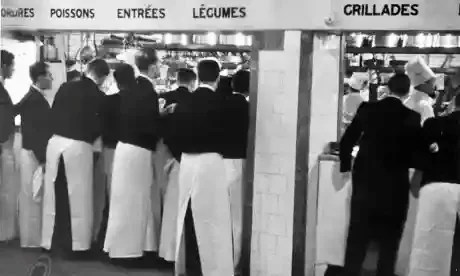
“… The fact was that the whole industry was chaotic. Hours and working conditions varied widely, though they were mostly bad. The lack of facilities was terrible, with bad shift and split duty terms; staff were treated like cattle, having to eat their food, usually left-overs as part of wages, standing up in any old corner; there were poor washing and toilet facilities. In one luxury establishment the staff had to go out and use the public toilets. There was a bitterness and hatred of working conditions; walk in, walk out, was the usual way…
…I decided that the biggest and best hotel was, as it is now, the Savoy and that if I could get organisation in the biggest and best, then the rest would follow. I used to go round to the back entrance, the staff door, send in leaflets, try and get them to meetings. Eventually a number joined, waiters and kitchen staff, and I tried to get the management to recognise the union. They adamantly refused. I couldn’t get letters answered; I tried the Ministry of Labour Conciliation Department without success…”
(Arthur Lewis M.P., district organiser of the Catering Branch of the National Union of General and Municipal Workers)
By hard organising, the Catering Branch built up that section of the union up from two to three hundred members into a membership of several thousands over the course of a few years in the 1940s. This climaxed in a struggle for union recognition.
1946 Strike
On October 8th, 1946, five hundred of the Savoy Hotel’s 800 employees walked out on strike at 6am, demanding trade union recognition and threatening to stay out until their demands were met by for by the management. Twelve hotels and eight restaurants at least were hit by the wider strike action, including Claridge’s and the Ritz. “Many of the big restaurants —the modestly priced as well as the grand—were closed down by sympathy walkouts.”
The London catering branch of the National Union of General and Municipal Workers issued a statement, that the workers would return on the signing of a trade union recognition agreement and assurances of no victimization and no stoppage of pay for the time lost during the strike. The strike committee said ‘we have been forced to take this action after every other avenue of approach has been closed by the management.’
Waiters, chefs and kitchen hands at the Savoy hotel were solid. It was decided that tables were to be left bare and underserviced in the private suites, restaurant and Grill room.
A mass rally was held in Hyde Park on 13th October.
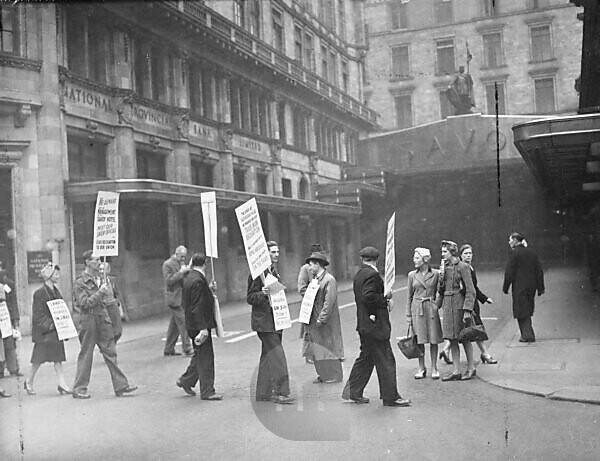
In line with the support given to the strikers by meat handlers and electricians, the milling section of the Transport and General Workers Union decided that it would halt deliveries of flour to all hotels that would not recognise trade unions.
On October 15th, full recognition of the hotel workers’ union by the managements was conceded in an agreement reached between the Hotels and Restaurants Association and the National Union of General and Municipal Workers, arranged by conciliation officers of the Ministry of Labour.
The union promised the immediate resumption of work and the strikers began tonight to trickle back as they learned of the decision reached at a conference The managements agreed that there should be no victimization or intimidation of strikers.
The 1946 strike appeared to have won concessions on recognition of unions in the West End hotels, but as events of the following year showed, these may have existed mainly on paper only…
March 1947 Strike
Two 1947 strikes at the Savoy seem to have partly knock-on from the strike of the previous year, and wider union activity connected to it.
On March 13, 1947, around 600 catering workers walked out of the Savoy again, on an official strike supported by the catering union. They were protesting the dismissal of one employee who, they held, had been victimised because of union activities. The strike was cleverly called just before the serving of dinner: hundreds of Hotel patrons had to leave to find food elsewhere!
The strike was not expected this time to spread to other hotels, and the Savoy’s workers were described as overwhelmingly favouring the walkout.
Apparently the dispute was triggered by management’s suspension and subsequent dismissal of a waiter called Frank Piazza, then living in Catford, South London, a member of the Communist Party, for alleged “indiscipline and breach of his duties” as a grill room waiter at the Savoy. Apparently Piazza had been interned as an enemy alien during the war because of his supposed Italian ancestry. (Hundreds of British residents of Italian descent were held in camps during WW2, including, ironically, Italian anti-fascists, communists and anarchists, no friends to Mussolini’s regime).
Piazza was shop steward of the Savoy Grill Room, and had been sacked for defending trade union principles. In the plate room a stoppage had taken place because the workers resented the replacement of a popular foreman. In the course of this, dirty plates had accumulated to such an extent that the management tried to manoeuvre the apprentice waiters into washing the dishes, which they insisted was not their job, and they refused to break the dispute in the plate room. Frank Piazza intervened to emphasise this, and was sacked in response the next day.
This strike lasted a week, and involved 1000 workers, of several nationalities, including Jamaicans, Burmese, Indians, and French.
This dispute was settled after a Court of Inquiry consisting of representatives from both the Hotels and Restaurants Association and the National Union of General and Municipal Workers, met to hear evidence and concluded that Piazza should not have intervened in the plates dispute, and he was reinstated but with 14 days suspension.
November 1947 Strike
In November 1947, yet another strike broke out, seemingly a continuation of the dispute over the sacking of Piazza, who had been unable to get his job back.
Since March, the dispute had dragged on through various stages of the arbitration machinery over a period of months, before workers had the legal right to go on strike. Although the decision of the District Council and the National Arbitration Tribunal had ruled Piazza should be reinstated, the Savoy management blocked this.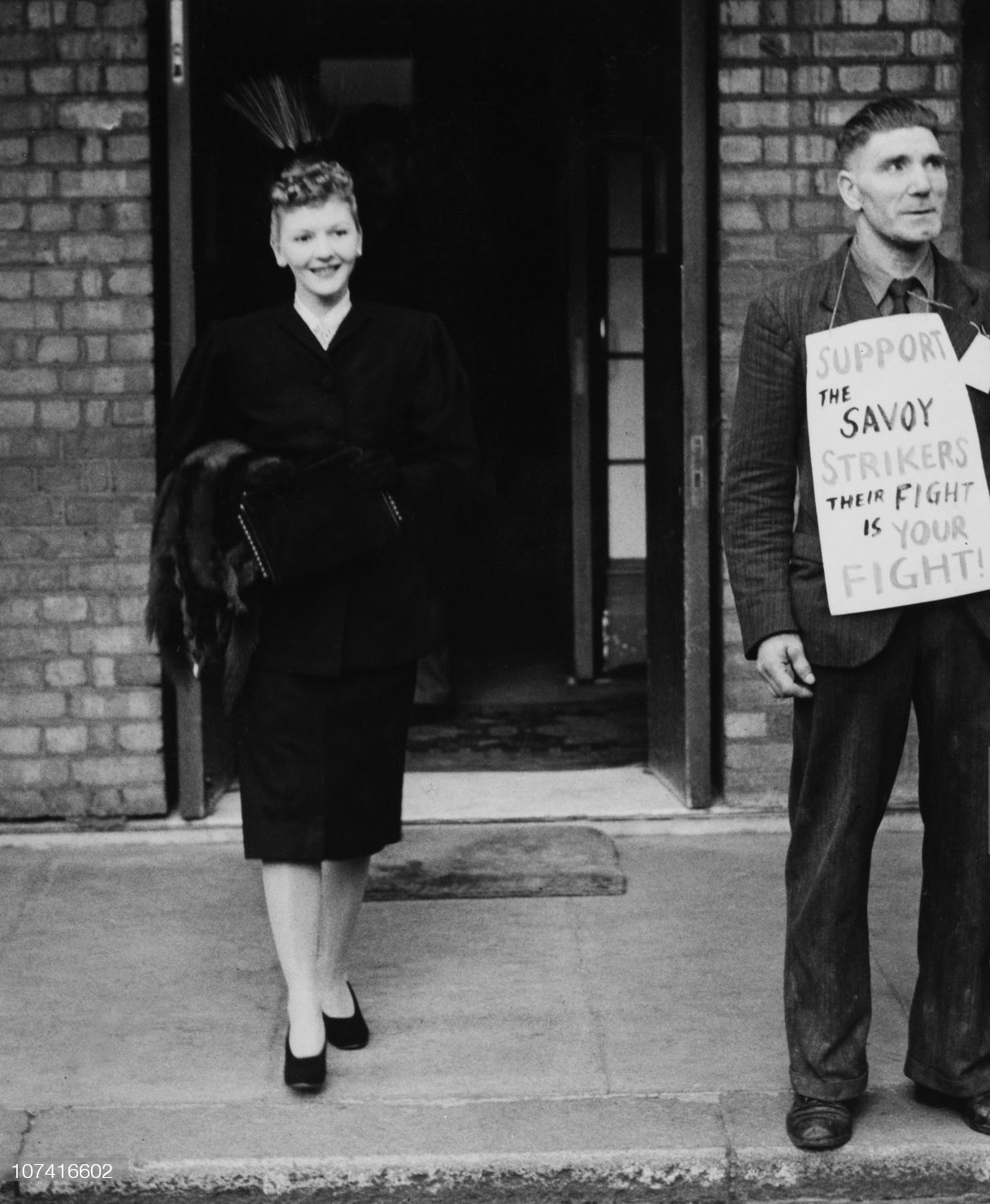
Meanwhile, it was illegal for the workers to go on strike without going through the whole arbitration procedure, and even at the end of this process, though the decision was still that Piazza should get his job back, there was no legal means of enforcing it upon the employer. The National Arbitration Tribunal had no power to force the Savoy to back down.
After going through all the stages of negotiation and arbitration, by law the workers had to give 21 davs’ notice of strike action, which they did. Meanwhile, however, the Savoy were making every preparation for the impending strike. Every inch of available space was alleged to have been filled with additional stocks. Additional staff were brought into the hotels. Scabs were being contacted.
About half the 1,300 catering staff came out on strike on November 7th, striking for a fortnight over Piazza’s sacking.
The Savoy and Berkeley Hotels Group responded to this latest dispute by sending registered letters .to between 409 and 500 strikers terminating their employment unless they reported for ‘ duty on November 15th.
The November 1947 strike was declared official by the NUGMW executive, although reluctantly; in the run up to the strike the Union Executive tried to delay strike by action, pleading that the Minister of Labour had set up a Court of Inquiry to investigate the cause of the dispute. The action of the Savoy
management, in giving an ultimatum to the strikers to return or consider themselves sacked, forced the Executive to declare the strike
official.
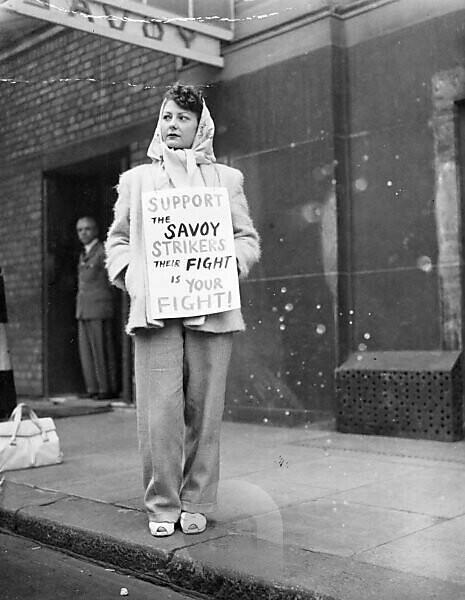
The dispute was also backed by the London Trades Council, to which 650,000 trade unionists were then affiliated. The Trades Council helping to organise 24-hour pickets, which were supported by workers from various trades as well as a number of students from the London University.
Immediately the strike commenced, militant workers at Smithfield Market (who themselves were well-known for going on strike on a regular basis at that time) showed their sense of class solidarity. Without waiting for the Union Executive to issue an instruction, they refused to handle or supply meat for the Savoy Group. Any firm which handled meat for the Savoy was approached by Smithfield workers and threatened with being black-listed and their supplies stopped. This example was soon followed by the workers at Covent Garden vegetable and Billingsgate fish markets. At some point during the strike porters at Smithfield meat market and some shipyard workers walked out in sympathy.
“We carried the campaign to all hotels and restaurants in West London. Thousands and thousands came out on strike, hardly a one of them in the trade union movement. The Hotel Owners’ Association of the day dug in their heels. Only the Grosvenor House managing director agreed to meet me and discuss recognition…
But now we were all out together and were going to stay out. The esprit de corps was terrific. It used to be said that British waiters resented Italians, but British, French, Spanish and Chinese were on picket together like the United Nations. And the highest paid, the managers and maîtres d’hotel, the head porters, they all supported it. They believed in justice for the poorer paid. We had one demonstration to Hyde Park, when the whole West End was at a standstill; it was reckoned that over 80,000 were on the march…
Since the hotels had oil-fed central heating, we next tried to get the oil tanker men to stop delivery, with the help of the Transport and General Workers’ Union.”
(Lewis)
After several pickets, including Arthur Lewis, had stopped an oil tanker from delivering fuel oil, the workers employed by the London Oil Pool put the Savoy Group on the black-list and refused to deliver further supplies. The Savoy had to get oil delivered 200 miles from Lancashire, manned by scabs to break the picket line.
This oil was eventually delivered with the active support of the police, who forced a path through the picket line to make way for the oil trucks. 21 pickets were arrested outside the Savoy while attempting prevent the oil being delivered, including Lewis.
“The Savoy did manage to get some oil in on blackleg lorries. We tried to persuade them not to go in, and when they would not agree, I and the other pickets lay down on the road. At first they were reluctant to arrest me but in the end they did. There was nothing about it in the law on picketing, but they charged with me obstruction. The Establishment can get you, right or wrong. In Parliament, the Labour back benchers were unanimous in their support of me and some helped us on the picket line. Some Labour Ministers told me privately they supported me, and some, not of the trade union school, rather looked down their noses. Naturally the Tories, particularly the ones who used the luxury hotels, didn’t like it. Even today, when they can’t think of anything else to throw at me, they shout, ‘Lie down, lie down.’ “
(Lewis)
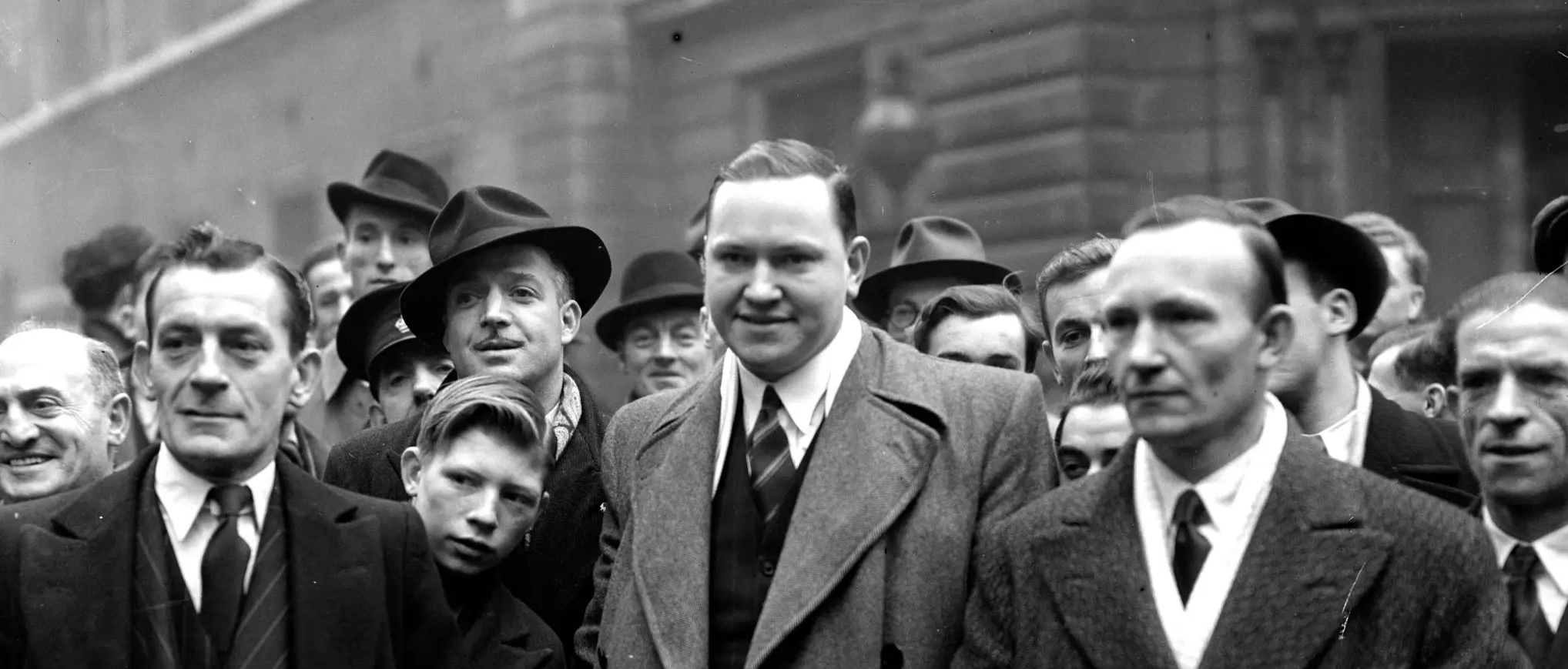
A Russian Plot?
The sporadic Savoy strikes may have seemed like a very local dispute, but in fact they caused disquiet and anxiety at the highest level of the British state. The November 1947 strike in particular – which threatened the hotel’s services on the eve of princess (later queen) Elizabeth’s marriage to prince Philip.
The Savoy & Berkeley hotel group, which included Claridge’s, the Berkeley and Simpson’s in the Strand, was then host to three kings, four queens and a “crush of princes, princesses and grand dukes”, all invited to the royal wedding in November 1947.
Communist trade unionists were involved in the strike: notes kept by the cabinet secretary, Sir Norman Brook, released decades later at the National Archives, show that Labour foreign secretary, Ernest Bevin, believed the strike was a Russian plot.
Nye Bevan, the health minister, was afraid that the Communist Party was in danger of gaining control of London’s “best hotels”. He believed managers would be open to blackmail and they could become centres for espionage against their influential guests!
Ernest Bevin said there was “a danger of Moscow stirring up trouble because of our refusal to come in with their political line”.
Prime Minister Clement Attlee personally tried to get Frank Piazza deported, asking the deputy director of MI5 why he had not already been deported as an ‘undesirable alien’. Guy Liddell replied it was not the policy of the Home Office to halt the naturalisation process for members of the Communist Party.
Some of the Savoy’s waiters seem to have opposed the strike.
Which is interesting in the light of Wilf Daniel’s observations on differences in class relations between waiters and kitchen staff…
A report in the Conservative Spectator magazine reveals some of the bile thrown at the Strike at the time, as well as being riddled with lies:
“The hotel strike in London, with its paraphernalia of pickets and of strikers or their political supporters, usually the latter, who lie down in front of lorries and have to be dragged off by policemen, is as mischievous and indefensible a performance as can well be imagined. The ostensible origin of the strike was the dismissal by the Savoy Hotel management of a waiter named Piazza, who had only been at work there a matter of days. Whatever Mr. Piazza’s vices or virtues the Savoy management was not alone in the view it took of him, for when his reinstatement was mooted the staff of the grill room, where he had worked, declared they would stop work themselves if he was brought back. The National Arbitration Tribunal, to which the matter was referred, did indeed recommend Piazza’s reinstatement, but the hotel management contended that the tribunal had no power to enforce it, and a higher ruling has since confirmed that view. (The management paid Piazza some £17o in wages, without reinstating him, before he was actually dismissed.) From that point a confusion of negotiation, with a good deal of unwisdom on both sides, developed, and a Ministry of Labour Court of Enquiry has gone into the whole matter. Its report is expected to be published this week, and though the Court has no power to enforce its ruling its review of the whole case will at least give public opinion something to work on. Sinister aspects of the affair are the obvious attempt to make life in London’s principal hotels impossible in the week of the Royal Wedding, and the evidence that exists of the activity of agitators who are far more political than industrial. The fact that only a small proportion of the staff at the Savoy, where the whole thing originated, has come out on strike is significant.”
(The Spectator 29/11/1947)
The dispute was settled after 26 days in early December, after a government inquiry, with the Savoy agreeing to work out a complaints procedure with the National Union of General and Municipal Workers and Frank Piazza being offered a new job at a West End restaurant.
It was noted when the government stepped in with its inquiry, that “The workers are incensed at the action of the Minister of Labour in stepping in at the last moment with á Court of Inquiry, instead of supporting such an inquiry many months ago. They feel that the action of the Minister at that stage was of assistance to the management, confusing the issue at the decisive moment. They bitterly remark that the Minister is eager to step in when a strike may involve the comfort and well-being of members of the ruling class who frequent the Savoy Group of Hotels, but is very reluctant when the well-being of the workers is at stake.” (Socialist Appeal, November 1947)
The November-December strike was viewed as essentially a defeat for the workers, as Piazza did not get his job back, and the workers issued with notice for striking were only partially re-employed. “The conditions of return as stated by Mr., Crane, a national officer of the Union, and reported in the ” Daily Herald,” are as follows: Fifty per cent. of the workers go back the first week, and twenty-flve per cent the second week… Others will go back as and when opportunity arises.Those with longest service will return first.”
The Savoy Management regulated this to select those whom they want back, refuse many of the most militant trade unionists re-employment, giving scabs their jobs. Many workers were angry at the NUGMW Union Executive for agreeing to this.
On top of this, the Union Executive proceeded to suspend Arthur Lewis, the Branch Committee, and then the entire District Committee of the Catering Section of the Union, “pending an investigation into their actions preceding and during the strike.” This represented an attack by the right wing against more left wing officials, who were prepared to align themselves in militant action.
The top leadership of the Union was perceived as having been forced into support of the strike unwillingly, of giving no real support to the strikers once it had broken out, seizing every opportunity to block militant workers’ action and then accepting the decision of afforded by the Industrial Court to capitulate to the employers and seek scape goats for the failure of the strike. Confidence in the Union was considerably undermined.
“If we had had the full backing of the official trade union movement, we would have got a lot more than we did. As it was we achieved minimum standards and the applying of wage board levels, and the Restaurant and Hotel Owners’ Association had to recognise house representatives. There was a rush of people into the union, and I began to recruit new members in places outside London… Without industrial action things would never have changed.”
(Lewis)
Sources
Arthur W. J. Lewis, Labour MP for West Ham North; former district organiser of General and Municipal Workers’ Union, account of organising catering workers at the Savoy and the background to the strikes
(reprinted from STRIKE A Live History 1887 – 1971, edited by R. A. LEESON)
1946-47 copies of Socialist Appeal, paper of the Revolutionary Communist Party (the main Trotskyist grouping of the time). Archived at Marxists Internet Archive
Wilf McCartney, Dare to be a Daniel, A revolutionary union in the catering trade AKA The French Cooks’ Syndicate, published 1945.
@ @ @ @ @ @ @ @ @ @ @ @ @ @ @ @ @ @ @ @ @ @ @
PS: 60 years later in 2007, the Savoy was still treating its workers like dirt…
Related: An Italian restaurant workers union organised in London by anarchists, c 1901.


Leave a comment