Everywhere, and Nowhere: The General Strike: Myth and Fact
“[the General Strike]… is a revolution that is Everywhere, and Nowhere…” (Fernand Pelloutier).
1926: A BRIEF OVERVIEW
In May 1926 2 million workers joined a General Strike across Britain. It lasted nine days, before being called off by the people who had called it – the General Council of the Trades Union Congress.
The TUC leadership had unwillingly called the Strike, in support of a million miners who had been locked out of the pits until they accepted drastic wage cuts. The General Council had been forced into action by the overwhelming class feeling of the members of the unions, who both strongly supported the miners and believed a General Strike to be in their own interests in the face of a wider economic assault from the bosses and the government.
The Strike was in most cases rock solid: increasing numbers of workers were walking out, and towards its end it was spreading into other industries not officially on strike. But the government was very well prepared, having planned in advance – ensuring the amassing of coal stocks to make sure the miners could be defeated and industry could keep going, recruiting volunteer strike-breakers ahead of time, and setting up networks to organise nationally and locally.
Repressive legislation was passed in advance and in the first days of the Strike, to make controlling the situation easier – enabling councils and hastily appointed officials to take control of food and coal supplies, and to give police powers to arrest activists spreading strike news, or taking direct action.
On the ground, the strike was mostly organised in each town or borough by Trades Councils, local committees of trade union branches, some of which formed local Councils of Action or Strike Committees to specifically co-ordinate activity, picketing, the holding of meetings, . Through mass picketing, and refusal to cross picket lines, in many areas the Strike Committees gained total control of transport (trams, tubes etc in London), and shut down many industries. In some places they were issuing permits to travel or permits to work to employers. Local Strike Bulletins, and a national daily paper printed for the TUC, the British Worker, attempted to keep information flowing to strikers and supporters. Although unions in theory attempted to prevent workers’ resorting to violence, there were regular clashes between strikers and police, who were busy trying to protect scabs and volunteers attempting to run public transport and break the strike in other industries. Attacks from police and special constables recruited to reinforce them, was a feature in many areas. Hundreds who fought back, or who targeted scabs and blocked transport run by volunteers, were arrested and many jailed. Union activists or supporters printing or distributing local pro-strike bulletins or leaflets were also often nicked, especially if anything in their material breached heavy laws against “spreading disaffection” – persuading others to strike or support the strike, and particularly suggesting soldiers or police should refuse to strike-break (or spreading rumours they had in fact so refused).
An Emergency Order was passed, around 5th May: Police were given powers to enter “if need be by force, any premises suspected of being used for printing documents likely to cause mutiny, sedition or disaffection among HM Forces, police or public and seize anything used for that purpose.” This in fact looks suspiciously timed, given that it was then widely used against strike supporters producing communist bulletins – it’d be a good guess that there were police spies or informers among the printers…?
Although the General Strike gathered mass support, the TUC General Council (GC) were afraid of the possibilities of workers escaping their control, and seeing class warfare overflowing their very limited aims, and having done little preparation themselves, the GC could see the Government had highly organised in advance and gained a lot of support, a lot of it from the middle and upper classes.
The TUC bureaucrats tried hard to avoid the Strike, attempted to hamstring strikers on the ground from any autonomous action, negotiated throughout with the government and finally called the strike off, claiming they’d gained concessions, even though none had been won. This settlement caused great confusion at first as rumours spread that the Strike’s aims had been won.
Although 100,000 more workers came out on the day following the ending of the Strike than had previously been called out, very quickly most workers in fact were forced to returned to work, facing worsening pay and conditions from employers made bold by the defeat – and leaving the miners to fight on alone for six months until they too were forced to give in and accept wage reductions.
This sellout did leave a powerful legacy of bitterness. At the time, and ever since, the TUC leadership have been blamed for betraying the General Strike and the miners.
MYTH AND REALITY IN THE NINE DAYS
Since 1926 the events of the General Strike have become part of the mythological catechism of the working class movement and the left. (Though as the events of 1926 recede into distant history, its looming presence diminishes in people’s minds.)
The “nine days” were for decades held up as an example to illustrate many lessons about trade unionism, organisation, solidarity. Much of memory is shrouded in myth, however.
The following discusses some of the myths, and some of the realities, of 1926.
First of all, the myth of 1926 as a great climax of the class struggle.
1926 was not the climax of industrial militancy, but actually a last ditch action, a last upsurge of the wave of militancy among workers at work, that had begun during World War 1 and escalated in the immediate post-War years. 1919 and 1920 had both seen stronger strike waves and more dangerous moments of crisis for the ruling classes. In 1919 a huge wave of strikes saw a potential for some genuine re0dereing of class power in the UK. But it was disarmed by the leaders of the big unions. After the government had in fact met TUC bigwigs and told them the strikes had left the state at their mercy, having correctly guessed that TUC leaders would back down as they weren’t prepared to take power. Union leaders backed down from pressing their advantage.
Strikes had been declining in number and effect since 1920; despite grandiose statements of alliance by the unions, the wave of industrial militancy was in many ways faltering. There’s no doubt that the fact that over two million people were prepared to go on indefinite strike in support of the miners was a magnificent display of solidarity and fellow feeling; and that many clearly saw that standing by one group of workers was fighting in defence of all. But it was always a defensive strike; and it mainly kept within strict bounds of legality and union hierarchy and discipline. In practice this meant passivity was encouraged among many workers, and attempts to spread the struggle laterally or strike unofficially were squashed.
In contrast with some of the syndicalist struggles before World War 1, or even some of the events of 1919, it had little sense that it could break its bounds and expand.
The General Council sold out the strike.
This is hardly disputable. It should have been hardly surprising though – the same union leaders had been doing the same for years, (and particularly in the potentially far more dangerous years of 1919 and 1920) – stitching up workers and capitulating to employers. The TUC leaders were more afraid of the workers than of the boss class, they said so, to quote J.R. Clynes of the General and Municipal Workers Union: “I am not in fear of the capitalist class. The only class I fear is our own.” Militant workers taking action from the grassroots without being ordered around by their officials scared them.
The bureaucrats inevitably became divorced from the day to day struggles of their members, and became closer to the boss class they sat down and made deals with.
During the Strike, the TUC did try to shut down workers’ autonomy – preventing mass meetings, banning local strike propaganda, and restricting the power of local union bodies to issue transport permits, which gave Trades Councils and unions power over local movement of goods.
Was the lack of TUC preparedness, their refusal to plan for the strike, a deliberate tactic? Or just dithering and indecision? The TUC General Council (GC)’s strategy seemed to be based on nothing apart from a determination not to let strikers run things themselves.
Their other masterplan consisted of a tactical decision to divide workers into a front line (transport workers, printers, dockers, builders, iron and steel & chemical workers), to come out on strike immediately on May 3rd, and a reserve, to be called out later if needed (including engineers, and shipyard workers). This left workers in many areas very isolated, where the ‘front line’ were in a minority, and was confusing and disempowering.
In many area workers ignored this directive, or tried to: many walked out on their own initiative; some were persuaded back to work by the Trades Councils, or their own unions. As the TUC’s daily strike paper, the British Worker put it:“the biggest trouble is to keep men in [ie at work] who are not involved.”
Also the General Council’s instructions were very confusing, so many workers, for instance municipal employees, were left not knowing if they were to strike or not. Most notoriously, workers at one Lewisham factory walked out three times, and were ordered to go back by their union, three times, during the nine days. Power workers were supposed to supply light but not power – practically impossible; as a result, where electric workers came out completely, they were sent back to work. This issue was still undecided at the end of the strike. Many electricians walked out or cut off all power on their own bat. Postal, telegraph and telephone workers were never called out, which left communications intact – a crucial mistake.
If all workers had been called out, it would have had a bigger impact; also workers not called out were in practice supporting scab labour, ie using buses, electrics, etc., or told to keep working when members of other unions in the same workplace were on strike – which was demoralising and divisive. Great bitterness arose after the strike because of this issue. For example, at Woolwich Arsenal, there were many workers in several unions doing different jobs – some ordered by their unions to strike, some ordered to remain. Despite strong feelings locally, and calls from the grassroots for everyone to strike regardless of the ‘rules’, many wouldn’t come out without official union backing. When those still working struck they were often told to go back by the GC or their union; when the strike ended those who had remained at work (many reluctantly but under union orders) were given preferential treatment, and this fractious legacy lasted for years.
Unions did issue strike pay to many strikers – obviously this was useful and necessary, but as with all official strikes, this did keep them under union control. Which was bound to have had an influence on people’s thinking, when strikers wanted to carry on after the TUC backed down. Strike pay would not be forthcoming.
The idea of the Strike Committees issuing permits for transport of food, coal etc, was actually made powerful by the strength of mass picketing, keeping trams, trains, etc from running. Where government control broke down (for example in the North East of England) employers forced to go cap in hand to Councils of Action. But refusal to prevent movement of all materials was another quietist decision made by the General Council; it meant challenging the state control of food; which the GC was unwilling to do. In fact they offered to co-operate with the government over food distribution, but the government refused, recognizing they had the upper hand anyway.
Trades Councils and local unions acted as local brakes on action.
Although many trade unionists, and union branches, fumed at the General Council’s betrayal, the hard reality is that it was the union structures at ground level that ensured that the General Strike did not grow and flower into something wider.
The majority of Councils of Action and Strike Committees made no attempt to exceed the TUC’s directives; even those who were in theory more radical politically (eg the ones controlled by the Communist Party). Its true that where of the latter did exceed TUC guidelines, several Trades Councils were later punished, losing Labour Party/TUC recognition, often being forced to disband.
The Strike Committees mostly emphasized the TUC line: strikers should stay away from picket lines, stay off the street – go to church, do your garden etc. Wear your war medals on demos, don’t get involved in trouble. Passivity was the watchword: many unions made frantic attempts to organise anything to keep people from getting involved: concerts, sports, etc. Many workers bought into this, co-operating with police, not acting against scabs, going to church, concerts etc, – and staying off the streets.
Certainly some of the Strike Committees made their obsession with controlling strikers and keeping the peace clear: many strike bulletins and letters to the TUC talk about keeping order as paramount, and dismiss, slander or disassociate themselves from those taking part in street battles, stopping cars, attacking scab trams and other direct actions. Or they stress the ‘problem’ of keeping at work those not ‘yet’ called out: “Our difficulty to keep others at work… main headache keeping in workers not called out…” etc. Many spent much energy trying to control the workers fighting with the cops or trying to take matters into their own hands. Many strike committees, (for example, Wandsworth, and Willesden) set up some kind of picket defence corps, ostensibly to defend strikers against police violence, but as much it seems to prevent any trouble, or autonomous activity, as to shore up the picket lines or defend them against the cops. Recruitment into defence Corps was used to divert people away from confrontations with police. In some areas they even co-operated with police in ‘keeping order’.
Trades Councils had never been very radical in most cases. Many had been overtly hostile, or at best frosty, towards the more radical grassroots shop stewards movement in World War 1. Although some of this movement had subsequently had some involvement in Trades Councils, ideologically, most Trades Councils were in practice identical with local Labour Party branches: they distrusted outbreaks of independent thinking by rank and file workers. Many Labour and union activists felt themselves entitled to organise things for the workers, seeing themselves as an elite with the nouse and experience to take charge.
Far from seeing a General Strike as an opening to revolution, as the Government accused them of, many held to quite limited views even of what trade unionism existed for.
There was a widespread, powerful and undeniably genuinely belief in solidarity with other working class people needing support, and hundreds of thousands of trade unionists were prepared to risk alot in support of the miners. But what there wasn’t was as widespread an understanding that boundaries would need to be broken to win.
When the strike was called off, many Councils of Action did feel the miners had been betrayed and the strike should continue: in practice, few did carry on. For many, integrated into the structures of the TUC, and the complex strictures of union practice, it’s possible they simply could not conceive of a mass wildcat continuation of the struggle.
It has been said the TUC General Council put themselves at the head of the Strike in order to defeat it NATIONALLY. It may not be fair to say Trades Councils put themselves at the head of it LOCALLY with the same view – to prevent workers taking things into their own hands. But in practice, their adherence to the TUC’s line contributed to the Strike’s defeat.
Many workers took autonomous action.
Despite the General Council’s line, and the tight control that trades councils attempted to impose, thousands of workers DID take collective action on their own initiative.
In fact it was unofficial action that sparked the outbreak of the strike, when Daily Mail printers downed tools on May 2nd, in protest at an anti-Union editorial; their union leader tried to get them to go back, though later he denied this. They had jumped the gun, leaving the General Council in the lurch, as they DIDN’T want the strike to go ahead, but the government DID, so it broke off negotiations.
The Strike saw a mass of autonomous actions: street fighting, blocking and trashing trams, buses, harrassing middle class drivers in their cars, stoning the police from rooftops; in the north of England especially streets were barricaded, there were arson attempts; miners even derailed the Flying Scotsman Edinburgh to London train (though they had only intended to knock out the local coal train!)
To some extent this activity was increasing as the strike went on. As well as wrecking buses and trams (smashing engines and motors, and burning vehicles, there were incidents of scab-bashing. For instance, on Wednesday 12 May, the last day of the strike, a strikebreaker called James Vanden Bergh, an undergraduate at Cambridge, was found in the cab of his Central London Railway (now the underground’s Central Line) train with head injuries. He had no memory of the attack, and police were treating it as foul play: this was the first reported violence on the tubes.
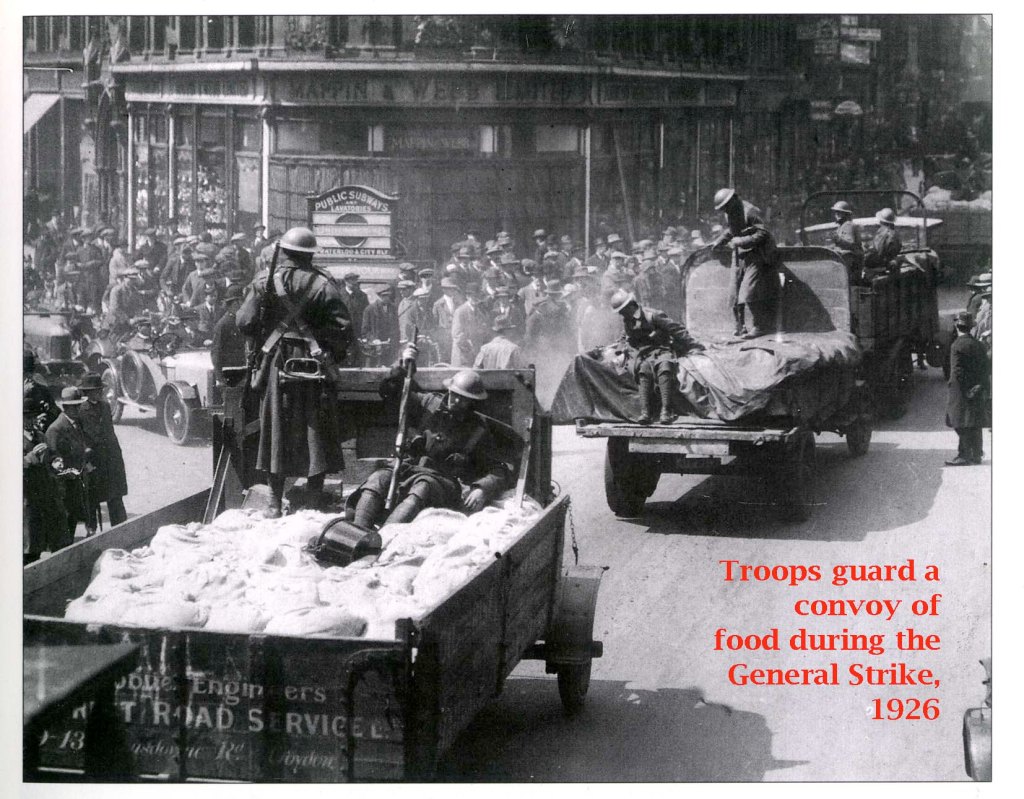
But in fact, there was a low level of violence compared to other mass strikes (eg the Liverpool general strike of 1911). The Army was called in very little, and used mainly for dramatic effect by the government. The Workers Defence Corps did more to prevent workers violence than to stop pickets getting nicked or bashed.
Unionised workers and non-unionised workers in the Strike.
Large numbers of non-union workers, dismissed by many TUC and union bigwigs before Strike, came out on strike, got involved in the autonomous actions, picketing etc, and many joined unions during the nine days. This on one hand elated some Trades Councils, but it scared the GC. There was a certain snobbery about workers not already unionised, and a dismissal of those involved in streetfighting: the GC line, followed by many trades councils, was all trouble was caused by non-trade unionists – though this is unproveable in many cases, it’s certainly untrue in others, in that union members were arrested for involvement in fighting. It’s also true to say that denials of union involvement in any trouble was sometimes a smokescreen – officially disapproving, but in practice tacitly backing – to deter police action against strike committees.
The Genteel Strikebreakers
To some extent a counter-myth has grown up, of the middle classes and posh students actively enlisted to scab, to defeat the Strike and defend the status quo. In daily reality this wound more people up than the idea of the suffering of the miners – there was open class hatred for posh scabs, and to a lesser extent for anyone trying to break the strike, eg by trying to drive to work.
But most volunteers were useless – a small minority could do anything, most being idle and untrained for anything practical. Their impact has probably been over-hyped, partly by the government, partly by the strata of the upper and middle classes involved. They were only successful in certain areas, not at all in parts of north, and despite huge numbers on paper, had a limited impact even in London, and caused a number of accidents and disasters when put to work on trains, buses and trams.
Could it have turned out differently?
What if the Strike had lasted longer? Could it have done? Was it getting more solid or weaker? The government, often through local authorities, had managed to keep control of food supplies, and demonstrated its ability to keep supplies going, eg in London, through the docks; did this show there was no chance of success?
There was a line put about by the TUC General Council that the strike was weakening or even crumbling towards the end – but the evidence of this is disputed, since government and press sources played this tune, but local union sources generally claimed the opposite was true.
Were the General Council covering the fact that they were afraid of rank and file autonomy? Or did they realistically feel state power was just too organised and could not be defeated by this approach?
As the strike went on, with autonomous actions increasing: would all out class war have resulted if it had gone on?
Although thousands of workers came out when they were not ‘authorised’ to, although some Councils of Action and Strike Bulletins broke the TUC rules, although many workers stayed out longer after the Strike was called off, the fact is that in the end, most workers didn’t break out of the union structures, the structures that ensured their defeat. In reality, given the General Council’s back-pedalling and then betrayal, and the tight control of local union branches, open escalation of the Strike controlled from below was the only way it could have gone forward. Some workers were said to have thought the real fight would start now, with the TUC out of the way; if so not enough, or they didn’t or weren’t able to act on it. But conditions were in fact loaded against them.
British Syndicalist Tom Brown later suggested that a major tactical advantage could have been gained by the striking workers occupying their workplaces, rather than abandoning them to the OMS and posh scabs. Possibly this is true, but the stay-in-strike he championed was never suggested at the time; the idea was developed only later – admittedly often successfully…
The TUC kept emphasizing the industrial nature of dispute… that the Strike was not aimed at overthrowing the government… but in reality the only direction to go in WAS towards challenging the state, in an all out attempt to (at the very least) impose working class interests on the ruling class. Even the Government saw this more clearly than the TUC leaders. A mass strike NOT prepared to do this was bound to fail, in the face of the government’s preparations and determination not to bend.
The role of the Communist Party
The Communist Party of Great Britain was involved in the Strike, and in the day to day running of some Councils of Action. But the party was weak, small; it had been weakened by the arrests and jailings of many members in the previous year. The CP spent most of time before and during calling on the TUC to lead. We can see how well that worked! The CPGB’s idealogy was tightly controlled from Moscow, and its line on the General Strike was “All power to the General Council” – in the circumstances, a sick joke. Centralising power in the hands of the GC was precisely the opposite of ‘All power to the Workers”. The CP made no attempt to challenge the GC’s control, there were no attacks on passive picketing, no discussion of Councils of Action obeying the GC, or of who was running them, and no criticism of the daft ‘two-waves of strikers’ policy. The few CP-controlled Trades Councils and Strike Committees did sometimes push weakly for escalation but barely, and in little more than words.
Although its always fun crying “traitor” at the TUC leaders, many who bitterly attacked them, remained fixated on the same union structures, the idea of capturing the leadership of the unions for the left etc. This is as valid a critique today, as then, many of the left groupings still spend vast amounts of time manoevering within Broad Lefts etc in the unions… “Union leadership would be ok if it was the right kind of leadership” – ie us. But the Left union leaders in 1926 were as useless as the right were treacherous, left leaders were among ones claiming a victory afterwards, in blatant defiance of the facts… and left controlled unions still attempt to control and hamper the autonomous activity of people struggling on the ground. The Communist Party later became critical of left Union leaders, though they had helped them to power! The daily practice of much of today’s union structures is one way that class anger and resistance is controlled, diverted, channeled – this is not to attack all union members or even branch reps, convenors etc; it’s a structural problem that draws militant activists in and gradually neuters them in the guise of enabling them to achieve their political aims.
It has been suggested that the Strike Committees or Councils of Action could have provided an alternative structure take over the state, or institute dual power or whatever. Some trotskyist critics of the GC have expressed the view that Councils of Action should have taken more power locally, over-ruled local union branches and been more centralised bodies directing strike activity. Without a willingness for these Councils to go beyond central TUC boundaries, this is pie in the sky. A Communist International report later suggested the Councils were embryonic soviets or workers’ councils… while in a few areas a glimpse of this might have been possible, for much of the country, this claim is simply not born out by reality.
After the Deluge
While government preparation, and national and local union structures may have all contributed to the defeat of the Strike, the result was a disaster for the trade union movement. It led to a vengeful employers offensive, wages being driven down, blacklisting of many militants.; the government brought in savage anti-union laws. Workers also left unions in droves, partly with the legacy of betrayal and bitterness, but also because hamstrung unions couldn’t do much for them. After the strike there was a tendency for bosses and unions to avoid confrontation and for employers to maintain wage rates. Industrial collaboration improved considerably in the years after 1926. Sir Alfred Mond – head of ICI – organised a joint committee of union leaders and employers, for “improving efficiency of British industry and for reducing unemployment”. TUC policies were steered towards negotiation and co-operation with bosses.
Was the General Strike a disaster which should have been avoided?
Although it became pretty clear that this had been a heavy defeat, it is true that many union organisers and militants didn’t immediately see the Strike this way. Or more accurately, thought that while things had not gone well, there were lessons to be learned – “for next time”. Many trade unionists were expecting a “next time” and relatively soon. (See the responses from Trades Councils to a Labour Research Dept questionnaire in “The General Strike 1926: Trades Councils in Action”, Emile Burns…)
But there wasn’t a “next time”.
As with the 1984-85 miners strike, the government in 1926 saw in advance that a clash of some kind with the union movement (most likely over the mining subsidy) was inevitable, and could in fact be necessary, and desirable, as a way to clobber the organised working class. On this basis, they laid their plans carefully, and made sure that if and when the clash came they would win.
The government climbdown of 1925, allowing the Coal subsidy to continue, for another few months, was merely a ruse to buy time to marshall its forces… (much as Thatcher backed down from confronting the NUM in the early ‘80s, waiting till the time was right…) The stocks of coal it was thus able to build up, left it in a stronger position. The Government also pre-planned scab labour and food distribution, after previous scares with strikes. Forming the Organisation for the Maintenance of Supplies in advance of the Strike, it recruited strikebreakers ahead of time, and worked out ways of breaking union control over transport particularly.
The GC and the unions, in contrast, were not ready, although with some clear thinking this could have easily have been different. Unlike the state, the TUC leadership wanted to avoid the strike, and did little to ready themselves, in the hope it wouldn’t happen. While workers on the ground and some local officials pressed for a strike to support the miners, they neither realised that the government was better prepared, nor were able to overcome the contradictions within the labour movement.
Many on the left obsess on the myth of May 1926 as some kind of potential revolutionary situation, thwarted by union leaders holding back class struggle. But in reality it wasn’t: few at the TIME saw it as more than an (admittedly huge) industrial dispute, limited to support for the miners. It’s possible that it was doomed to failure, given the conditions prevalent at the time. For a general strike to have contained ‘revolutionary potential’ depended on the willingness, confidence and numbers of working class people prepared to go beyond the trade union structures, ideology and tactics, when it became necessary. Whatever bitterness and anger at the selling out of the miners may have existed (and it was widespread), there was no critical mass of people able to translate it into maintaining or extending the Strike.
Postscript:
It’s not our intention here to go into detailed theoretical proposals for how a possible future General Strike might pan out differently. But one classic communist text we have read we did find useful, and in some ways relevant to the events of 1926.
Rosa Luxemburg, in her book, The Mass Strike (1905), made some critiques of how anarchists, syndicalists, and trade unionists all saw the General Strike. She suggested that the idea of the anarchists and syndicalists of a political general strike pre-arranged with a political aim to overthrow capitalism was unlikely to succeed, but posited instead (based on an analysis of the 1905 Russian Revolution) that a mass strike, evolving more organically out of people’s immediate economic struggles in daily life, meshing together, constituted a new phase in the class struggle, not an abstract and artificial moment plucked from the air, but a historical development, emerging from below, not being imposed or ordained by any higher authority, or even she suggests by an external political radical structure like a socialist party.
Part of Luxemburg’s intent in writing The Mass Strike, it is true, was to discredit the existing theories of the General Strike as put forward mainly by anarchists and syndicalists, trends of radical thinking that she and other marxists were struggling to liquidate from the working class movement, as they saw it. But she was also engaged in a parallel battle against those within the Marxist camp who were attempting to steer it towards a reformist position, away from the idea of a revolutionary transformation of capitalism; as well as being critical of trade unionists mainly concerned with purely day to day economic gains at the exepense of the bigger picture.
Theorists of the General Strike thus far had almost exclusively conceived of it as a road to revolution. I’m not sure if William Benbow was the first to think up the idea of a general strike, but in his classic pamphlet of 1832, The Grand National Holiday of the Productive Classes, he proposed that the producers of the wealth, being exploited by an idle and rich minority, should cease to work en masse, for a month, and elect a congress to begin the process of re-ordering society in their own interests. Benbow was a radical pamphleteer and bookseller, an activist of the National Union of the Working Classes; he later became a leading physical force Chartist, and spread his idea of the ‘Grand National Holiday’. The Chartists took the idea, and renamed it the Sacred Month, and plans to introduce it and overthrow capitalism were well under way in 1839, but support was limited and Chartist strikers were repressed by the government.
Sixty years later the French syndicalists, organized in the CGT union confederation, developed theories in which the General Strike was central. They saw it as the supreme weapon for the workers to overthrow capitalism and take control of society in their own interests. One of the CGT’s founders and leading theorists, Fernand Pelloutier, wrote about the General Strike. Two examples showing how he and other revolutionary syndicalists saw this future strike:
“ … Every one of them (the strikers) will remain in their neighbourhoods and will take possession, first, of the small workshops and the bakeries, then of the bigger workshops, and finally, but only after the victory, of the large industrial plants….”
“ … Because the general strike is a revolution which is everywhere and nowhere, because it takes possession of the instruments of production in each neighbourhood, in each street, in each building, so to speak, there can be no establishment of an “Insurrectionary Government” or a “dictatorship of the proletariat”; no focal point of the whole uprising or a center of resistance; instead, the free association of each group of bakers, in each bakery, of each group of locksmiths, in each locksmith’s shop: in a word, free production….”
The syndicalist line on the General Strike was very much to the fore when The Mass Strike was written. It attempts to dismiss the prevailing ideas of the potential of such a struggle : “It is just as impossible to ‘propagate’ the mass strike as an abstract means of struggle as it is to propagate the ‘revolution.’ ‘Revolution’ like ‘mass strike’ signifies nothing but an external form of the class struggle, which can have sense and meaning only in connection with definite political situations.”
You can’t create either by going round calling for it, in other words; it will emerge as and when needed and according to the conditions of the moment. It is not ONE predictable fixed open and close struggle, but an inter-connected web of movements events, themselves caused by local or specific economic conditions, though led and expressed by people with a political idea of the movement, at least as Luxemburg saw it.
Another nice quote: “It flows now like a broad billow over the whole kingdom, and now divides into a gigantic network of narrow streams; now it bubbles forth from under the ground like a fresh spring and now is completely lost under the earth. Political and economic strikes, mass strikes and partial strikes, demonstrative strikes and fighting strikes, general strikes of individual branches of industry and general strikes in individual towns, peaceful wage struggles and street massacres, barricade fighting – all these run through one another, run side by side, cross one another, flow in and over one another – it is a ceaselessly moving, changing sea of phenomena.”
Rosa saw it as not a method but THE form itself of workers struggle… A rallying idea of a period of class war lasting years or decades… It cannot be called at will by any organization even The Party! She goes further and almost says that it cannot be directed from above or outside, though she does say elsewhere that the socialists have to provide political leadership.
She does contrast the mass fighting strikes with one off ‘demonstration’ strikes – what the TUC or Unison calls today, in other words.
Related to this, she says the successful mass strike arising in the way described above would not/must not be limited to the organized workers: “If the mass strike, or rather, mass strikes, and the mass struggle are to be successful they must become a real people’s movement, that is, the widest sections of the proletariat must be drawn into the fight.” The union structures must recognise the common interest of unionised and non-unionised workers, in other words (to their surprise many strike committees learnt this lesson in practice in 1926, as unorganised workers flocked to the struggle in thousands).
She suggests minority movements are pipe dreams; “a strategy of class struggle … which is based upon the idea of the finely stage-managed march out of the small, well-trained part of the proletariat is foredoomed to be a miserable fiasco.” Even though the Socialists are the leadership of the working class, she suggests, they can’t force things through on their own… (past tense would question that the working class needs an external leadership, here we do differ from auntie Rosa).
Later on she talks about trade unions getting to the point where preservation of the organization, its structure etc, becomes end in itself, or at least more important than taking risks, entering into all out struggles, or even any at all! Also how daily struggles over small issues often lead people to lose sight of wider class antagonism or larger connections… Interestingly she points out that trade union bureaucracies become obsessed with the positive, membership numbers etc, and limited to their own union’s gains, ignoring negative developments, hostile to critics who point out the limitations to their activities. And how the development of professional bureaucracies increase the chance of divorce of officials etc from daily struggles… Nothing sharp-eyed folk have not also pointed out over the last hundred years, but she was among the first to diagnose it. (She also says the same ossification processes are dangers the Revolutionary Party needs to beware of… showing foresights to the developments of the communist parties and other left splinters over the following decades).
Rosa Luxemburg’s ideas are interesting.. Without going into it too deeply, her assertion that a successful general strike would have to arise organically, meshing together from below rather than being ‘called’ by any committee or confederation, looks more realistic… though Rosa would probably have dissed Fernand Pelloutier, her vision also suggests a revolution that is ‘everywhere and nowhere’, part of a tangled period of change and dual power… a future that remains open and in our hands…
The text of the Mass Strike can be found online here
Tomorrow, we will mostly be posting – an incomplete roundup of class struggle in London during the General Strike…


Leave a comment