
The Public Order Act into law just a week ago on May 2nd has already aroused some controversy, with the first arrests under its provisions – of members of the anti-monarchist campaigning group Republic while preparing to demonstrate in protest at the coronation of Charles Windsor, as well as the nicking of three workers for the London Borough of Westminster’s Night Stars team handing out rape alarms on the streets the night before (this last makes more sense of you consider how many Metropolitan Police officers have been accused of rape or sexual assault in the last few years – the cops are just protecting their own…)
The new legislation had been pushed through Parliament in the last couple of months, clearly with the looming royal beano and disruption of it in the minds of MPs. Some attempts by the House of Lords to strike out a clause or two were eventually dropped, so the Act is mostly as repressive as intended.
The Act updates various previous Public Order Acts with new offences and strengthens police powers in notable ways:
• Sections 1 and 2, Locking-on and going equipped to lock-on covers those who attach themselves to others, objects, or buildings in order to cause serious disruption. It now carries a maximum penalty of six months imprisonment, an unlimited fine, or both. The maximum penalty for the offence of going equipped to lock-on will be an unlimited fine
‘Locking on equipment’ has already been interpreted as a piece of string or cord last weekend… the wording may also open up the chance of using it against people linking arms! (No metaphors here… move along…)
• Section 6, Obstructing major transport works: covers acts that obstruct or interfere with the construction or maintenance of major transport projects. The maximum penalty for this offence is six months imprisonment, an unlimited fine, or both.
• Section 7, Interference with Key National Infrastructure (as defined in s8): covers acts which prevent or significantly delay the operation of key infrastructure, including airports, railways, printing presses and oil and gas infrastructure. This offence carries a maximum penalty of 12 months imprisonment, an unlimited fine, or both
These clauses are aimed at any blockades, notably at XR, but will also handily prevent strikers picketing in lots of possible workplaces, useful at a point where the current wave of pay and conditions disputes is at a crossroads..
Printing presses here largely means those printing national newspapers – a result of Extinction Rebellion blockades of climate denying rightwing newspapers. All the doubts about the Act on the side, labelling swivel-eyed comics like the Sun, Times, Sunday Times, Daily Telegraph, the Daily Mail, and the London Evening Standard as ‘vital national infrastructure’ is hilarious. All are as vital as a swift bottle of arsenic up the jacksy.
• Sections 10 and 11 of the new Act extend stop and search powers for the police to search for and seize objects (such as locking-on devices) that may be used in the commission of a protest-related offence. It permits a police officer of or above the rank of inspector to authorise stop and search without the need for suspicion, amending Section 1 of the Police and Criminal Evidence Act 1984. This power is exercisable anywhere within a specific locality within the officer’s police area, and for no longer than 24 hours.
A search “without the need for suspicion”?!? seems to make no sense at all, unless meant to be a catch all justifying searches after the fact, so that no challenge can be made to a search where nothing was actually FOUND – or just allowing searches as a harassing tactic.
• Sections 20–29 allow the courts to place requirements that they consider to be necessary in order to prevent someone from causing serious disruption. It must be necessary to impose for a specified purpose – this includes preventing the individual from committing another protest-related offence.
An SDPO on conviction may only be imposed when an individual, aged 18 or over, convicted of a protest-related offence, has on a previous occasion within the relevant time period:
- Committed another protest-related offence for which the individual was convicted, or
- Committed a protest-related breach of an injunction for which the individual was found in contempt of court
The protest-related offence for which the individual was convicted, and the previous offence or breach must relate to different protests or have taken place on different days.
Additionally, a court may only impose an SDPO on application by police where the court is satisfied, on the balance of probabilities, that an individual over the age of 18 on at least two occasions in the relevant period has:
- Been convicted of a protest-related offence, or
- Committed a protest-related breach of an injunction for which the individual was found in contempt of court
The two occasions must relate to different protests or have taken place on different days.
The relevant period for consideration of convictions or behaviour will be five years prior to the day an SDPO is imposed. However, a court will only be able to look back to when the individual was aged 16 or over.
Prohibitions or requirements imposed on a person given an SDPO may include prohibiting an individual from being in a particular place, being with particular people, having particular articles in their possession, and using the internet to facilitate or encourage people to commit a protest-related offence.
Breach of an SDPO without reasonable excuse is a criminal offence carrying a maximum penalty of six months imprisonment, an unlimited fine, or both.
All of this is an extension of the trend over recent years towards injunctions, restrictive bail conditions, etc, with the aim of preventing people from attending or taking part in protest at all at the whim of police and the authorities. Handy.
• Section 16 extends the powers to manage public assemblies in part II of the Public Order Act 1986 to the British Transport Police and Ministry of Defence Police. This includes the power to place conditions on public assemblies and single person protests in certain circumstances.
• Section 18 enables a Secretary of State to bring civil proceedings where protest action is causing, or is likely to cause, serious disruption to key national infrastructure or access to essential goods or services in England and Wales, or where protest activities have, or are likely to have a serious adverse effect on public safety. Where the court grants an injunction in the context of those proceedings, the measure enables the court to attach a power of arrest.
———————————
The arrests of the Republic group have been melodramatised on both sides of the argument. On the one hand the tory government have been pushing the line that protest, especially street occupations and blockades, is seriously jeopardising ‘public life’ – by which they mean, occasionally and very mildly inconveniencing the economy. The wild arm swinging that protestors were going to cause a stampede of horses on the mall, possibly by pressing a few rape alarms, was never more than a blatant lie to allow repression at the moment of need. Police and the state are happy to prevent public dissent, then drop charges and pay out compensation, as the money lost is worth the silencing. Especially with future strikes in mind, that might cause more than mild disruption… Creeping authoritarianism is easy to bring in and harder to reverse, as they know, and they have the numbers and bodies on the street to enforce it, over the top as it may be.
On the other hand, as usual, there was a chorus of liberal handwringing that these arrests were unprecedented, anti-democratic and ‘Un-British.’ This is bobbins, as anyone who has been active in protest or struggles for social change over the last few decades, or read any British history at all, can easily relate. (Even the very specific pre-emptive nicking of anti-royalty protestors has a direct precedent from 2002.)
Far from being un-British, police repression backed by carefully worded law is historically as truly British as, well, looting the wealth and jewels of the world to decorate a parasitical monarch then parading the useless individual through the streets in a golden Disney wheelbarrow worth more than the combined GDP of much of Africa.
The 2023 Public Order Act is only the latest in a long line – the Crowning Glory as it were – of repressive legislation aimed at restricting protest and limiting the effectiveness of political campaigning.
There is a long history of government action trying to control and shut down demonstrations and direct action. There is an equally long history of resistance…
Here is a short summary of some of the most prominent public order laws and tendencies in policing and repression. It is not comprehensive… Many innovations on other areas of policing and the law are not covered here, nor are the parallel developments in undercover policing and spying on activists and campaigners.
The Tumultuous Petitioning Act
The Tumultuous Petitioning Act 1661, aka “An Act against Tumults and Disorders upon pretence of preparing or presenting publick Peticions or other Addresses to His Majesty or the Parliament” was passed in 1661, a few months after the English monarchy was restored to the throne after King Charles I’s defeat and execution in the English Revolution.
The Act laid into law that ‘no petition or address shall be presented to the king or either house of Parliament by more than ten persons; nor shall any one procure above twenty persons to consent or set their hands to any petition for alteration of matters established by law in church or state, unless with the previous order of three justices of the county, or the major part of the grand jury.’
The 1661 Act was partly a response to the many petitions, often brought outside the House of Commons by large rowdy demonstrations, towards the climax of the English Civil War and which led to the execution of Charles I.
But the Act was also partly a response to fact that Parliament had been recently inundated by petitions relating to disputes over land confiscated under Cromwell’s Commonwealth from 1649 and then restored from 1660. Numerous legal disputes had arisen over these forfeitures and restorations.
The Act required any petition to Parliament to be agreed by Justices of the Peace before it could be presented.
One major point of the Tumultuous Petitions Act was to both practically AND symbolically repress the sense that the civil war years had engendered, that all parts of society had a right to participate in civic and political life. Or at least, if they were to be allowed to participate, to regulate their approaches to formal, respectful and pleading, not demanding, in numbers, assertive of their “rights”.
Nearly three decades later, after another overthrow of a monarch, the 1689 Bill of Rights declared that: “It is the right of the subjects to petition the king, and all commitments and prosecutions for such petitioning are illegal.” The Bill of Rights was widely assumed to have nullified the 1661 Tumultuous Petitions Act and enshrined the right to petition Parliament as well, although at the trial of Lord George Gordon in 1780 Lord Mansfield ruled that it had in fact not done so. Understandably, given the fallout from the Gordon Riots.
Although the Tumultuous Petitions Act was generally thought to be dormant by the 20th Century, its use was threatened against suffragettes demonstrating over the right of women to vote, in 1908.
In 1908, a Mr Muskett was successfully prosecuting a group of suffragettes in the Westminster Police Court. The group were sentenced to two months in prison and a £5 fine, a common punishment that was levied many times against the suffragettes. Mr Muskett warned the group that if they offended again, he would seek to use the long dormant Tumultuous Petitioning Act 1661 against them.
Emmeline Pankhurst wished to test Mr Muskett’s assertion and the day after the successful prosecution above, she brought a group of 13 suffragettes to Parliament to petition. A prosecution under the 1661 Act would require a full trial before a jury (something the suffragettes desperately wanted as many members of the public were sympathetic to the cause of women’s suffrage), rather than a closed trial at the Police Court. Mrs Pankhurst was however arrested on her approach to Parliament; she was tried in the Police Court, so no reference was ever made to the 1661 Act.
In fact the 1661 Act was only repealed with the introduction of comprehensive public order legislation by the passing of the Public Order Act 1986 (Of which more below).
The Riot Act
The Riot Act of 1714 authorised local authorities to declare any group of 12 or more people to be unlawfully assembled and to disperse or face punitive action. The act’s long title was “An Act for preventing tumults and riotous assemblies, and for the more speedy and effectual punishing the rioters”, and it came into force on 1 August 1715.
The introduction of the Riot Act was sparked by a period of civil disturbances including the Sacheverell riots of 1710, the Coronation riots of 1714 and the 1715 riots in England. The preamble makes reference to “many rebellious riots and tumults [that] have been [taking place of late] in diverse parts of this kingdom”, adding that those involved “presum[e] so to do, for that the punishments provided by the laws now in being are not adequate to such heinous offences”.
The act was specifically aimed at implementation by local officials, who could make a proclamation ordering the dispersal of any group of more than twelve people who were “unlawfully, riotously, and tumultuously assembled together”. If the group failed to disperse within one hour, then anyone remaining gathered was guilty of a felony without benefit of clergy, punishable by death.
The proclamation could be made in an incorporated town or city by the mayor, bailiff or “other head officer”, or a justice of the peace. Elsewhere it could be made by a justice of the peace or the sheriff, undersheriff or parish constable.
The wording that had to be read out to the assembled gathering was as follows:
Our sovereign lord the King chargeth and commandeth all persons, being assembled, immediately to disperse themselves, and peaceably to depart to their habitations, or to their lawful business, upon the pains contained in the act made in the first year of King George, for preventing tumults and riotous assemblies. God save the King.
The Riot Act was read and thus implemented at some of the most turbulent moments of insurgence and radical agitation: in the St. George’s Fields Massacre of 1768, during the Gordon Riots of 1780, at the Peterloo Massacre of 1819 (though this is disputed) and the Cinderloo Uprising of 1821 as well as before the Bristol Reform Bill Riots at Queen’s Square in 1831.
But for the authorities the Act in practice proved impractical and unwieldy. The ‘failure to disperse within one hour’ deadline caused confusion. Rioters often believed that the military could not use force until one hour had passed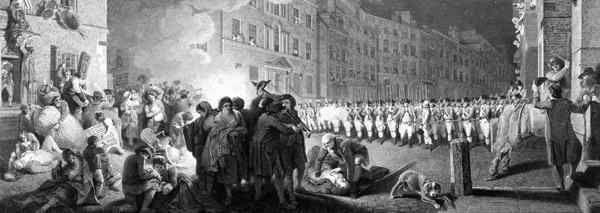 since the reading of the proclamation. Hence demonstrators at the Massacre of St George’s Fields kept on provoking the soldiers present, thinking they couldn’t shoot yet. The Act also had to be read out to the gathering concerned, in theory be heard (above crowd noise etc, though people’s ability to hear was generally ignored) and had to follow the precise wording detailed in the act; several convictions were overturned because parts of the proclamation had been omitted, in particular, leaving out “God save the King”.
Using the Riot Act didn’t save many of the wealthy and powerful being targeted in the 1780 Gordon Riots, and it too several days before troops could effectively re-take the streets from “His majesty, King Mob’.
Original Red Scare
If the Gordon Riots of 1780 put the fear of the Mob into London’s rich, this was nothing to the scare that was to follow in the following decade. The French Revolution of 1789, and the overthrowing of the monarchy and guillotining of several hundred royals and aristos had the British ruling class shitting itself that something similar could erupt here. They saw the evolving movements campaigning for reform of the political system in Britain as a potential revolutionary movement in embryo, and introduced new laws to repress it, mainly aimed at publications and meetings.
Thomas Paine’s classic book ‘The Rights of Man, and the massive interest in it from the artisan and working classes, led to the book’s banning, and Paine having to flee the country to avoid prison or a death sentence. Spies paid by the Home Secretary’s Office were infiltrated into radical groups, particularly into the fertile and expanding London Corresponding Society, and every method was used to disrupt them: landlords of pubs where they met were threatened with loss of their licences; agent provocateurs tried to take control of their activities.
But popular opposition to the war against France led to riots against military recruitment, and a panicked government arrested LCS leaders, who had spoken out against the War, and radicals who had met in Scotland to set up a British Convention (revolutionary alternative government..), The Scots radicals were transported, but the LCS treason trials backfired, resulting in high profile acquittals.
This only led to further government repression… The law of Habeus Corpus, which guaranteed the right of a prisoner to a trial, was suspended in 1793. This ‘relaxation’ of the law would allow for numerous pro-reform activists, publishers issuing radical texts, and others influenced by the French Revolution, to be imprisoned, including members of the LCS. Several were to remain in detention for a number of years until the lack of a trial was challenged.
The Act against Unlawful Combinations and Confederacies was passed in 1799, aimed at restricting the activities of radical secret societies. Membership of the LCS, United Irishmen, United Englishmen, United Britons and United Scots were all banned by the Act. To prevent similar societies springing up, it was made illegal for any society to require its members to take an oath. Societies were also required to keep lists of members available for inspection. A magistrate’s licence was required for any premises on which public lectures were held or any fee-charging public reading room (many of the LCS chapters and other radical groups met in pubs and coffee houses). Printers were closely regulated, because one of the main problems in the Government’s view was that seditious pamphlets were widely circulated and untraceable. Anyone possessing printing equipment was required to register, while all printed items were required to carry the name and address of the printer on the title-page and/or the final page and printers were required to declare all items they had printed to magistrates and retain copies for inspection.
During the passage of the Bill exemptions were introduced to avoid this broadly-drafted law affecting the publishing of newspapers that Parliament itself had ordered to be printed, or causing hassle for weirdo clubs like the Freemasons, who required members to swear oaths upon joining. In the end any Masonic lodge existing at the time of passage of the Act was exempted, so long as they maintained a list of members and supplied it to the magistrates.
The Act was not particularly effective, as radical political organisations continued in more secret or less formal ways.

Crowds meeting for political purposes were also dispersed. LCS tactics notably included the ‘monster meeting’ – huge rallies on open spaces on the edge of the city. The later meetings were ordered to be dispersed by the Home Secretary, using forces of Volunteers, run by local worthies and concerned middle class citizens, set up ostensibly to resist invasion by France, though only ever used against home grown radicals. These militias were often farcical (the only fatalities they ever experienced was from friendly fire), but they expressed the organised class hatred that would later be institutionalised in the police.
Pointedly relevant to the 2023 Coronation farcical nickings, part of the immediate spark to some of the late 1790s legislation was attacks on the monarchy: crowds inspired by London Corresponding Society mass meetings had attacked mad king George III on his way to Parliament in 1795.
This attack led to Parliament passing Pitt’s Treasonable Practices and Seditious Meetings Act, better known as the Treason Act, which made it “high treason” to “within the realm or without, compass, imagine, invent, devise or intend death or destruction, or any bodily harm tending to death or destruction, maim or wounding, imprisonment or restraint, of the person of … the King”. This was derived from the Sedition Act 1661, which had expired. The 1795 act was originally a temporary act which was to expire when George III died, but it was made permanent by the Treason Act 1817
The radicals responded by organising a series of public meetings against such an assault on the Bill of Rights, and there was another mass attack in St. James’s Park-this one on 17 December, against Pitt himself.
(Laws also can’t prevent divinely inspired individuals seeing through the veil – James Hadfield nearly ushered in the Millennium, shooting at George III a couple of years later…)
Throughout the Napoleonic Wars agitation around working conditions continued; despite two Combination Acts, passed in 1799 and 1800 prohibiting trade unions and collective bargaining by British workers. The Pitt government of the time feared Jacobin influences could cause large scale strikes; the juggernaut of industrial change was imposing more and more unbearable conditions in factories, and imposition of work discipline and loss of rights to organise were needed to drive more productivity. Although repealed in 1824, restrictions on union organising remained heavy after that.
The Six Acts
After the French Revolutionary/Napoleonic Wars ended, mass pressure for political reform revived; large demonstrations calling for changes to the franchise began to be organised around the country. After a demo at Spa Fields erupted into rioting in 1816, and poverty and starvation led to the march of the blanketeers and the Pentrich Uprising, legislation aimed at political movements and ideas was again introduced.
These took the form of the Six Acts:
- The Training Prevention Act, now known as the Unlawful Drilling Act 1819 made any person attending a meeting for the purpose of receiving training or drill in weapons liable to arrest and transportation. Military training of any sort was to be conducted only by municipal bodies and above. [This was because radicals were actually practising with pikes in preparation for an uprising…]
- The Seizure of Arms Act gave local magistrates the powers, within the disturbed counties, to search any private property for weapons and seize them and arrest the owners.
- The Misdemeanours Act attempted to increase the speed of the administration of justice by reducing the opportunities for bail and allowing for speedier court processing.
- The Seditious Meetings Act required the permission of a sheriff or magistrate in order to convene any public meeting of more than 50 people if the subject of that meeting was concerned with “church or state” matters. Additional people could not attend such meetings unless they were inhabitants of the parish.
- The Blasphemous and Seditious Libels Act (or Criminal Libel Act) toughened the existing laws to provide for more punitive sentences for the authors of such writings. The maximum sentence was increased to fourteen years’ transportation.
- The Newspaper and Stamp Duties Act and increased taxes to cover those publications which had escaped duty by publishing opinion and not news. Publishers were also required to post a bond for their behaviour.
The Habeus Corpus law was also suspended again in 1817.
The pinnacle of repression at this point was reached in August 1819, with the charging of a crowd meeting to hear speeches on political reform at St Peter’s Field in Manchester, which was attacked by a mounted force of Yeomanry, ordered by the Cheshire magistrates to arrest radical orator Henry Hunt. Up to 18 people were killed and several hundred injured.
No legal justification had been found to ban the Peterloo meeting beforehand, despite the rising climate of radical agitation, and an air of imminent trouble obvious to all. If the Riot Act was read (as the Cheshire magistrates later claimed) to the crowd, it was possibly afterward and in nobody’s hearing; no warning was given before the charge.
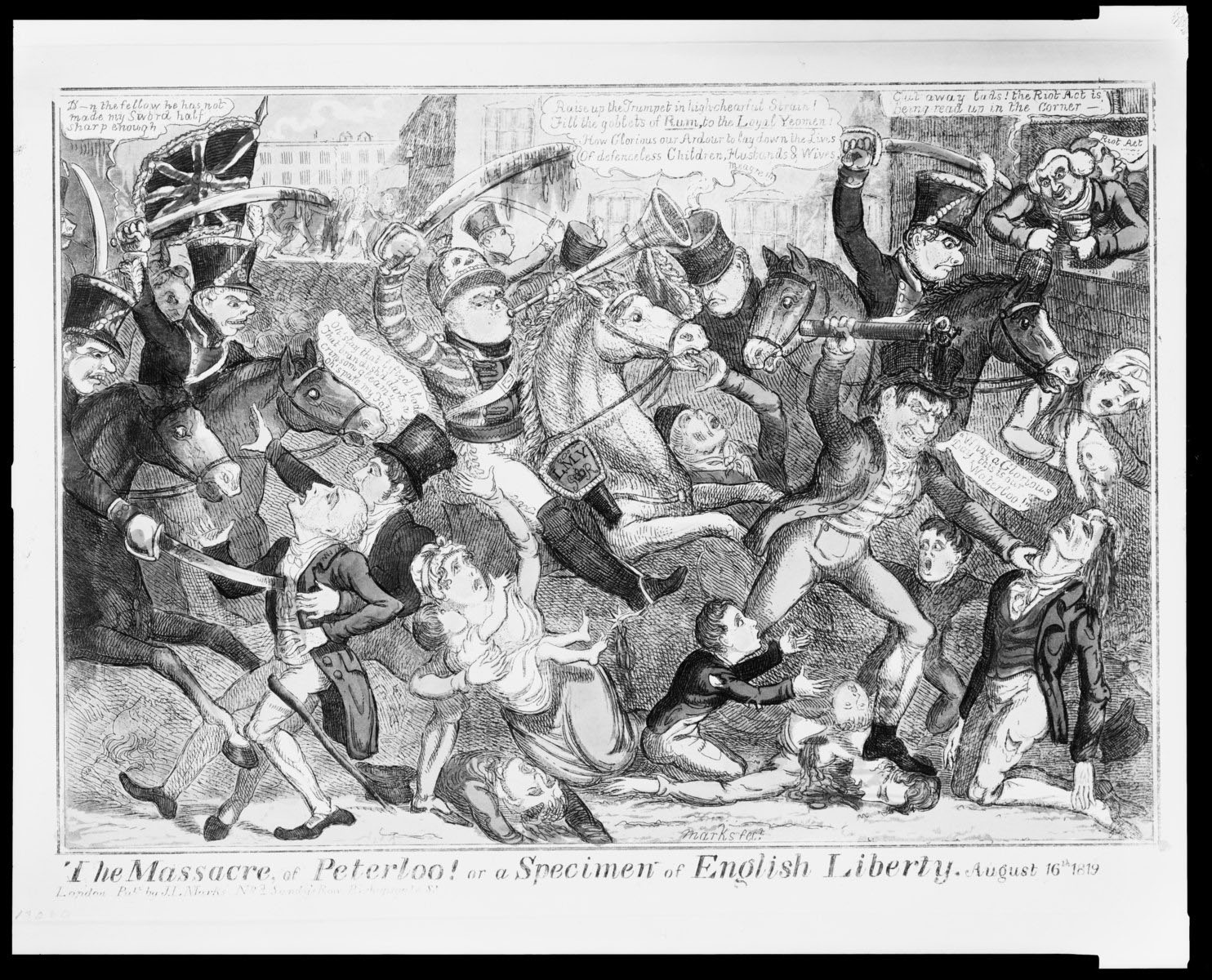
Nevertheless the government and local authorities backed the Massacre to the hilt, and followed it up by ratcheting up repression, and arresting and sentencing almost every leading radical figure to imprisonment. The enraged atmosphere among working people following the Manchester events almost backfired on them, however; uprisings and plots for revolution in London, Yorkshire and Scotland were foiled. Peterloo was possibly the defining moment of the 19th century – thinking it was smashing a radical meeting, the reactionary establishment in fact ensured that the movement for political reform had martyrs, a central uniting moment to refer to; a moment of legend that still arouses passion.
Like the 1661 Tumultuous Petitions Act, the 1817 Seditious Meetings Act was also only repealed with the passing of the 1986 Public Order Act.
Move Away From the Street
Use of troops, yeomanry, militia or the newly-founded Metropolitan Police in 1829, the authorities continued throughout the 19th century to consider street protest and organised political action as a direct threat to its existence.
Many tactics were employed, generally under existing laws (though readings of the Riot Act did become fewer):
- Kettling – as at the Battle of Coldbath Fields;
- Barricading the centre of London against marchers: see the Chartist march of April 10th 1848;
- General mayhem and repeats of Peterloo – Bloody Sunday
Police also used the law to attack political meetings on streets and in open spaces.
Attempts to prevent demonstrators from entering Hyde Park led to riots in 1855.

The development of Speaker’s Corner, at the edge of Hyde Park, arose as it became the focus of a battle over the right to speak publicly here. In October 1855 a carpenter addressed a meeting at modern speakers corner, not being arrested (because he had not asked police in advance) .. he did the same next Sunday… and over next the few weeks was joined by militant and radical speakers and cops intervened to quell “riotous behaviour’ (people getting together). Police supervision prevented any more meetings till 1859, when a large crowd gathered to demonstrate support for the French emperor Napoleon III’s invasion of Italy… This led to the Garibaldi riots… After the reformers tree in Hyde Park became the centre of a 1866 meeting for political reform, (its branches were torn off and it was set on fire, reducing it to a charred stump) it became a symbol of the right to meet and speak freely.
After much struggle, a space for political meetings was allowed but 150 yards away on the corner of the park, at Speaker’s Corner.
But many areas also evolved their own traditional Speakers Corners. Often in the centre of town or suburb, on an open space or at a monument, landmark or junction. Radicals, socialists and reformers would have to take turns with other, often christian evangelists, or fight to take the pitch first. In the late 19th century, the struggle for free speech for political ideas was transported to these local speaking pitches. Police harassment of speakers, especially socialists and anarchists, was a weekly feature of these outdoor meetings. Often police simply used the common law offence of obstruction of the highway to arrest speakers.
Just some examples in London: In Dod Street, Limehouse, in 1885, local Social Democratic Federation supporters used the waste land as a speakers corners. Police repeatedly arrested the speakers. Supported by the other socialists they persevered, suffering a police attack on 20th September 1885, when 8 socialists got nicked. When the case came to court the blatant bias of the magistrate caused a mini-riot in the court. The following Sunday, an alleged 50,000 people flocked to Dod Street: the cops from then on leave the meetings alone.
Bell Street, Marylebone was another centre of a long struggle over free speech with the police. In July 1886 socialists Sam Mainwaring and Jack Williams were arrested for obstruction when addressing a crowd in Bell Street. A year later William Morris was summonsed to court for addressing an open-air meeting at Bell Street sponsored by the Marylebone Branch of the Socialist League. The summons claimed he ‘Wilfully [did] obstruct the free passage of the public footway and Highway at Bell Street, Marylebone, by placing yourself upon a stand for the purpose of delivering an address thereby encouraging a crowd of persons to remain upon and obstruct the said Highway and footway at 12 noon.’ With arrests, fines & jailings, the pitch was closed down in July, but the Marylebone branch of the League started another nearby. Most local speakers corners saw something of this kind – an organised attempt by police to prevent dissemination of radical ideas.
Bloody Sunday 1887 was in some ways the peak of 1880s attempts by police to bash and arrest socialists off the streets… Banning political meetings in Trafalgar Square only incited larger crowds to attend demos there, which the police simply used overwhelming force to disperse, with extreme prejudice.
Local speakers corners remained an arena of dispute into the 1890s, for instance at Wanstead flats, which saw the arrest and imprisonment of local anarchists in 1891-2 and Peckham the following year.

Public Disorder
Police action against suffragettes and post-World War 1 unemployed hunger marchers mostly relied on harassment, direct violence and assault, rather than modifications to the law (legal innovations regarding suffragettes were more notable in allowing them to release hunger striking women from prison when their health was threatened and then re-arrest them when they recovered, under the ‘Cat and Mouse’ Act’).
In the 1930s, the rise of the British Union of Fascists (BUF), their violence against Jews, and the staunch opposition to them from anti-fascists, led to calls for controls on demonstrations.
The Public Order Act 1936 was ostensibly drafted against the BUF, which its clauses against marching in uniform were clearly aimed at, but much of it was also really aimed at preventing physical anti-fascism. The victory of East Londoners in preventing a BUF march at Cable Street in October 1936, despite the attempts of the cops to push through their barricades, was worrying to the government, partly because it was only one of a series of mass mobilisations against fascism in London and beyond.
The Act banned the wearing of political uniforms in any public place or public meeting. It also required police consent for political marches to go ahead (now covered by the Public Order Act 1986). The Act also prohibited organising, training or equipping an “association of persons … for the purpose of enabling them to be employed in usurping the functions of the police or of the armed forces of the Crown”, or “for the use or display of physical force in promoting any political object”.
In terms of the BUF, it may in fact have had the indirect result of actually improving their fortunes. The party’s forced abandonment of paramilitary and armed tactics improved their relations with the police and, by making it
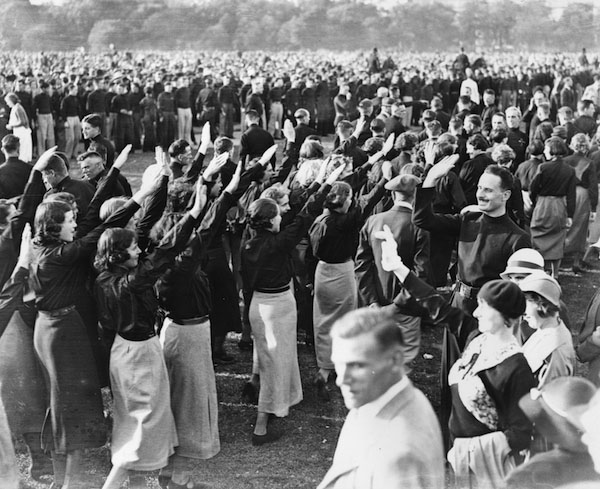
more “respectable”, increased the BUF appeal among traditionally conservative middle-class citizens, who became the party’s main base in the years after the Public Order Act 1936 was passed.
But a powerful reason for the introduction of the Act was the autonomy it gave to police chiefs to act against demonstrations, on their own initiative, bypassing police authorities, who were increasingly becoming controlled by elected Labour politicians, who were less likely to authorise repressive action. Tory central government saw more reliability for control of disorder in giving the police their head. (The 2021 legislation in some senses again grant more autonomy to police discretion to crack down.)
There’s some good background to the Public Order Act in this account of the BUF and opposition to them.
In 1936, the Labour Party welcomed the ban on uniforms and paramilitary organisations, and in the end supported the Public Order bill in parliament, though some MPs disliked the new power of the police to determine the route of marches and processions.
Some Labour MPs even spoke of ‘dictatorial powers’ for chiefs of police. Labour radical Aneurin Bevan vigorously defended the freedom of heckling, which he feared the bill would erode: ‘As there is so little humour left in politics, do not let this right be taken away.’ And while most Labour amendments were rejected, at Labour’s request the government withdrew a provision which would have given the police the authority to regulate or ban the use of flags and provocative slogans in demonstrations. Still, within Labour circles, the Public Order Act remained controversial. Especially as the authorities used the new legislation particularly to regulate and ban left-wing manifestations. The Public Order Act did not end the presence of the BUF on the streets of British cities. Although the movement lost much of its popular appeal in the final years before the outbreak of the Second World War, it was still able to organise public meetings and demonstrations.
Bastard Squad
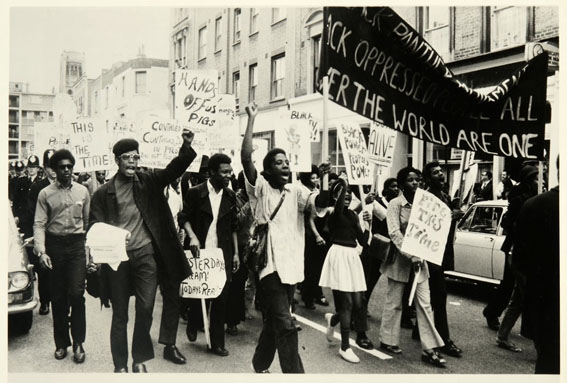
Until the late 1970s, the police approached tackling public order without any specialist training or equipment… But from the mid-1960s, specialist units were created to take on public order situations ,especially demonstrations and strikes – the Special Patrol Group. Set up as a para-military unit of the Metropolitan police to provide a centrally-based mobile squad for combating public disorder and crime. The SPG gained a notorious reputation through the 1970s, being involved in the killing of two young Pakistani men in 1973, (who had been holding toy guns, demonstrating at India House), in the raids on the Mangrove restaurant and Metro club in Notting Hill, in in 1974 when Kevin Gately died during a demonstration against the National Front in Red Lion Square, in mass operations in Lewisham in 1975 over a spate of ‘muggings’, in policing the Grunwick dispute of 1976-8, and the mass mobilisation against the fascists in Lewisham in August 1977.
Southall and the death of Blair Peach in 1979 brought this to a peak. Peach was killed during SPG operation against an anti-fascist demo in April 1979; the resulting outcry led to inspections on SPG lockers, which revealed extra-curricular weaponry and National Front regalia among officers. Quite apart from doing the state’s public order job, police often represent the layer of rightwing, moralistic, usually racist and misogynist upper working class/lower middle class which hates foreigners, lefties, poofs and sees women as fair game. A set of ideas the state is happy to sponsor so long as it doesn’t get too blatant at the wrong times.
Before the introduction of the Public Order Act 1986, policing public order was based on various relevant common law offences, and the Public Order Act 1936. Several factors influenced the introduction of the Public Order Act 1986. Significant public disorder, such as the Southall events in 1979, the innercity riots in Brixton and wider afield in 1981, and the miner’s strike 1984-85 – in particular the Battle of Orgreave in June 1984.
The Public Order Act 1936 was used extensively against the flying pickets during the 1984/5 miners’ strike. Preventing mass picketing and movement of miners around the country to picket other pits was the crucial  battleground – the authorities main aim was to prevent a repeat of the victories strikers had won in the 170s through mass picketing.
The mass disorder during the miner’s strike led to the government concluding that new public order arrangements needed to be made. Instead they oversaw a new regime where specialist uniforms, helmets and riot shields, as well as other equipment, were available to the police and significant training was developed to help officers control public order situations. This new style of paramilitary policing rapidly became the norm, and this modernised style of policing needed a new legal structure to support it. The SPG was upgraded, rebranded as the Territorial Support Group.
Even prior to the Miner’s Strike the Law Commission had recommended that the law on public order be modified, and following the strike the Government introduced a Bill into Parliament that in due course became the Public Order Act 1986. The Law Commission had concluded that public order laws as they currently stood, comprising a mix of common law and statutory offences, was inadequate and ineffective, and that a comprehensive statute was required to bring the law up to date; The Public Order Act 1986 was the result. This formed the basis for what most people nicked on demos and riots are charged with today.
The Act as originally drafted contained five main offences relating to public order: riot, violent disorder, affray, threatening behaviour and disorderly conduct:
Section 1 of the Act created the offence of riot. For a riot there needs to be at least 12 people involved who must be present together and must be acting with a “common purpose”. They must use or threaten unlawful violence and this must be of such a level as would cause a person of reasonable firmness to fear for their personal safety. This is a test that occurs on a number of occasions in the Act. Riot is an indictable only offence and carries a maximum sentence of ten years imprisonment. It is the most serious public order offence under the act.
Violent disorder: Section Two of the Act. This requires the involvement of at least three people and again has the requirement that there is a use or threat of unlawful violence. The reasonable person test again applies. Violent disorder can be tried either at the magistrates or the Crown Court and has a maximum sentence of 5 years imprisonment.
The most serious public order offence that can be committed by a person acting alone is affray under Section Three of the Act. This is an offence that can be tried at the Magistrates’ Court or Crown Court and has a maximum sentence of three years imprisonment.
The final two offences under this part of the act can only be tried at the Magistrates’ Court. These are threatening behaviour and disorderly conduct. The maximum sentence for threatening behaviour is six months imprisonment and disorderly conduct is non-imprisonable. These offences differ from the more serious ones in that the requirement that the defendant used or threatened unlawful violence is not present, and the reasonable person test does not apply.
Part 2 – Processions and assemblies:
Section 11 – Advance notice of public processions requires at least six clear days’ written notice to be given to the police before most public processions, including details of the intended time and route, and giving the name and address of at least one person proposing to organise it; creates offences for the organisers of a procession if they do not give sufficient notice, or if the procession diverges from the notified time or route
Section 12 – Imposing conditions on public processions, provides police the power to impose conditions on processions “to prevent serious public disorder, serious criminal damage or serious disruption to the life of the community”
Section 13 – Prohibiting public processions a chief police officer has the power to ban public processions up to three months by applying to local authority for a banning order which needs subsequent confirmation from the Home Secretary.
Section 14 – Imposing conditions on public assemblies provides police the power to impose conditions on assemblies “to prevent serious public disorder, serious criminal damage or serious disruption to the life of the community”. The conditions are limited to the specifying of:
- the number of people who may take part,
- the location of the assembly, and
- its maximum duration.
Section 14A – Prohibiting trespassory assemblies added by section 70 of the Criminal Justice and Public Order Act 1994, to control raves.
Section 16 – Public assembly: Originally meant an assembly of 20 or more persons in a public place which is wholly or partly open to the air.
The Anti-Social Behaviour Act 2003 amended the act to reduce the minimum numbers of people in an assembly to two, and removed the requirement to be in the open air.
There was a Campaign against the Police Bill in 1986-7, but it was small and not very effective. Fairly limited groupings of anarchists, socialists and campaigners organised a vocal campaign and even held illegal marches that breached the terms of the Act when it came in (in January and April 1987). But the campaign did not catch fire or receive widespread support and momentum. (We’re working on rounding up some of this campaign in a post and will have it out there at some point).
The other notable changes in the 1980s that affected public order involved anti-trade union laws. Along with tightening rules about ballots for strikes and political funds, a series of anti-trade union laws introduced by successive tory governments in the 1980s/early 90s brought in bans on secondary picketing – ‘sympathy strikes’, or supporting other workers on strike. Police had powers to impose restrictions on numbers on picket lines, reducing the impact of strike action and facilitating scabbing.
The incoming New Labour government in 1997 did not so much as amend the tory anti-union or public order legislation, happily inheriting the powers to fuck over workers and repress protest if they needed to.
The Criminal Justice Bill 1994
If opposition to the Public Order Act had been limited, the next massive legislation addressing public order was to spark much larger resistance.
Among many other repressive sections attacking travellers, squatters, ravers and anti-roads protestors, Part V of the 1994 Criminal Justice Bill was subtitled ‘public order: collective trespass or nuisance on land’. It redefined trespass – in terms of where it could be applied, and in relation to particular groups that the state regarded as deviant or dangerous at the time, notably new age travellers, the outdoor rave movement, and environmental and animal rights protesters.
This also aroused the ire of groups like the Ramblers Association – who feared the definition of ‘aggravated trespass’ could be applied in a hostile environment to their actions, for example defending rights of way against being stopped up by a landowner.
Section V outlined a new definition of ‘aggravated trespass’ under section 68 of the Act. Section 61 increased police powers to remove trespassers on land, replacing previous powers in the 1986 Public Order Act. Sections 63 and 65 applied specifically to raves, codifying directions to leave land. Section 69 provided the police with the power to stop people whom they suspected were on their way to trespass. Section 77 empowered local authorities to remove unauthorised campers from land.
Opposition to the CJB coalesced into a powerful coalition of ravers, squatters, travellers and any more, who produced a huge wave of protest culminating in three massive demos in London, the last one ending in a riot in October 1994. While not preventing the passing of the Act, this diverse movement ensured that resistance to it and its implementation was strong and continuous, in a way that previous legislation had not really seen.
Exclusion Zone
In the wake of mass public protests against the UK/US invasion of Iraq in 2003, the government attempted to control public order and demonstrations aimed at the Houses of Commons and Lords, through the use of an exclusion zone: an area around Parliament where certain types of protest were banned or could be more tightly regulated.
The Serious Organised Crime and Police Act 2005 (SOCPA) banned unlicensed protests within a designated area up to one kilometre from Parliament and required advance police permission for any demonstration within this zone.
This Act was at least partly stimulated by the permanent anti-war camp set up opposite Parliament on Parliament Square by Brian Haw and others. The campers were regularly arrested but always returned, and SOCPA was aimed at preventing such camps being set up. Unfortunately the Act was introduced without a clause making it retrospective, so it only banned any future camps in Parly Square, not the one already entrenched that MPs wanted rid of! Better read the small print next time.
These provisions of SOCPA 2005 were contested (link) by protestors. They were eventually repealed and replaced by the Police Reform and Social Responsibility Act 2011, which created a smaller “controlled area” in Parliament Square itself with different rules for enforcement.
The 2011 Act introduced a “controlled area” around Parliament; this was then extended by the Anti-social Behaviour, Crime and Policing Act 2014 to include a wider area. The full “controlled area” now comprises:
- Parliament Square garden;
- The footways immediately adjoining the central garden of Parliament Square;
- Highways and gardens next to the Palace of Westminster.
Activities prohibited in the “controlled area” include:
- Unauthorised use of amplified noise equipment, like loudspeakers or loudhailers (applications for authorisation can be made to the relevant authorities);
- Erecting or using tents or structures for facilitating sleeping;
- Using or intending to use sleeping equipment, like sleeping bags or mattresses.
The police or authorised officers can direct people to stop these activities and leave the area; if they do not, property can be seized, and the police can use “reasonable force” to do
The Police, Crime Sentencing and Courts Act 2022
The most recent legislation severely cutting back on right to protest (and other rights including regarding trespass on land – see this separate post on the long and often murderous history of such laws) is only a year or two old. The Police, Crime Sentencing and Courts Act, introduced in sections through 2021 and 2022, aroused fierce opposition on the streets to some of its clauses, and was itself used to attack those that protested against it. The most serious protests in Bristol have led to many protestors being jailed for long periods.
The sections of this Act that aroused the fiercest criticism included:
- Widening the range of conditions that the police can impose on static protests, to match existing police powers to impose conditions on marches; including impose the power to make conditions such as start and finish times and maximum noise levels on static protests. The police already have the power to impose such conditions on marches.
- Broadening the range of circumstances in which police may impose conditions on a protest

- Restating the common law offence of public nuisance in statute
- Preventing blockading of entrances to Parliament
- Creating a new offence of “residing on land without consent in or with a vehicle”.
- Amending the existing police powers associated with unauthorised encampments to lower the threshold at which they can be used. Amendments would also allow the police to remove unauthorised encampments on (or partly on) highways and prohibit unauthorised encampments moved from a site from returning within twelve months.
- Increasing penalties for criminal damage to memorials – sparked obviously by collective removal of slaver Edward Colston’s statue in Bristol in 2020.

Reading the repressive State the Riot Act?
Are there lessons of previous legislation that can help with those trying to oppose public order acts?
Public outcry is all very well, and publicising the clauses in such repressive Bills is always useful at making people aware. But how likely is it we can prevent such laws passing? Unlikely. Labour opposition is generally shaky, and they are already humming and harping when asked if the will overturn any of these recent Acts if elected – experience suggests all such laws will remain, as Thatcher’s laws did under Blair after 1997. Labour have – as we have seen above – supported the 1936 Public Order Act (although anyone could see it would also be used against the left), mostly failed to vote against the 1994 Criminal Justice Bill, and failed to repeal other public order and union laws when in power…
As with previous Public Order legislation, it always becomes a question of how to resist the new law in its implementation.
Repressive laws pass. It’s vital not to let activity diminish or get depressed, and to find ways to continue our activity, to defend people targeted and stand together to prevent the police using their power when ever we can. to learn how to subvert the law. Yes law can be challenged in court, but also the ways that people learn to duck and dive, to find ways around, creatively develop new tactics, in the face of legal restrictions are crucial. The main lessons of struggles against the 1994 Act are not to let ourselves become divided into ‘peaceful’ and ‘violent’ protestors, splitting ourselves to do their work for them. Too much energy was spent in the mid-90s debating methods – in fact greater unity comes from an acceptance of diverse and multi-headed tactics.
The Riot Act, the Public Order Acts and the CJB never prevented us and those who came before us from fighting for – and winning – social change.


Leave a Reply