Members of the CPSA civil servants’ union (the forerunner of today’s PCS) went on strike in May 1987 for a pay rise. As a result, dole offices were closed, and benefit claimants weren’t able to sign on or receive their girocheques (for younger readers, this was your benefit paid by a green cheque that either arrived fortnightly in the post or got given to you over the DHSS office counter).
The strike was for a decent pay rise for all civil servants, 1000s of who were paid so badly they were themselves claiming supplementary benefit.
At a time when unemployment was high across the country, workload per person for DHSS workers had increased (the CPSA estimated by 30 per cent) while at the same time pay had decreased by 30 per cent. relative to comparable workers.
One third of social security staff were said to be earning less than the Council of Europe’s decency threshold and that 40,000 staff had pay so low that they were themselves entitled to means-tested benefits. Staff turnover nationally was running at 70 per cent per year, and was higher than that in London.
The Government had offered 4.5 per cent. Which the CPSA union rejected as undervaluing an underpaid workforce whose morale had “hit an all-time low”. The Government had dismantled pay research unit in 1980, thus leaving civil servants with no proper means of arbitration.
Workers in dole offices and DHSS were among the most willing to take strike action.
During the strike, no giros were going to be issued – hitting the many 1000s on the dole hard. Claimants were told to ask local councils for emergency payments while the strike was on… This was official government policy! But many councils initially refused to pay claimants anything… The official position of the CPSA was that councils should NOT pay claimants, as this was trespassing on their members’ jobs (!) Members themselves were divided on this…
In some areas, this led to groups of benefit claimants occupying local town halls to demand emergency payments.
During three days of the strike between 5th-8th May 1987, claimants across North London faced with no benefit payouts took action to force councils to support them.
Camden Town Hall was occupied on on May 5th by a demonstration of over 100 claimants (later swelling to 300, and supported by some CPSA strikers), who demanded emergency payments. They were in possession of the council chamber for 3 hours despite violence by Town Hall security. Security thugs tried to prevent entry by punching people, old and young.
After being offered sandwiches – ‘which we pointed out wouldn’t fit in our electricity meters’ – they got payments of £28 each – 6 hours later. But the council forced them to sign forms so it could be deducted from benefits! Two days later there was a mass occupation of Camden Social Services, but claimants were refused further payments.
Allegedly Camden didn’t have any way of checking people’s i.d when they made payments and again, ‘allegedly’, some people got payments who shouldn’t have, or some people got two payments…
Hackney: In 1983, during a long DHSS strike, 1,000 claimants had occupied the Town Hall and forced the Council to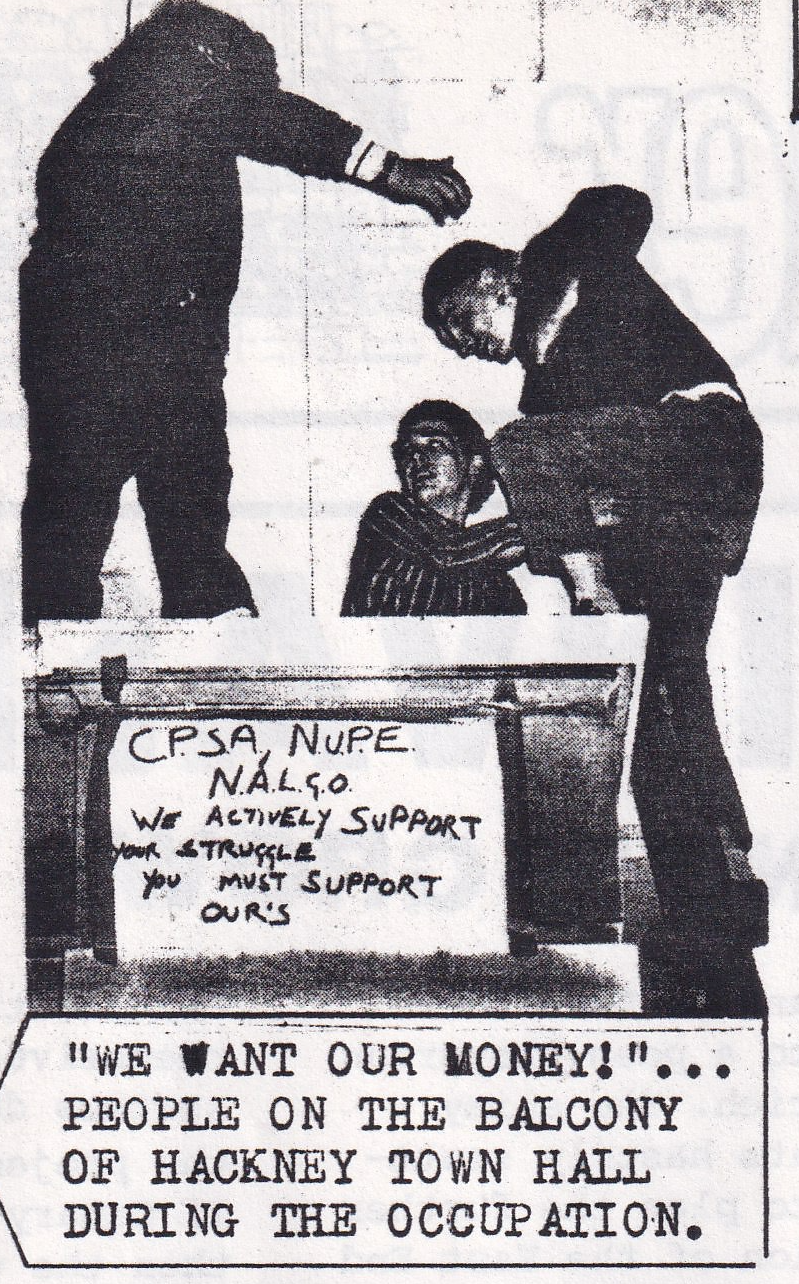 pay out. This time, under pressure, the Council agreed to distribute food from the Town Hall.
A Union Local official declared this “strikebreaking” and the Town Hall was closed completely. 40 claimants, supported by 60 outside, used a ladder to occupy a committee room demanding money. After 2 days, the Council allowed police to smash their way in and evict the claimants.
Islington: After pressure from Barnsbury Claimants Union (including leafleting claimants calling on them to go to the Town Hall to demand money). the Council decided to pay Urgent Needs Payments (£27 per person) to all claimants.
Local DHSS strikers (CPSA Union) passed a resolution refusing to collect back, after they return to work, any monies paid out to claimants.
In the meantime, Islington Council were complaining that claimants were ‘abusing the system’.
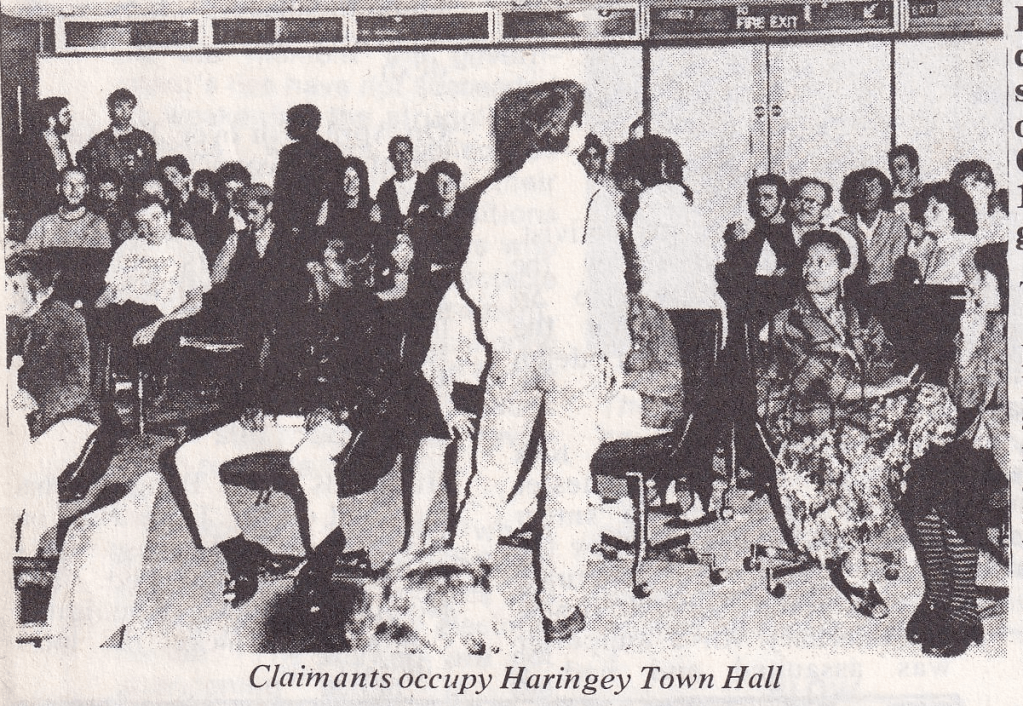
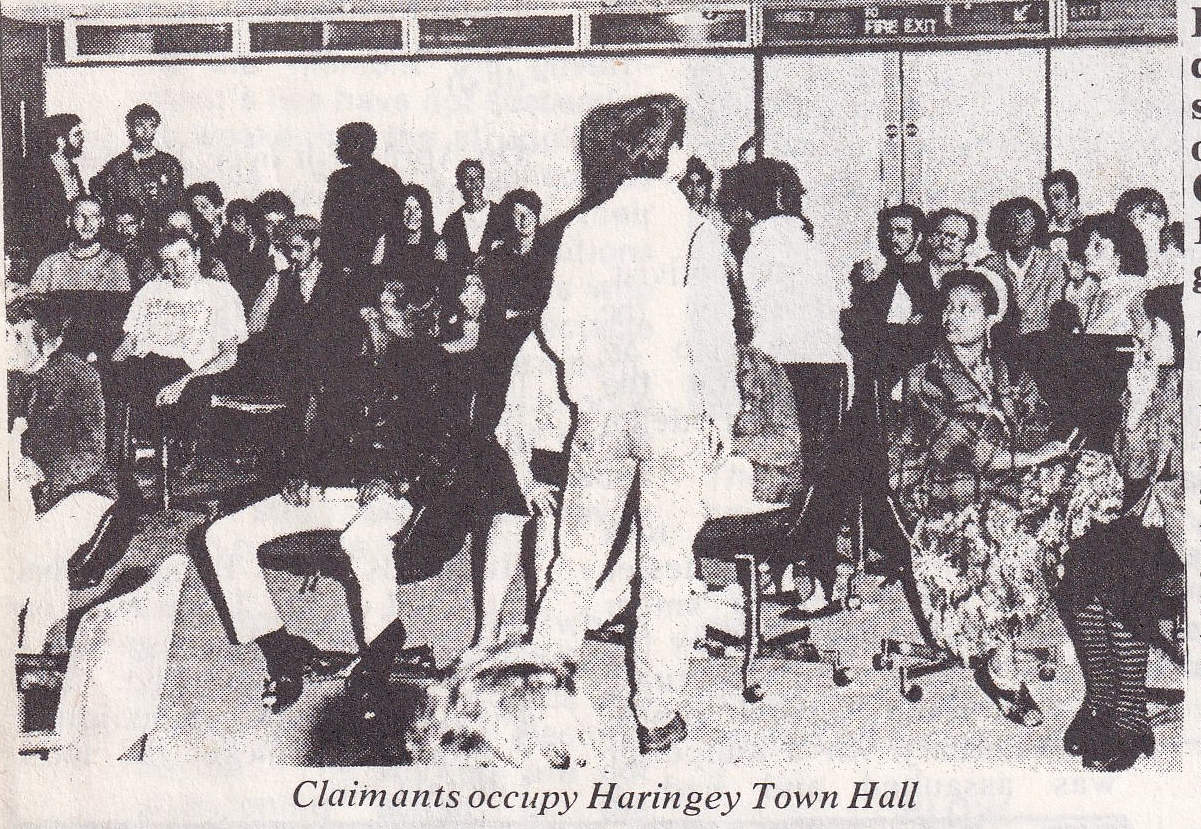
Haringey Town hall was occupied 8/5/1987 by 120 claimants organised through Tottenham Claimants Union. The Claimants Union called for claimants to rally at Haringey Civic Centre on 8th May. Some strikers supported this (after the issue was discussed all week on picket lines etc). Both the local branches of CPSA strikers and NALGO Union Town Hall workers agreed that payments should be made by the Council). Whilst local politicians came out to make speeches, 120 penniless claimants went and occupied the Council chamber.
The Council said they’d agreed to a Council pay out, but that one NALGO Union official had refused to let ‘his’ members sign the cheques. After 4 hours, Bernie Grant (leader of the Council) ordered staff out of the Town Hall and called in the police who violently evicted the occupiers. 80 then went to occupy the nearby Finance Dept. and talked to workers there. Police arrived in 15 minutes. After a meeting in a nearby community centre, claimants marched down the High Road chanting “We want money” and 30 occupied a Social Security office before going home.
The claimants groups fighting for emergency payments all supported the Civil Servants’ struggle for better wages and conditions.
“The argument put by some Union leaders that such emergency payments are “strikebreaking” is stupid.
Claimants can’t support the Civil Servants fight if they’re starving. If the state is forced to pay out extra money to claimants that makes the strike more effective. To really benefit claimants, and to impose more costs on the
government, these payments must NOT be taken off claimants’ future giros.”
There was also an occupation in Edinburgh: Claimants occupied Lothian Regional Council HQ on both 18th & 19th June to demand emergency payments:
“Leafleting & postering by Lothian Claimants Union resulted in a claimants mass meeting on the 18th. Claimants & a civil service striker spoke. The Tory government were to blame for claimant’s hardship, not the strikers. And all that the Labour Council was providing for claimants in Edinburgh was soup kitchens. ACTION WAS NEEDED. 70-80 of us made for the Council HQ, went straight inside & occupied a large room. “Elect a small delegation” said the Council representatives. “We are all spokespersons we replied. We discussed our aims & views among ourselves. After 1½ hours Council representatives promised each claimant would get a £5 food voucher per day for 4 days.
And it seemed they’d agreed to pay us in one go. Claimants wouldn’t have to repay the Council and NOTHING would be taken off our future giros.
We then left. A mistake. We should have stayed in the council building until we actually got the vouchers – or, better, cash – in our hands. Because, though the Council subsequently made some vouchers available, they didn’t pay the amount promised.
By noon the next day most claimants had only got £10 worth of vouchers, not £20.
Angry at this, 30-35 claimants occupied the Council HQ again. Council reps claimed they’d only promised to pay £10’s worth of vouchers altogether! liars! Eventually they used the police to evict us.
Later the Council paid out for a third day’s vouchers.
To sum up claimants direct action won a partial victory. And for future strikes? Claimants should force the Council to pay out cash if possible, food vouchers if not from Council premises (this time there was to much pressure on the Unemployed Workers Centre distribution voucher point). But if there’s an all-out indefinite strike new tactics
might be needed, claimants will have to act together to satisfy our material needs, direct action against central
government property & mass shoplifting would be 2 real possibilities.”
Sources: ‘Counter Information’ free new-sheet
‘EastEnder’ free news sheet
@@@@@@@@@@@@@@@@@@@@@@@@@@@@@@@@@@@@@@@@@@@@@
The 1987 CPSA DHSS strike ended in failure, because ‘the union spent 3 months restraining the workers anger with short regional, useless strikes, until they were too tired for an all out strike that could have achieved something…’
Were there other occupations or actions by claimants during this strike? If anyone does now of any, it would be useful to know more so we can add to this post.
The areas where some of the above actions took place did benefit from having existing local groups of active claimants’ groups – Tottenham Claimants Union, the Camden Unemployment Action Group, Lothian Claimants etc – which may have made organising such occupations easier at short notice.
Claimants Unions had been around since the early 1970s, and though they were not as prevalent as they had been 10—15 years earlier, another wave of unemployed centres had been set up in the early 80s by the TUC and trades councils (often more official and bureaucratically managed, uneasy with the more self-managed Claimants Unions , which always had a more libertarian grassroots ethos).
For an insight into unwaged organising in North London around this time, see the history of Islington Action Group of the Unwaged (this group had ceased to exist a few months before the 1987 strike). A short account of Tottenham Claimants Union can be found here.
Another strike took place in North London DHSS and dole offices a few months later, in 1988, this time a wildcat kicked off by changes in workplace structures which pissed the workers off.
Accounts of the 1988 strike make it clear that the tensions between dole office workers and the unemployed claimants they dealt with, and questions of how the two groups could co-operate and not end up thinking of each other as either enemies or collateral damage, had not been resolved. A decade later, unwaged groups’ fight against the new rules brought in to hit benefit claimants hard under the Job Seekers Allowance, brought this question up again, as some groups pledged to highlight particular workers in Job Centres known for picking on an bullying claimants, which caused argument with trade unionists in dole offices (though the tactic was only ever used once or twice, generally against horrible managers).
The ability of claimants to organise and get together to force councils to pay out in 1987 may seem like a lost world now – organising as benefit claimants is incredibly hard, and surviving on the dole much more difficult and individualised. When we used to all line up in a big queue to sign on, your mates were all there, there was camaraderie, it was easier.
One action that Claimants Unions used to undertake regularly was to target and expose the activity of the DHSS fraud investigators (sometimes called Specialist Claims Control Unit – or SCCUm to their friends), who used to target claimants ‘suspected’ of working while claiming, ‘co-habiting’ while claiming to be single, etc, to try and get people kicked off benefits… These charmless folk were sometimes photographed, the names and faces publicised, occasionally threatened…
Tactics badly needed today, as the DWP announce a new round of disgusting harassment of claimants…


Leave a Reply