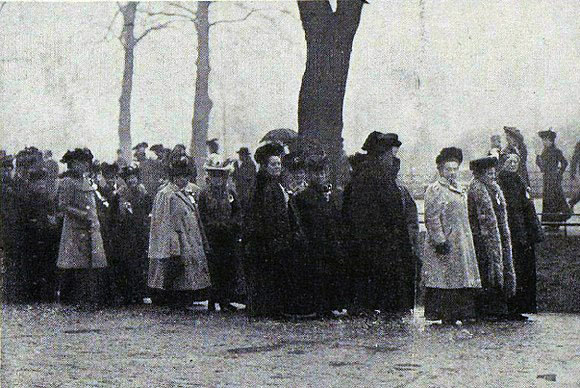
On 9 February 1907, the National Union of Women’s Suffrage Societies held the first large-scale women’s procession through London, from Hyde Park Corner to Exeter Hall; on the Strand, (now the site of the Strand Palace Hotel).
Around 3,000 women took part, from a range of social classes and occupations, and representing over 40 suffrage organisations. The march was organised by Phillippa Strachey, daughter of leading suffragist Lady Strachey. The women’s suffrage movement had adopted a myriad of tactics, but had never really attempted a mass demo before; the success of the Mud March inspired the NUWSS and the WSPU to organise many larger and larger marches over the next few years.
The torrential rain led to this demonstration becoming known as the “Mud March”: “mud, mud, mud” was the dominant feature of the day, wrote Millicent Garret Fawcett.
The movement for women’s suffrage had become divided between the ‘constitutional’ wing, broadly grouped around the NUWSS, and those who supported direct action, who had largely joined Emmeline Pankhurst’s Women’s Social and Political Union (WSPU).
The NUWSS continued to lobby, campaign, work through the main political parties, and try to convince politicians as female suffragists had done for several decades. The WSPU held that this approach had been failing to achieve the vote for women for so long that new tactics were needed – more militant and confrontational. WSPU demonstrations, heckling and harassing of politicians, and disrupting of political meetings had been achieving publicity beyond what the constitutional suffragists had managed… Although at this time, relations between the NUWSS and WSPU were still reasonably cordial, and certainly not as acidic as they became later, the more respectable wing felt the pressure to up their game a bit, to show they still had as much influence…
In January 1906 the Liberal Party, led by Henry Campbell-Bannerman, had won an landslide general election victory. Before the election many Liberal MPs had made vague or more definite promises that the new administration would introduce a bill to legislate for women’s suffrage, But after the election, safe in power, Campbell-Bannerman refused to act on the vote for women, saying that it was “not realistic” to introduce new legislation.In response, the WSPU organised a march in protest, attended by 300–400 women.To show that there was support for a suffrage bill, the Central Society for Women’s Suffrage proposed holding a mass procession in London to coincide with the opening of Parliament in February.
Plans for the march highlighted the divisions that were already opening up in the suffrage movement. The Women’s Cooperative Guild would attend only if certain conditions were met, and the British Women’s Temperance Association and Women’s Liberal Federation (WLF) would not attend if the WSPU was formally invited, objecting to the WSPU’s criticism of the government. The WLF was an arena where much of the suffrage movement thus far had been operating. At the time of the march, ten of the twenty women who sat on the NUWSS executive committee were connected to the Liberal Party.
The procession designed to raise public awareness for a private member’s bill for women’s suffrage at the opening of the Parliament.
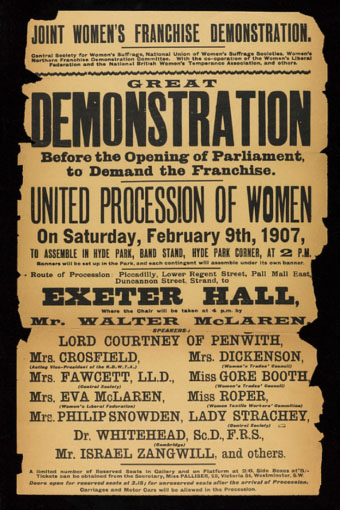
The march was noted at the time for its wide-ranging class representation. The leadership of he suffrage movement was often highly aristocratic, and this was reflected in the prominent figures heading the march, including Lady Frances Balfour, sister-in-law of Arthur Balfour, the former Conservative prime minister; Rosalind Howard, the Countess of Carlisle, of the Women’s Liberal Federation; the poet and trade unionist Eva Gore-Booth; and the veteran campaigner Emily Davies. But the middle class was also heavily present – professional women – doctors, schoolmistresses, artists – and there were also large contingents of working women from various cities, marching under banners announcing their varied trades: bank-and-bobbin winders, cigar makers, clay-pipe finishers, power-loom weavers, shirt makers. If the leadership of the NUWSS and WSPU was generally posh, women’s suffrage was a cutting issue right down to the active layers of the working class.
The march was led by Millicent Fawcett, leader of the NUWSS, Lady Strachey, Lady Frances Balfour, and Keir Hardie, also prominent suffragists. The Artist’s Suffrage League designed posters and postcards advertising the march, and designed and made around 80 embroidered banners for the march itself.
Despite the wet weather, thousands of people turned out to watched the march. The sight of thousands of women from across social divides marching together was enough of a novelty to persuade people to brave the rain. Press from across Europe and America were fascinated by the diversity of women involved. At the time, it was perceived that women were reluctant to make displays of themselves in public. As such, the participants in the march were considered to be even more dedicated to the suffrage because they were willing to put themselves through such an experience. Kate Frye was on the march, and she obviously relished taking part, writing in her diary that she “felt like a martyr of old and walked proudly along.”
The rally at the end of the march was chaired by Walter McLaren, and his wife, Eva, a member of the Women’s Liberal Federation, gave a speech. Other speakers were made by Eva Gore Booth (Women’s Trades Council) and Esther Roper (Women’s Textile Workers’ Committee), and Millicent Garrett Fawcett, president of the NUWSS, Lady Strachey, Keir Hardy, and Israel Zangwill.
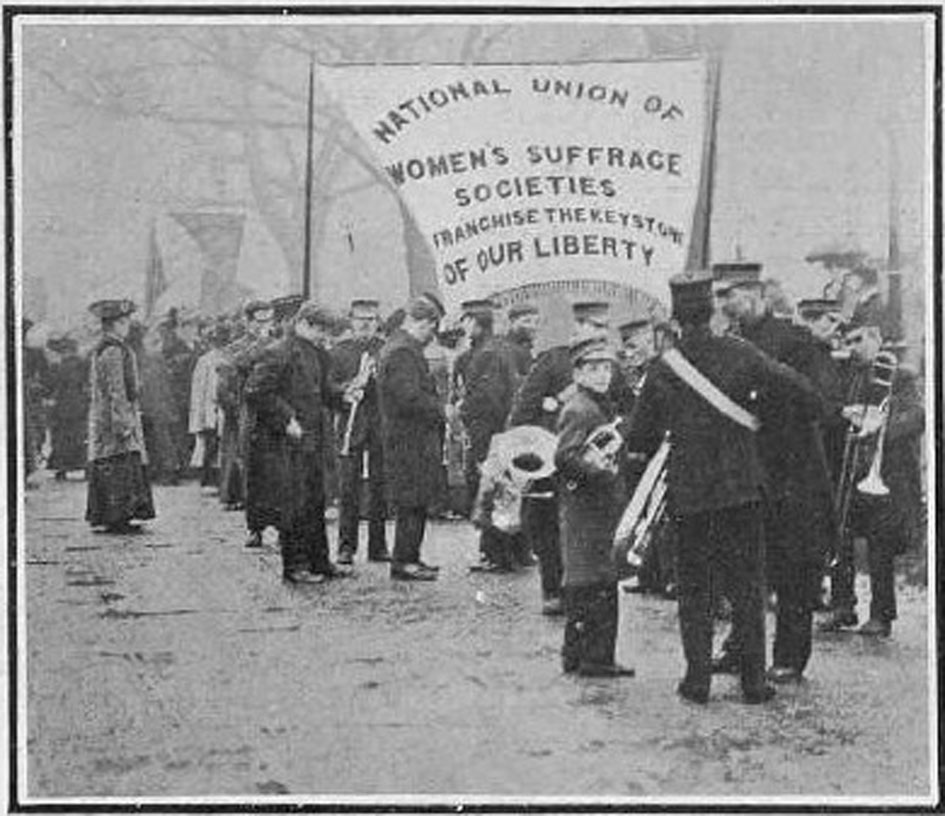 Although the militant WSPU was not officially represented, many of its members attended the demo, including Christabel Pankhurst, Emmeline Pethick-Lawrence, Annie Kenney, Anne Cobden-Sanderson, Nellie Martel, Edith How-Martyn, Flora Drummond, Charlotte Despard and Gertrude Ansell. At this point “belonging to both organisations, going to each others’ events and wearing both badges was quite usual”, though heavy divisions were opening up and would sharpen over the coming months.
At 2.30 pm the march, having formed a line down Rotten Row, set off in the drenching rain, led by a brass band, and followed by a phalanx of carriages and motor cars, many of which carried flags bearing the letters “WS”, red and white banners and bouquets of red and white flowers. Despite the rain, thousands of onlookers thronged the pavements to enjoy the novel spectacle of “respectable women marching in the streets”.
Some of the press was heavily critical of the demo, including modern liberal darlings, The Observer, whose leading article the day after the march read:
“It is not so much who is to mind the baby … but a question concerning the fundamental idea of sex, and the effects physical, mental and economic, that any revolutionary change in the conditions of women’s life must have on the vital civic duty and natural function of women—which is the healthy propagation of race. … What is aimed at is nothing less than complete sex emancipation; the right of women not only to vote, but to enter public life on equal conditions with men. It is a physical problem before all things, and an economic problem of great complexity and difficulty. … It is the fact that woman are not educated to take any rational interest in politics, history, economics, science, philosophy or the serious side of life, which they, as the embodiment of the lighter side, are brought up, and have been brought up since the days of Edenic beginnings, to consider as the privilege and property of the stronger sex. The small section of women who desire the vote completely ignore the educational feature of the whole question, as they do the natural laws of physical force and the teachings of history about men and Government”
Lovely.
The Observer also recorded that “there was hardly any of the derisive laughter which had greeted former female demonstrations”, although The Morning Post reported “scoffs and jeers of enfranchised males who had posted themselves along the line of the route, and appeared to regard the occasion as suitable for the display of crude and vulgar jests”. The Daily Mail —which supported women’s suffrage (unusually progressive, for them?) —carried an eyewitness account, “How It Felt”, by Constance Smedley of the Lyceum Club. Smedley described a divided reaction from the crowd “that shared by the poorer class of men, namely, bitter resentment at the possibility of women getting any civic privilege they had not got; the other that of amusement at the fact of women wanting any serious thing … badly enough to face the ordeal of a public demonstration”.
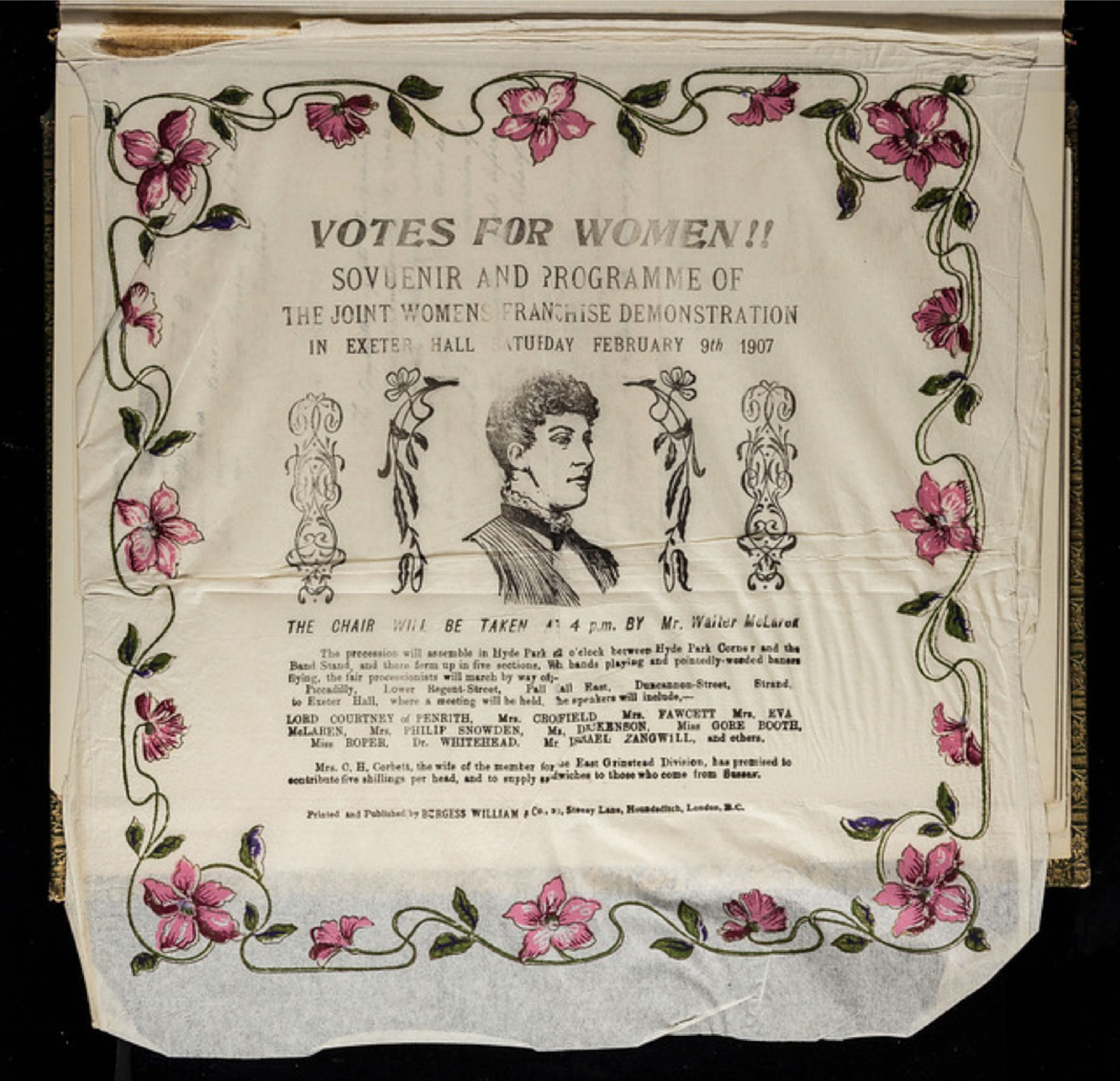
Approaching Trafalgar Square the march split in two (along, er, class lines!): representatives from the northern industrial towns held an open-air meeting at Nelson’s Column, which had been arranged by the Northern Franchise Demonstration Committee. The main march continued to Exeter Hall, for a more respectable indoor rally chaired by the Liberal politician Walter McLaren, whose wife, Eva McLaren, was one of the scheduled speakers. Keir Hardie, leader of the Labour Party, told the indoor meeting that if women won the vote, it would be thanks to the “suffragettes’ fighting brigade” (possibly meaning the actions of the WSPU, a comment that got him loudly hissed by several Liberal women on the platform) Hardie spoke strongly in favour of the meeting’s resolution, which was carried, that women be given the vote on the same basis as men, and demanded a bill in the current parliamentary session. Daggers were certainly out between the constitutionalists and the militants: at the Trafalgar Square meeting, Eva Gore-Booth referred to the “alienation of the Labour Party through the action of a certain section in the suffrage movement”, and asked the party “not to punish the millions of women workers” because of the actions of a small minority. But when Hardie arrived from Exeter Hall, he expressed the hope that “no working man bring discredit on the class to which he belonged by denying to women those political rights which their fathers had won for them”.
The march was considered so successful that Pippa Strachey was asked to organise all the NUWSS’s later large marches.
Four days after the march, the NUWSS executive met with the Parliamentary Committee for Women’s Suffrage to discuss a private member’s bill. The same day, the suffragettes held their first “Women’s Parliament” at Caxton Hall, after which 400 women ‘rushed’ the Commons to protest against the omission from the King’s Speech, the day before, of a women’s suffrage bill; over 60 were arrested, and 53 chose prison over a fine.
On 26 February 1907 the Liberal MP for St Pancras North, Willoughby Dickinson, published the text of a Women’s Enfranchisement Bill, proposing that women should have the vote subject to the same property qualification that applied to men. This would have enfranchised between one and two million women. Although the bill received strong backing from the suffragist movement, in the House of Commons, some of the MPs who might have normally supported votes for women regarded it as giving more votes to the propertied classes, while doing nothing for working women. On 8 March Dickinson introduced his bill in the House of Commons for its second reading (pleading that members should not be swayed by their distaste for the WPSU’s militant actions; the “Ladies Gallery” was kept closed during the debate in case of protests by the WSPU). But the debate was inconclusive and the bill was “talked out” (filibustered) without a vote. After a mammoth effort in supporting the bill, lobbying MPs and campaigning, this feeble end affronted many on the NUWSS; the damp squib respectable campaigning had achieved had the effect of increasing support for the more militant WPSU.
The success of the Mud March, despite the foul weather, helped establish the large-scale organised procession as a key tactic for the campaign for women’s suffrage in Britain. The demo was the largest-ever public demonstration in support of woman’s suffrage thus far; although progress on the parliamentary front seemed as far off as ever, the demo had huge significance in the general suffrage campaign. It brought the constitutionalists’ tactics closer to those of the WSPU. The ‘humiliating’ idea of parading in the street also established a theme of martyrdom in the movement, which was to increase over the next decade (especially among the upper class women for whom public appearances were supposed to be carefully choreographed). Ray Strachey wrote:
“In that year the vast majority of women still felt that there was “something very dreadful in walking in procession through the streets; to do it was to be something of a martyr, and many of the demonstrators felt that they were risking their employments and endangering their reputations, besides facing a dreadful ordeal of ridicule and public shame. They walked, and nothing happened. The small boys in the streets and the gentlemen at the club windows laughed, but that was all. Crowds watched and wondered; and it was not so dreadful after all … the idea of a public demonstration of faith in the Cause took root.”
The Mud March marked a sea change in public perception of the NUWSS – from being seen as a “regional debating society” it entered into the sphere of national politics. The failure of Dickinson’s bill also led to a new direction in NUWSS strategy; it began to intervene directly in by-elections, on behalf of the candidate of any party who would publicly support women’s suffrage.
The stage was set for seven years of intense campaigning, that would accelerate into near civil war…
@@@@@@@@@@@@@@@@@
An entry in the 2020 London Rebel History Calendar – buy a paper copy here
 LONDON RADICAL HISTORIES
Leave a reply to The Proud Mud March for Suffrage – Stories of Her Cancel reply