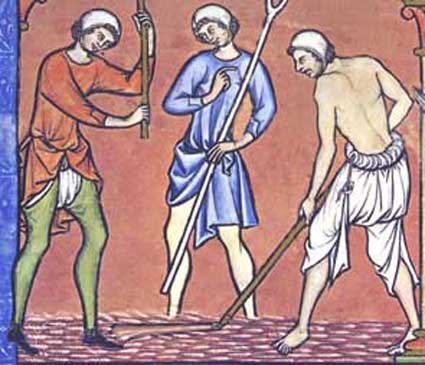
“Whereas late against the malice of servants, which were idle, and not willing to serve after the pestilence, without taking excessive wages, it was ordained by our lord the king… that such manner of servants… should be bound to serve, receiving salary and wages, accustomed in places where they ought to serve… five or six years before; and that the same servants refusing to serve… should be punished by imprisonment…”
Between 1348 and 1351 a virulent plague known as the Black Death devastated Europe. Historians estimate that between 30% and 50% of the English population died from the disease. This dramatic loss in population led to great changes taking place. Fields were left unsown and unreaped. Entire villages lay abandoned. Those who had not died of the plague were in danger of dying from starvation.
Food shortages also resulted in much higher prices. The peasants, needing extra money to feed their families, demanded higher wages. The landowners, desperately short of labour, often agreed to these wage demands. The landowners were worried that if they refused, their workers would run away and find an employer who was willing to pay these higher wages.
The feudal system had largely restricted freedom of movement for the poor, especially those who worked the land – the serfs. Landowners had to keep their workforce, the source of the wealth, labouring for them by force, or threat of force, or by law (really the same thing, since the law was entirely in the hands of the ruling elites). They feared rebellion (in retribution for the vicious treatment and grinding poverty of their existence), or gradual or mass absconding to find somewhere better – usually this meant to the towns, where conditions were laxer and some eventually became free.
The labour shortages caused by the Black Death threatened to shatter this tense system; the bargaining power was suddenly with the labouring poor.
In 1348, Ralph, Earl of Stafford, and John Giffard were paying their farm labourers one pence a day. By 1350 they were forced to increase it to two pence a day. Other local landowners were paying three pence a day. John Giffard warned the Earl of Stafford that there was a danger that the serfs would leave Yalding in an effort to obtain higher wages.
Landowners like the Earl of Stafford complained to king Edward III about having to pay these higher wages. The landowners were also worried about the peasants roaming the country searching for better job opportunities.
The king issued the Ordinance of Labourers on June 18th 1349, in what is seen as the beginning of English Labour law. It decreed that
- Everyone under 60 must work.
- Employers must not hire excess workers
- Employers may not pay and workers may not receive wages higher than pre-plague levels
- Food must be priced reasonably with no excess profit
The Ordinance, however, was largely ineffective – mainly because it flew in the face of the material needs of both landowner and worker. In 1351, Parliament attempted to reinforce the Ordinance, by passing the Statute of Labourers Act. This law made it illegal for employers to pay wages above the level offered in 1346.
Some employers, who were desperately short of workers tended to ignore the law. This was especially true of those employers living in towns. Some freemen who had skills in great demand, such as carpenters and masons, began to leave their villages. Serfs became angry when they heard of the wages that people were earning in towns. Some serfs legged it, heading to towns in search of higher wages. Large numbers of serfs went to London. Most of these serfs could only find unskilled manual work. By 1360 over 40,000 people were living in London, swelling a poor and often rebellious population.
Any serfs who got caught was taken back to their village and punished: however, it was difficult and counter-productive for the lords of the manor to punish them too harshly. Execution, imprisonment and mutilation only made the labour shortage worse, so most runaways were fined. Sometimes runaway serfs were branded on the forehead. The rest of the serfs’ tithing group were also fined for not stopping him or her from running away.
The statute’s changes failed to take into account the changing economic conditions during the Black Death, and furthermore the period from which wage levels were taken was one of economic depression in England as a result of The Hundred Years’ War. Therefore, wages during the Black Death were set even lower to match those during this depression. In practice, the statute was poorly enforced and unsuccessful, but it set a precedent that distinguished between labourers who were “able in body” to work and those who could not work for whatever reasons. This distinction was the genesis of ideas that resurfaced in later laws regarding poverty and welfare.
The Ordinance and the Statute naturally enraged the peasants, who wanted higher wages and better living standards. It is undeniable that this ongoing attempt to put the clock back contributed to the general air of resentment and rebellion that preceded and gave birth to the English peasants’ revolt of 1381. Similar processes happened throughout Europe – wage caps following a labour shortage after the Black Death resulting in popular revolts.
The Statute was poorly enforced in most areas, and farm wages in England on average doubled between 1350 and 1450. However, it’s also clear that the breakdown of the rigid feudal system in England was to some extent already underway, stimulated by other economic factors. That the Black Death accelerated a move towards free labour and a more independent class of small farmers us true; but serfdom was inefficient; it also benefitted the King to have freer peasantry rather than serfs, as it produced a larger tax base for national use, where serfs generally enriched the immediate landowner.
Post-Black Death rulers in several countries promulgated laws to tackle the problem. For instance, the French king Jean II, surnamed ‘the Good’, proclaimed his ‘Ordinance sur les métiers de la ville de Paris’ on 30 January 1351. In addition to setting ceilings on prices and wages, the ordinance included an extensive series of measures to curtail begging. Unemployed, able-bodied men and women were required to accept any work offered to earn their keep. Both the mendicants and the inhabitants of Paris were prohibited from giving alms to those capable of working, and this category excluded only the blind, the disabled, and other ‘unfortunate persons’.
Despite the obvious failure of the post-Black Death labour legislation, repressive laws regulating wages, almost always in favour of landowner, employer and master, continued to be imposed in England; just a few –
- the 1563 Statute of Artificers, which controlled skilled trades by providing a compulsory seven years’ apprenticeship, reserved the superior trades for the sons of the better off, empowered magistrates to force the unemployed to work and regulate all wages, required permission for a workman to transfer from one employer to another,
• Another Statute of Labourers in 1603, which banned workers from being paid more than the rate magistrates set,
- The 1800 Combination Acts, the last of a succession of laws banning workers from organizing together to improve wages or conditions, or from persuading others to strike…
- the Master and Servant Act 1823, only repealed in 1875, under which any worker could be leaving a job to seek another, without his boss’s permission.
… to say nothing of anti-strike laws…
Most of the above were only repealed by parliament after huge campaigns by workers… The employing classes through their representatives in Parliament will continue to try to adjust the law controlling our lives and limiting our ability to resist in their favour. And if we stop pushing them, they push back – harder –
@@@@@@@@@@@@@@@@@@@@@@@@@@@@@@@
An entry in the 2016 London Rebel History Calendar – check it out online


 LONDON RADICAL HISTORIES
Leave a reply to Today in London’s dole history: Belmont workhouse inmates riot, Sutton, 1910. | past tense Cancel reply