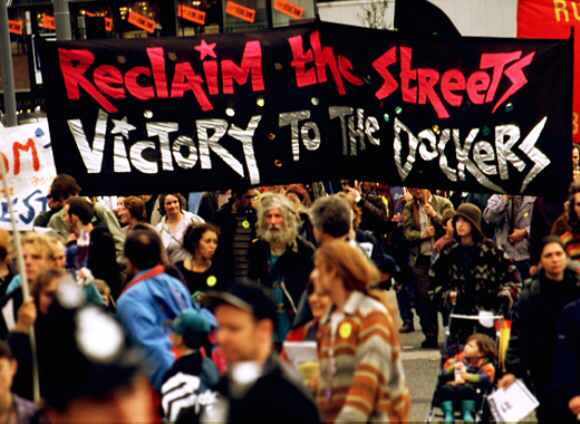
This is a post about a Reclaim the Streets action in 1997, the police response to it, and the police infiltration of activism that we now know underpinned the event.
Preface 1: This is a very long blog post, and could be confusing. Maybe it should be read as two posts – one about the day itself, and one about the murky secret policing that we now know took place.
Some of the following was also submitted (generally in different phrasing, though some sentences may have been lifted) as part of a collective witness statement by some former Reclaim the Streets (RTS) activists to the ongoing Public Inquiry into Undercover Policing. Sorry if anyone feels this shouldn’t have been done – but life is short and cut and paste is handy. Also: some things we would like to have written here, we can’t, without breaching Inquiry restriction orders. If they’d publish everything they have shown some of us – we could say more. Frustratingly much of the evidence is not being made fully public.
The author of this post was part of the Legal Defence & Monitoring group legal observer team for April 12th 1997, was also involved in London RTS for a while, and helped write that RTS witness statement. However, any conclusions in this post reflect individual/Past Tense thinking, and others who collaborated on that statement may not agree on all of the following.
Preface 2: We are not conspiracy theorists, in the sense that we don’t believe everything that happens is due to secret or elite groups conspiring. Mostly the classes imposing social and economic conditions on us do so openly, and as part of a complex structure that is integrated into every part of daily life.
However, obviously some of the iceberg of class society is not visible, hidden structures exist and some secretive organisations operate out of sight.
Not everything that follows should be read as indicating that secret political policing and its string pullers higher up in the British State were/are in fact behind all political protest. However: police infiltration of protest movements took place, on a massive scale that we’re still uncovering. It’s important to sift paranoia from the real repressive acts. Careful study is vital, and is being carried out. Don’t let the bastards in blue grind down your ability to fight back.
Preface 3: This post isn’t a history of either the Liverpool Dockers dispute or of Reclaim the Streets.
Re the dockers: For a brief history of the Liverpool Dockers’ dispute, this introduction and this series of articles are worth reading.
Re Reclaim the Streets: the collective statement to the Inquiry might not be a bad place to start, though it doesn’t cover anything like everything, and, of course, focusses on the actions of police spies alot.
There are various accounts of RTS online I think. A good oral history of RTS would be a lovely project.
Here’s a post on London RTS from Past Tense’s narrow, twisted, and sometimes unpopular perspective:
The Liverpool Dockers Dispute 1996-97
Dockworkers in Liverpool were locked out in 1995 after 80 were sacked for refusing cross a picket line, sparked by a dispute over pressure to work for a lower rate than they were prepared to accept. A long-running dispute evolved, involving around 500 dockers sacked. This became a major cause celebre in Liverpool and across the UK, with mass solidarity, huge international support… The battle lasted three years, but eventually only a few workers got jobs back, with most of those locked out taking severance payments.
Reclaim the Streets in London were approached by London supporters of the dockers, and launched a 3-day protest/party/occupation in September 1996 to mark the first anniversary of the dispute. Hundreds of activists attended and joined dockers on the picket line, and occupied a dock office block, as well as cutting the fence around Seaforth Dock and invading the facility…
They occupied a disused customs and excise office block, partly to provide sleeping accommodation for those who had travelled from other parts of the country, joined dockers on the picket line and marched through the streets of Liverpool together.
On Monday 30th September, 600 people picketed Seaforth Docks. Two van loads of RTS activists, dressed as dockworkers, successfully gained access from dock security to enter the port. They climbed and occupied two gantries.
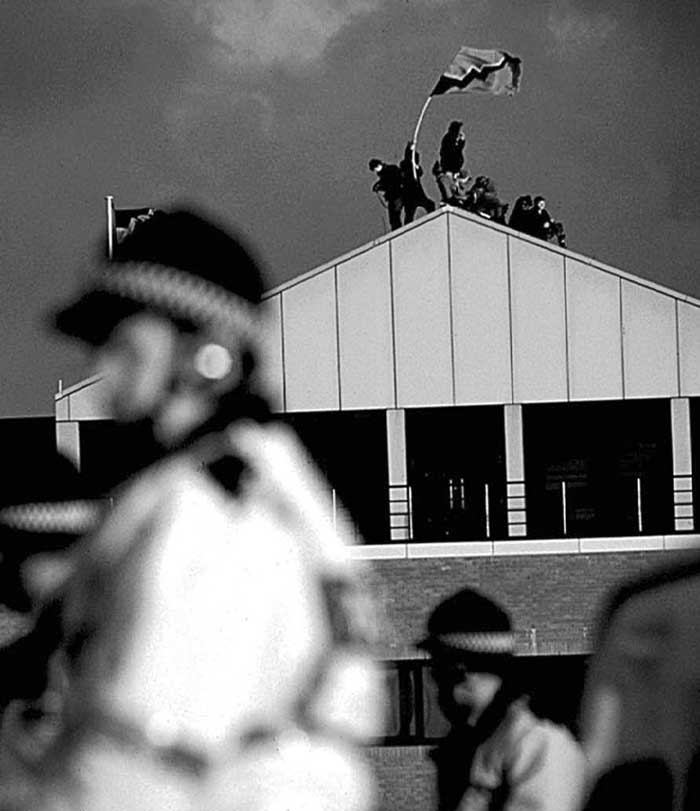 There were 44 arrests, many seemingly at random, including people violently grabbed from the good natured crowd by Territorial Support Group officers clad military-style all in black. Arrestees were mostly held for the day, then released without charge once the event was over.
The dockers were keen that some of their cohort also gained access. One RTS activist recounts the cooperation that went into achieving this: “[the dockworkers] rather creatively came up with a way of getting through their fence because they had a picket and they had a tent backed onto the fence, a steel slatted fence, and yeah, a lot of drums in our group enabled them to hide the sound of them hacksawing through the fence. They managed, they hacksawed in rhythm with the drums to make a hole in the fence.”
Having representatives from both groups inside the port, the groups then worked together again. The two groups scaled fences and made a human pyramid to climb onto the office roof from where they flew two black, red and green flags, representing the alliance of anarchists, socialists and environmentalists, and hung a banner that read: ‘Sack the bosses not the workers’.
Here’s an RTS leaflet on the dockers dispute
Chris Knight was partly instrumental in solidifying the link between the dockers and RTS London – there’s a good interview with him about this
The March for Social Justice
Following the Liverpool actions, RTS and the Dockers collaborated on a demo/action/party in April 1997 in Central London, 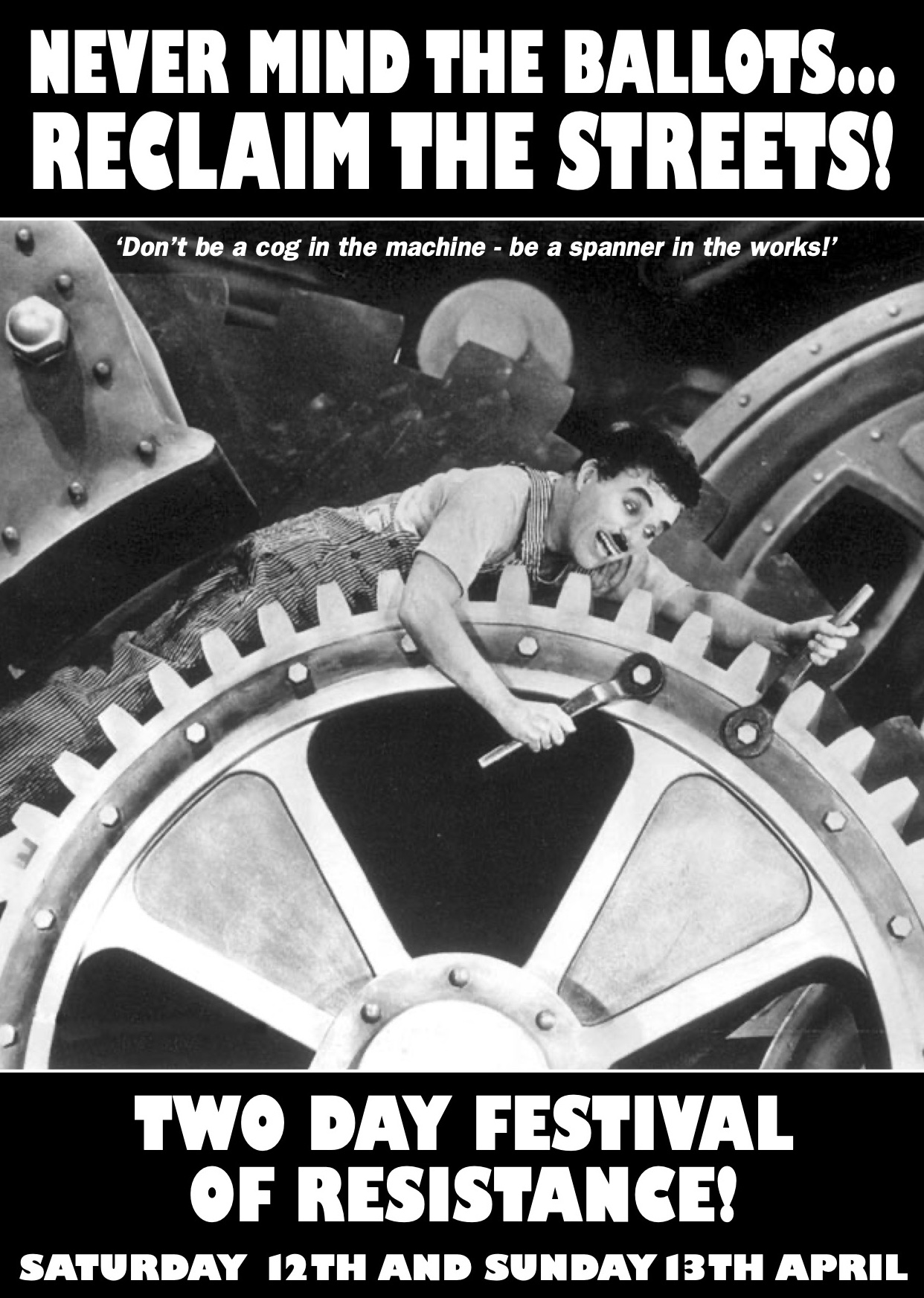 to coincide with the run-up to the general election – a series of events variously known at the March for Social Justice, Reclaim the Future, the ‘Festival of Resistance’ and Never Mind The Ballots.
On 12th April 1997, some 20,000 people took part in the March for Social Justice, called by the 500 sacked Liverpool Dockers and their families, jointly with the Hillingdon Hospital and Magnet strikers.
The March for Social Justice brought together a broad range of struggles. In particular, it served as a bridge between organised workers and those who campaigned around ecological issues.
This link between Reclaim The Streets and the Liverpool Dockers may have been seen as a political threat by the authorities, who often try to stoke division between such movements by claiming a false narrative (i.e. the ecological movement wants to attack industry and will cost you your jobs).
“When such different groups show deep solidarity and a recognition that they share the same concerns and the same enemy, a system that prioritises profit over people and planet, there is a powerful energy for social change. This type of alliance was also seen in the famous ‘turtles and teamsters’ alter-globalisation movement after the Seattle World Trade Organisation protests in Seattle.”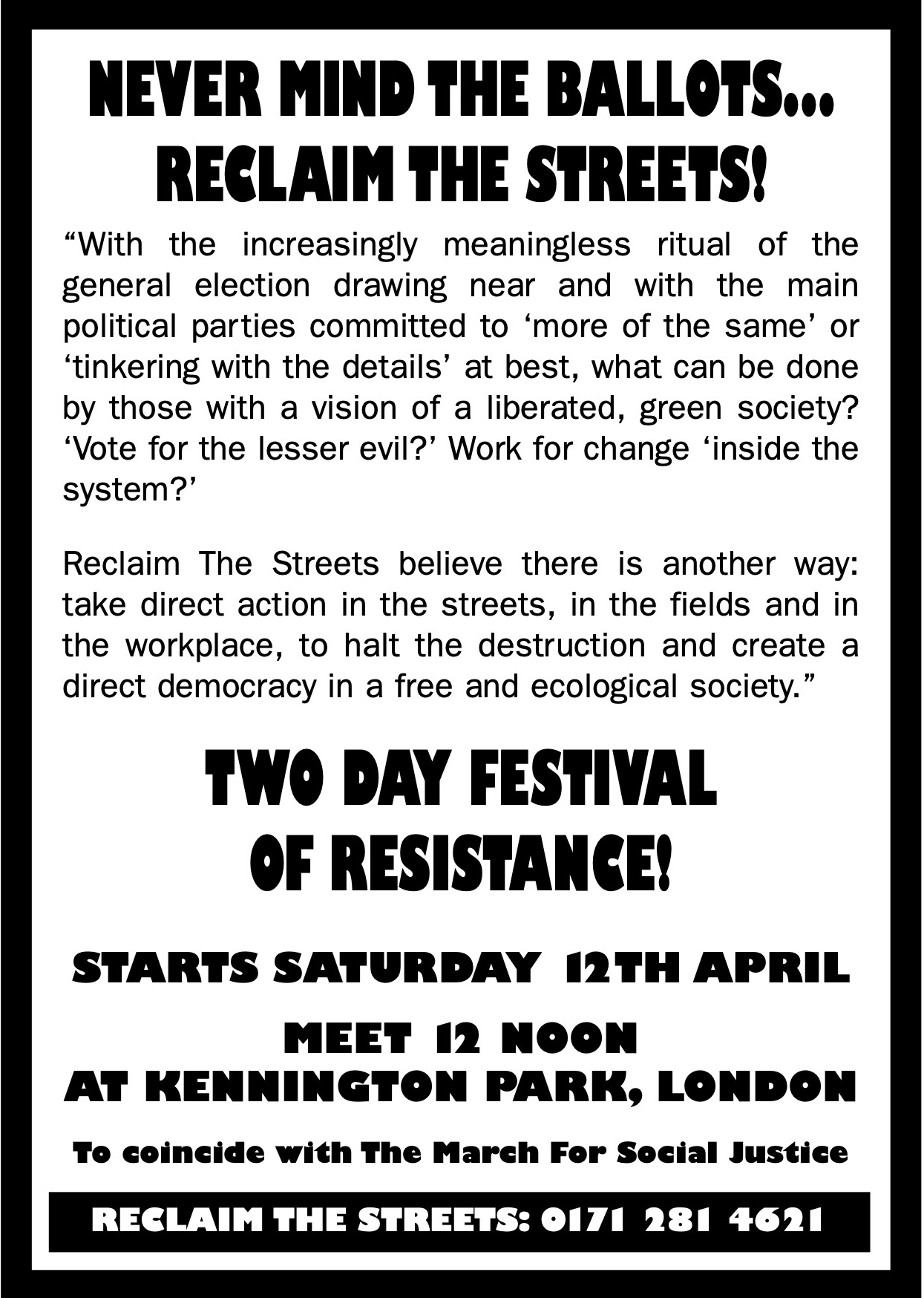
The gathering at Trafalgar Square was big, but after many demonstrators had left, and numbers were beginning to drop, a van containing the sound system managed to enter the square – the music and a street party then began. The dancing went on for hours, but by late afternoon, the cordon had successfully reduced the numbers in the square and riot police – some on horseback – stormed in to clear the area battering us out of the Square and over the bridges, with lots of extreme prejudice.
As we will relate – the events of the weekend were mired up with the reporting of an undercover police officer embedded deep in Reclaim the Streets, Jim Boyling, whose intelligence to Special Branch before, during and after the day reveal a web of police manipulation intended to sabotage and undermine the very possibility of opposition to the status quo…
Friday 11th April 1997
The weekend was planned to begin with the distribution of 20,000 copies of a newspaper called ‘Evading Standards’ (a spoof of the leading London newspaper, the ‘Evening Standard’) handed out free at tube stations across London during the evening rush hour. With the headline “General Election Cancelled”, the newspaper was produced as a counter voice to the mainstream media, to explain to the general public RTS vision of a world where people took back control of their lives from multinational corporations and governments, with forms of local democracy and local ecological production. It contained humorous or critical commentary along with information on a range of alternative politics and on the coming weekend’s events.
However, the first act of police repression and sabotage was the confiscation, the afternoon before the march, of all 20,000 copies of ‘Evading Standards’ before they could be distributed. Police from the Forward Intelligence Team (FIT) seized the papers, and three RTS activists were ludicrously arrested for ‘incitement to affray’ and ‘incitement to obstruct the public highway’. The three were released about five hours later, but bailed to reappear at a police station – on Saturday at 12:30pm – the exact start time of the march & rally. An attempt to keep them from any involvement in the day’s events.
When they did attend the police station the following day, the three were held until 6pm (when the march and the street party had all but finished) and additional charges were made, around ‘breach of copyright’ – specifically for a parody of the ‘Evening Standard’ logo (a drawing of the statue of Eros) and for a Metropolitan Police logo changed to Multinational Police, featured in a satirical spoof advert on the back page.
These copyright allegations were pretty much ‘vexatious’ and may have never been intended to ever come to court; indeed all charges were later dropped. This led to the three people involved suing the police and receiving wrongful arrest settlements of around £6000 each.
Although a second edition of ‘Evading Standards’ was published two weeks later, the damage was done. As a result of the MPS’s actions, the public only heard the mainstream media’s version of events; Reclaim the Streets’ alternative voice was effectively silenced at the crucial moment.
Despite the papers being confiscated, a [very] few copies got into circulation and the full paper is available on the Internet, see: http://www.mcspotlight.org/beyond/evading/
Saturday 12th April 1997
The next day, around 20,000 people took part in the March for Social Justice on Saturday 12th
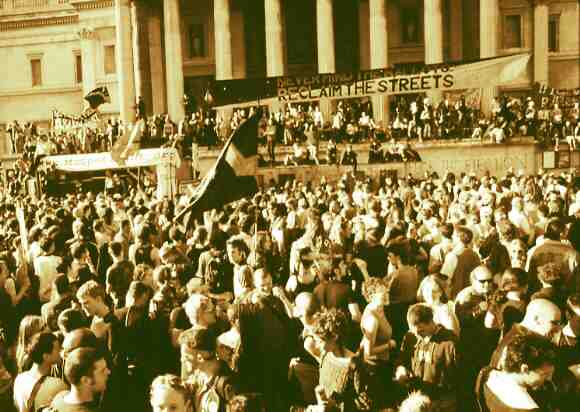
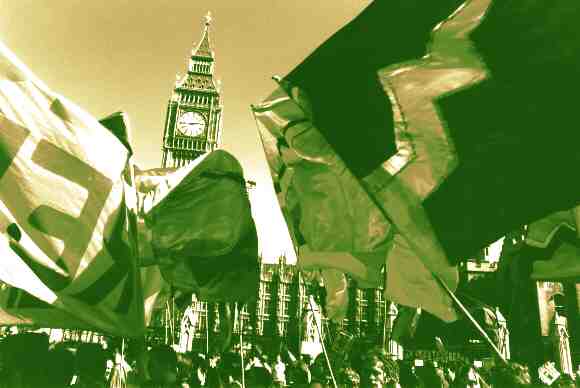
The march started at Kennington Park, and wound its way in bright sunshine over Lambeth Bridge, past the Houses of Parliament and Whitehall to Trafalgar Square where there was a rally. Most of the march took place in a carnival atmosphere, with hundreds of colourful and imaginative protest banners and flags, and much drumming, whistles and chants. The crowd was a varied mix of trade unionists, ravers, left-wing parties, anarchists and thousands of others. All through the march people handed out many different leaflets on upcoming events and protests, and alternative views – especially about the irrelevance of parliamentary politics, and about real change being made by people getting organised and trying to reclaim our lives, our streets and environment from those in power.
Several thousand police officers policed the demo – though riot cops were initially kept out of view. Even the Houses of Parliament were guarded by ordinary uniformed police only. However, there were riot police hidden in the building and backstreets and they were to be seen in force by the party-goers later.
The route was well covered by cameras, especially Downing Street which had a camera on a crane overlooking the gates. Downing Street had riot cops and mounted police opposite. There was the predictable anger at the gates and after most of the march had passed aggro broke out here.
An orange smoke bomb was thrown into Downing Street, distress flares were let off and a few minor disturbances resulted in the arrival of riot police and charges by mounted police.
Someone managed to climb into the Foreign Office and was seen throwing papers out of an open window. Further up the road a crowd gathered outside a McDonald’s store to protest against the company. The management locked the doors and a window was broken.
The gathering at Trafalgar Square was big (maybe 20,000 at peak) but most of the Dockers, other strikers and their families left soon after the rally (mainly because of their long journeys home). The numbers were beginning to drop when a van containing the sound system managed to enter the square. In the process of getting through the police lines, the van apparently knocked over a police motorbike. “A horn was sounded when the sound system was going to come in. The police were caught wrong footed and tried to reach the van, and as it slowed down to enter the square we quickly swamped around it to stop the police getting to it.”
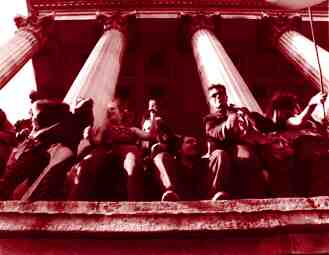
People flocked round the van which parked outside of the National Gallery (Britain’s most prestigious public art gallery). The tarpaulins on the side of the van were lifted to reveal the sound system behind. The music and the huge street party then began.
Many other banners were erected around the square, including one in front of the National Gallery which read “Never mind the ballots…Reclaim the Streets” and one on the top of Canada House saying “Reclaim your Environment”. Also, the Canadian flag on the embassy was replaced by a colourful RTS flag. Climbers took a ‘Support The Dockers’ banner up Nelson’s Column itself and it was still there on Sunday evening.
A painted slogan across the road read “END THE CARNAGE”. The ‘N’ of ‘CARNAGE’ was not completely painted in, so it also appeared to read: “END THE CAR AGE”.
A second sound system was stopped around the corner and never made it into the square. Many people who didn’t attend the march and turned up for the party were also prevented from entering. As soon as the march had reached the square, the police blockaded the roads leading into the square and closed the underground station, letting people out, but not in. A helicopter hovered constantly overhead.
People could sometimes get out of the Square, but couldn’t get in. There were parts of the crowd on both sides of the police cordon. Clad in black boiler suits, steel toe-capped boots and face masks, rows of riot police aggressively pushed inwards. As the numbers slowly reduced thoughout the afternoon, the police lines advanced slowly, tightening a grip on the Square. Over several hours, there were ongoing skirmishes at the edges of the party as some of the crowd resisted being corralled by the cops.
At a time pre-arranged by Reclaim the Streets, the sound system drove out of the Square, and attempted to lead the main mass of party-goers out of the Square. This was a tactic RTS had established at their wondrous M41 Street Party, to try to prevent a crowd being reduced to a point where it became vulnerable to police attack (as had happened at end of the Camden and Islington RTS parties). The majority of the crowd followed the RTS flags to a back-up squatted venue for an all night party in Vauxhall.
However, several hundred people remained in the Square. And once numbers had reduced significantly, riot police attacked the remaining demonstrators. Mounted charges panicked those trying to leave the area and many people were injured.
Viciously attacked and battered, sections of the remaining crowd were driven in different directions by police charges. The largest remaining crowd was forced up the Strand and chased south across Waterloo Bridge by riot police. Legal observers from the Legal Defence and Monitoring Group were harassed and attacked by police while trying to monitor police actions and document arrests.
These scenes were recorded by the mass media and predictably used to slant reporting of the entire day towards “crowd violence”. ITN and BBC film crews hardly bothered to remove their equipment from their bags while the vast majority of the crowd were dancing – waiting to film until the police violence at the end of the day. There was hardly any media coverage of the march, rally or street party which had preceded it.
The driver and passengers of the sound system van – which had bumped into the police motorcycle on its way in – were arrested, which was gleefully reported in the traditional media as “a murder plot against the police”. Only the Guardian bothered to follow up the story, reporting the following day that no such charges had in fact been brought.
The only charge to come from the arrests was suspicion of possession of drugs in relation to one of the van’s passengers.
In the wake of April 12th, the media was fed other juicy, negative, fabricated stories, including the arrest of “a man with a three foot broadsword”: this was in fact daft minor hippy celeb ‘Arthur Uther Pendragon’ (aka John Timothy Rothwell) with his ceremonial sword ‘Excalibur’, a fixture of many demonstrations in the 1990s.
This police riot established a pattern that was to characterise Metropolitan Police reaction to a number of RTS street parties and actions after 1997: on the one hand heavy police violence – sometimes provoking parts of the crowd to fight back – and high profile arrests, often initially resulting in dramatic and serious charges, which were generally hyped up to the media, but that could not be sustained, and were quickly dropped. However, the arrests too their toll: activists could be prevented from taking part in actions, scared off from organising actions, harassed, and the police line would dominate press stories in the immediate aftermath.
Over a number of years this police tactic did partly have the desired effect of scaring a lot of people off from attending street parties and protests.
Sunday 13th April 1997
A conference and workshops took place in the same venue as the party, a squatted empty office block. The building was looking slightly worse for wear after the party. Somehow the [RTS] phone line that was to inform people about the venue had been [suspiciously] shut down so many groups failed to attend. The mass media were told to leave (everyone was very unhappy with the reports of Saturday’s events and didn’t fancy allowing the press to make up more rubbish). The conference was small but very positive as were the workshops- on how to stand up to multinationals, on reclaiming the streets etc.
Plan A and Plan B
Crucial to understanding the events of the day – including the police repression and the location of the street party – is the part played by the secret reporting of undercover police officer Andrew James Boyling, who spied on Reclaim The Streets from 1995 to 2000. And how that intelligence was used by the hierarchical networks of the state – from Special Branch, through the Metropolitan Police, up to, allegedly, the then Home Secretary, Michael Howard. The aim being to make sure radical possibilities were shut down and silenced, and as much muck was chucked at protestors as possible.
This is a tangled web, not easy to follow, and we don’t have all the info – but bear with us.
The first and vital piece of information here is this –
Having a street party in Trafalgar Square was not Reclaim the Streets preferred plan.
Trafalgar Square was, as someone else wrote, “a great venue. Lovely sunshine, good vibe.”
It was – and remains – one of London’s traditional spaces for public protest – from its very opening as a public square in 1848 – the right to gather and protest there established in the face of repeated state repression involving serious violence, eg on Bloody Sunday 1887.
In fairly recent memory in 1997, the Square had seen a huge political protest against the Poll Tax erupt into a massive riot in response to a mounted police attack.
Many many more times, campaigners were used to attending ritualised marches ending in the Square, listening to some speeches, then going home.
The Reclaim the Streets April ’97 party was definitely something of a break from this leftist routine, as RTS had always aspired to – break the mould.
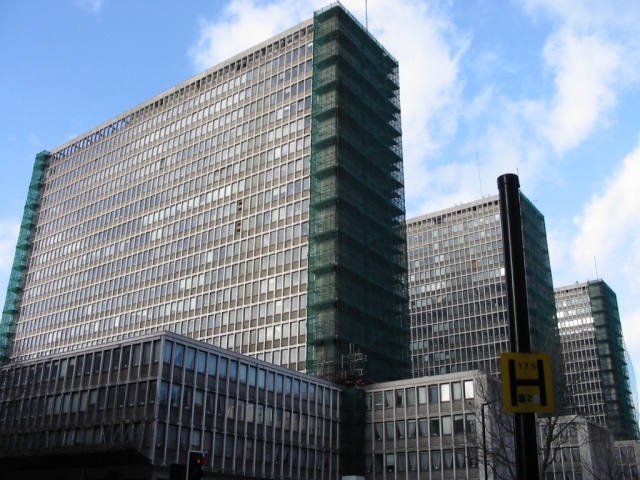
But RTS had originally planned an even more ambitious target – to mass squat the then partially empty offices of the Department of the Environment in Marsham Street, SW1. The plan had been for a section of the march to be led into a diversion off the demo, to occupy the offices for the entire weekend. RTS activists were standing by to move in and secure the building with the support of this crowd.
But when it came to the crucial moment, the DoE offices (and the road leading to it) were heavily protected by armed police. The activists poised to secure the building could see no way for the squat to be carried off successfully, so Plan B took effect instead.
It was only years later that a fuller picture of the events of the day emerged. After activists years of exposures of police infiltrating our movements and campaigns for social change, pressure and bad publicity forced the Home Office in 2014 to announce a Public Inquiry into Undercover Policing.
Thousands of secret reports have been disclosed to those spied on, and some of those have been made publicly available.
Some of the facts are still concealed, some of the machinations of police, secret police and government are still withheld from public view.
There are murky waters – the events around the March for Social Justice included.
Spy in the Cab
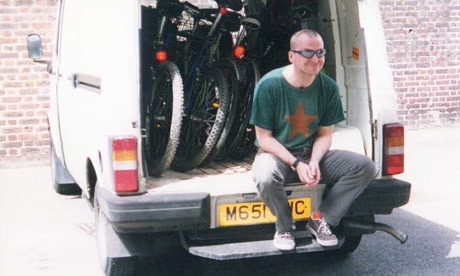
An undercover police officer from Special Branch’s Special Demonstration Squad (SDS) had begun to infiltrate Reclaim the Streets in late 1995. Using the cover name ‘Jim Sutton’, Andrew James Boyling had been tasked by his superiors to spy on the group, by his own account, after the police attack on the July 1995 Islington RTS street party ended in fighting with remaining partygoers. Already posing as a hunt saboteur and reporting on sabs from East London, Boyling gradually started attending RTS meetings, worming his way into the inner circles of the group, putting himself in a position where he could report on plans for upcoming actions. RTS would publicise its mass parties in advance widely, but by necessity some info was kept very secret, known to only a small core of organisers – where the event was to be, being the most guarded. Parties wouldn’t come off, it was reasoned, if police and authorities knew in advance where they were to be held.
Ironically, it turns out, after Boyling worked his way into a position of trust in RTS during 1996, police and their political masters DID know where events would take place. Boyling would be party to most of the closest kept plans of RTS from 1996 to 2000, and his reports to the SDS back office reveal that all of this was passed back to the police. And as we shall see – a lot of it was passed higher up.
Like several other SDS spycops, Boyling drove a van, pretending to work as a driver for builders. This was a well-worked SDS tactic, as a van is useful for moving stuff for protests, can be employed to ‘helpfully’ drive people to and from meetings (finding out where activists live and pumping them for information). Boyling became a trusted RTS driver, one of those who would pilot sound systems into party spaces, or crash the old bangers sometimes used to block the roads.
From the start of plans for the March for Social Justice ‘Jim Sutton’ was deep in the planning, and reported back every aspect he could get intel on. Detailed intelligence on planning for the event, who was involved in what, when and where action would take place, was in the hands of Special Branch, often within hours.
In the light of getting to read the documents supplied to Non-State Core Participants (campaigners spied upon) in the Undercover Policing Inquiry, Reclaim the Streets activists have come to some conclusions about Boyling’s reports, how they were used by Special Branch and the police hierarchy, and how this was then manifested in policing tactics on the day. The reports – and Boyling’s oral testimony to the Inquiry in February 2026 – have also thrown up some questions about how high up awareness of RTS’ plans, Boyling’s reports went, and who took the ultimate decisions as to what police did on the day. Did it go up as far as the then Home Secretary, Michael Howard?
Boyling’s intelligence and how it was used
As indicated earlier, the party in Trafalgar Square was not RTS’s intended plan, it was only a back-up – ‘Plan B’. ‘Plan A’ had been to stage an occupation of empty office space at the Department of the Environment building. The intention was that a section of the crowd would take a diversion from the official route of the march and set up a ‘Real Department of the Environment’ in these offices for the weekend. This would be a symbolic and temporary occupation of an empty building, in order to hold workshops and meetings on a wide range of topics (ranging from global trade to permaculture gardening, climate justice to composting), as well as a radio station and theatre shows, with a party in the street outside.
However, the deployment of police (including armed officers) across particular streets (e.g. Marsham Street, where the Department of the Environment was located) on the day prevented this occupation from going ahead. At the time this did raise activists’ suspicions at the time about the possibility of some kind of leak, and questions were asked among the RTS core organisers afterwards. Sadly, Boyling was not exposed at this time.
It is evident from Boyling’s intelligence reports that the police’s actions to thwart ‘Plan A’ were the direct result of his pre-emptive reporting the DoE plan – including reports coded MPS-0000194, MPS-0000250 and MPS-0000270. Crucially, these reports clearly highlighted that thwarting ‘Plan A’ would significantly increase the risk of public disorder on the streets of central London. Which was what eventually did happen – though the disorder consisted largely of a police attack on partygoers.
Boyling was in the RTS organising group which worked on this original plan, and reported comprehensively on its development to the SDS back office, as well as onpreparations for ‘Plan B’. Report from February 1997, including MPS-0000188, onwards show that he was aware of the plan to occupy the DoE building from very early on.
Boyling was also responsible for hiring the truck that carried one of the sound systems on the day of the MSJ. “Sound systems are the most vulnerable part of the operation”, he reported. [MPS-0000279]
By 10th April 1997, the SDS were fully aware of both Plan A and Plan B, as Boyling continues in this report [MPS-0000279] to say: “Communications between the organisers and the vehicles will be maintained, in order that the arrival at the DoE can be as co-ordinated as possible. Should the occupation of the DoE be thwarted, then a back up sound system will be located close to Trafalgar Square, the March’s final destination, where it will attempt to set up an open air rave to continue over the entire weekend.”
Another document reinforces how SDS analysed the potential for trouble – if the crowd (which they estimated would be 10,000-40,0000 strong) were prevented from occupying the DoE, there would be disorder. In their intelligence report [MPS-0000279] the ‘Source’ has commented that RTS accepts: “that should police physically block their entry then their control of the crowd will have been lost”.
This is followed by a similar comment from an unnamed SDS ‘handler’: “should RTS’ primary objective not be realized, particularly if it is as a result of confrontation with police, then there is little likelihood of their regaining control of the crowd. In such
circumstances, serious public disorder in the Westminster/Whitehall area cannot be discounted”.
An earlier report ([MPS-0000270]), containing very detailed intelligence of RTS’s plans, notes: “if the building cannot be taken, the spare sound system will be started up in Trafalgar Square and the crowd will rampage through Westminster to get there. If this too is thwarted a riot can be virtually guaranteed”. The ‘Source comment’ adds further: “The dangers to the public which would result from RTS plans being frustrated cannot be overstated.”
Boyling’s intelligence had been clear: blocking the occupation would lead to a very real prospect of “serious public disorder”. So why did they block it? The obvious conclusion is they would rather have serious disorder than a squat of a government building, where a weekend of constructive workshops under the title ‘The Real Department of the Environment’ as well as some raving might go down. It is hard not to conclude that the intelligence supplied by the SDS was co-opted by someone higher up the chain of command; either risking – or with the deliberate aim of producing – confrontation on the streets.
In the light of the SDS reports recently disclosed, it is clear that the Metropolitan Police’s actions to sabotage the MSJ was not about avoiding disorder, but formed part of an attempt to destroy the developing relationships between powerful social movements, to divide and conquer, as always, and to make sure popular opinion was turned away from such ideas by ensuring that only images of ‘violent’ disorder appeared in the press, and alternative messages were as far as possible silenced.
But who took the important decisions here? The SDS? Special Branch? The Met top brass?
According to evidence given by PC Boyling to the Public Inquiry into Undercover Policing in February, the decision to block the squat was taken by the then Home Secretary, Michael Howard.
Being Boyled
First let’s have a look at the Friday night arrests and seizure of all the copies of ‘Evading Standards”.
In the course of giving oral evidence to the Undercover Policing Inquiry in February 2026, Boyling claimed that the arrests on 11 April and seizure of all the copies of “Evading Standards’ were not directly co-ordinated with the SDS or Special Branch:
“they were arrested by CO11 without reference to Special Branch.”
(Transcript of Boyling’s evidence to the Undercover Policing Inquiry, page 180)
And in fact that the SDS would have opposed the arrests if informed in advance: “if there had been any reference at all to Special Branch then they would have been told “don’t do this”.
(Transcript page 181)
A report from Boyling shortly afterwards (MPS-0001420) in fact states: “These arrests were carried out by the Forward Intelligence Team in an effort to disrupt the following day’s march by preventing the organisers from taking part. Unfortunately none of the three men arrested were actually involved in organising the event.”
(Transcript page 182)
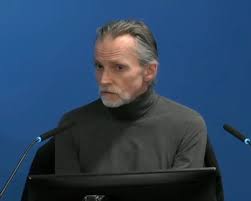
Giving evidence Boyling claimed that so heavy was inter-departmental rivalry between the SDS and CO11 (the Met’s public order unit, which carried out the arrests on Friday evening) that direct co-operation was rare, and that SDS evidence was unlikely to have been given to them:
“Do you know how your intelligence was disseminated for use policing this event?
A. No. I am pretty certain it wouldn’t have gone to CO11 on principle, because CO11, we wouldn’t have trusted them not to have compromised me. There was, um — they viewed Special Branch as a rival agency. They were just moving across — they had been set up to deal with football hooliganism and they were looking to move into areas that were traditionally Special Branch areas, but their tactics and approach were very different. And Special Branch didn’t really deal with them at all.”
(Transcript page 179)
This is contradicted, however, by other evidence as to CO11 and SDS’s relationship (see below) relating to April 12th.
The suggestion of a lack of co-operation between Special Branch and CO11 chimes with a number of comments Boyling made in his oral evidence to the Inquiry – effectively suggesting the SDS only produced intelligence, their job ended there, that decisions made by ‘higher-ups’ were not their work, and they may have even disagreed with those decisions. He even suggested the SDS were vaguely sympathetic to RTS’ aims (and other targets) and went out of their way to conceal evidence from the wider Met, on occasion, to allow some actions to achieve their goals.
All of which may generally be a smokescreen. For many reasons, but not least, because – if the arrests were not based on Boyling’s specific intel, how did the uniformed police obtain the information about the location where the papers were to be delivered? Core Participants from RTS have seen Boyling’s reports but no intelligence has been disclosed on how the police knew where to turn up. This evidence may exist and not have been made available – or may have been shredded (along with lots of other spycop material).
It is not impossible SDS material was passed to CO11 and then used by them without further reference to Special Branch – or even that other sources of info external to the SDS led to these arrests.
But given Boyling (like all the SDS cohort) is such a consistent and compulsive liar… who knows? Many questions remain unanswered.
The Sweet Smell of SDS Success
The SDS’s subsequent description of Boyling’s intelligence with regard to the April 12th events, as an “outstanding success” raises even more fundamental questions. The SDS’s stated raison d’etre was to produce intelligence that enables the police to prevent ‘disorder’ on the street. How can the large scale trouble that ended the night of April 12th be seen as successful?
Unless this ‘success’ reflects the police’s actual motivations for gathering this intelligence and their actions – ie, the way they used the information: to deliberately provoke a fight, then use overwhelming force to clear the street.
The Liar Lies Down with the Lambert
A few days after the March for Social Justice, on 16th April 1997, Boyling was visited at home by a superior SDS officer, referred to in the memo by the initials ‘BL’, so almost certainly Bob Lambert, at the time SDS ‘Controller of Operations’, himself a former undercover operative, with his own dubious record – mentor and inspiration to Boyling (they remained close for decades)
Notes of this meeting appear on pages 34-35 of a longer document [MPS-0748100].
The report of this meeting note describes Boyling’s role in preventing the DoE occupation as an “outstanding success”, one that had led to “plaudits from senior management… reigning [sic] down on the Branch”.
The 16th April meeting note states that “an original undertaking by uniformed police to allow RTS to enter the building had been gradually eroded as the day got nearer and positions hardened”. This implies that the police initially intended to allow the DoE occupation to go ahead, but that this decision was reversed in the run-up to the event. Ie: a deliberate decision to prevent the occupation was taken at some (late ?) stage, despite the SDS’s concerns that this action could increase the risk of one of their undercovers being exposed, not to mention the increased risk (phrased as “virtually guaranteed”) of public disorder flagged up over several reports by that officer.
People running workshops in a disused building, with a party outside, is not ‘disorder’. Trapping people in Trafalgar Square, and keeping some outside, then creating panic and attacking them (a policing tactic that has centuries of history), makes ‘disorder’ inevitable, as well as creating front page headlines declaring the event a riot or worse, obscuring the political message of the event. Reading this and other reports from Boyling, it is hard to avoid the conclusion that disorder was the desired outcome of at least some elements in the Metropolitan Police.
Communications from CO11 (the Met’s Public Order Unit) shown to the Undercover Policing Inquiry, as well as other evidence, shows again that the Met regarded the policing of the April 12th action as very successful and congratulated SDS on the part its intelligence had played in making it a success, which does tend to undermine Boyling’s claim (see above) that the SDS and CO11 were not talking.
The dynamic of SDS evidence being used by elements in the wider Met in a fast and loose interpretation of ‘preventing disorder’ was later to be repeated, after a fashion, on June 18th 1999, the Global Carnival Against Capitalism.
Again there is strong evidence of the SDS reporting being used by the Met, allowing rioting rather than preventing it, at least partly for their own ends: this time, to mislead the City of London Police, with whom the Met had a history of turf wars. Intelligence from Boyling was time withheld from being passed to the City Police, and the riot headlines in the aftermath helped the Met gain one over on their neighbours – they took over the responsibility to deal with public order in the City from the City force.
Light in April
Reading the reports as disclosed to RTS Core Participants, one big question was: Whose “positions hardened?” i.e. who decided they’d rather we ended up with a police riot in Trafalgar Square than hold a peaceful occupation of the former Dept for the Environment?
From the evidence disclosed to ex Reclaim The Streets activist Core Participants in the Public Inquiry, until the most recent Inquiry hearings in February 2026, there was a growing realisation that on April 12th we had all been set up. We assumed from the reports that this had been arranged either by SDS/Special Branch in cahoots with uniform Met hierarchy, or by the hierarchy based on SDS intel but at odds with SDS views on how that should be used.
Jim Boyling’s oral evidence to the Inquiry in February (aside from throwing up many other issues, which we can’t go into here) cast the setup in a different light. We don’t yet know if this is really light, or shade.
Boyling said during his evidence that stopping the RTS’ plan to take control of the vacant Department of the Environment building was motivated by the order to head off the high profile embarrassment of an ‘anarchist’ squat close to Parliament during an election campaign.
He played innocent at any suggestion that the intent was to allow a riot, in fact directly contradicting what he said in his reports at the time by asserting that the decision was justified by the fact it ‘kicked off big time’ in Trafalgar Square.
As we saw above, he knew this was likely, told his bosses, this was passed up the line and the decision taken. Boyling has subtly (?) reversed his position here.
Boyling’s evidence to the Inquiry sounds like it may have been ‘modified’ – in the light of someone pointing out that if the SDS reason to exist was to prevent disorder, him saying “this will prevent disorder”, then the police doing the exact opposite LOOKS LIKE the deliberate creating of disorder.
Was this a direct response to Boyling’s own Inquiry lawyer (or those for the Metropolitan Police as Core Participant?) reading RTS own witness evidence, set out in a collective statement several former RTS activists wrote and submitted (and also evidence in some individual witness statements)? Focussing on April 12th, the witness statement highlighted Boyling’s reports as disclosed so far, and the Core Participants’ obvious conclusions about the setup, as described above.
However, giving oral evidence to the Inquiry we heard – for the first time – Boyling claim that the decision to prevent the DoE squat was taken at the highest level – by then Conservative Party Home Secretary, Michael Howard.
“I was told on the phone that the decision that the activists would not be allowed to occupy the Department of the Environment building had been made by the Home Secretary… I think it was a phone call when I was driving my van… I was told… the Home Secretary has decided that the negative publicity in the run-up to an election caused by anarchists seizing a Government building next to Parliament Square would be too damaging and it’s not to go ahead.”
(Transcript of Boyling’s evidence to the Undercover Policing Inquiry, pages 173-4)
Jim went on to say that he and his boss Bob Lambert HAD recommended that RTS should be allowed to go ahead with their plan for the occupation, but were overruled as the day approached and “positions hardened”.
Boyling was asked if he thought Michael Howard had been told where the intelligence about the planned DoE occupation came from (ie an undercover officer embedded deeply in the organising of the plan). Boyling said he thought probably not, but claims he doesn’t know.
However, very relevant to this is that Michael Howard has been shown to be aware of the existence of the Special Demonstration Squad at least three and a half years earlier, in October 1993, in the wake of a huge demonstration protesting the presence of a fascist British National Party (BNP) bookshop in Welling in Southeast London. The shop and BNP activity in Southeast London was linked to widespread racist attacks, including murders, peaking in the notorious murder of Stephen Lawrence in April 1993.
The October ’93 anti-racist march was corralled by a huge police presence, and then attacked by the police, leading to street battles across the area.
At least four SDS undercovers are now thought to have been present – three spying on anti-racist campaigns, and one infiltrating the BNP themselves.
A memo mentioned by a Home Office Inquiry into undercover policing records that Howard was scheduled to visit the SDS “safe flat” in Marylebone to congratulate these officers in the wake of Welling, for their contribution their reporting had made to ‘successful policing’ of that demo.
In the event it seems Howard ‘was unable to make’ this visit to the safe flat. However, Met Police Commissioner Paul Condon DID visit, giving the relevant officers a bottle of whisky each to say thanks.
“Minister was due to meet SDS with Commissioner to thank them for efforts during Welling riots. Ultimately, the Home Secretary was unable to attend.”
The note is dated in the report as just ‘1993’ (though presumably dates from late October or early November – the Welling demo was 16 October).
The reference to Michael Howard’s planned visit to congratulate #spycops over their efforts to police Welling demo can be found on page 19 of Stephen Taylor’s report to the then Home Secretary: ‘Investigation into links between Special Demonstration Squad and the Home Office’ (published January 2015).
(Thanks to the Undercover Research Group for digging this reference out !)
Again, the ‘success’ at Welling involved a clearly pre-meditated mass police attack on a crowd which led to “Riot” headlines, lots of people beaten up, arrests and a number of jailings.
Yes, Minister?
If – as the targets of Boyling’s spying had previously thought – the Met hierarchy took the decision to confiscate thousands of anti-capitalist newspapers, prevent the DoE squat and provoke aggro and attack the crowd, this would consistute high level political policing.
If the Home Secretary took any part in that decision it takes the level up a notch. Or ten.
Non Stare Core Participants in the Inquiry did respond to Boyling’s claim that Howard was directly involved in making the decision to prevent the DoE occupation, by repeating a longstanding demand that Michael Howard – along with all other surviving Home Secretaries in the relevant period – be called before the Inquiry to give evidence as to what they knew about Special Demonstration Squad operations. This demand has always been denied by the Inquiry and we all accept that it is unlikely to happen.
Michael Howard is 84 and sits in the House of Lords, so maybe, he still has his marbles and retains his memories…?
The Home Office was instrumental in setting the SDS up, and directly oversaw its operations, outside of normal Met Police structures, from 1968 to 1989. How much each Home Secretary was told or signed off is still uncertain – to some extent the little we know about what Howard knew, is more than we know for most of the others who held the role.
If Boyling is telling the truth (yes, we know), and the Home Secretary took the DoE decision – the implication is this was even higher level political policing than revealed in the SDS reports. Theoretically, politicians are not supposed to interfere in operational policing decisions, which are meant to be taken by police themselves, independent of political control or direction.
“A fundamental principle of UK policing is that the police have “operational independence” from Ministers (e.g. see https://hansard.parliament.uk/commons/2023-11-09/debates/092F6A47-5FB4-465A-A05D-18A57A3C7189/MetropolitanPoliceOperationalIndependence.”
Obviously the reality is very different from the liberal illusion – policing is not apolitical, and politicians have always intervened to direct what police – and secret police – get up to.
Historically the Home Office oversaw the use of police spies and informers sent to report on, disrupt and agent-provocateur in movements for social change, trade unions and many more – this goes back centuries to the origins of the ministry. The setting up of the SDS under H.O. supervision was all in keeping with this. Any ‘operational independence’ is a smokescreen at best.
As noted above, campaigners spied upon by the SDS and other undercover units have for over 15 years been calling for the Home Office to be subject to the Inquiry and for what documents the Home Office held on us all to be revealed publicly.
So why did we campaigners NOT receive disclosure of whatever memos, briefings etc were sent from the SDS / Special Branch to the Home Office, and whatever responses were received, relating to the March for Social Justice and the rest of the 50 years of SDS operations?
Good question.
After initial revelations of widespread spycops activity hit the news in 2010-11, but before she bowed to public pressure to launch the Public Inquiry into Undercover Policing, former Home Secretary Theresa May commissioned a report into what the Home Office knew of the SDS.
This investigation – undertaken by Stephen Taylor, see above – neatly summed up its findings thus “The headline conclusion is that the Department was supportive of the SDS being created in 1968 and funded certain operational costs until 1989. Metropolitan Police Special Branch provided a level of accountability through an annual summary in this period. When funding ceased in 1989, no accountability was required until the SDS closed in 2008 and no significant evidence was identified of any links to the Home Office throughout this period.
Outside of the annual reviews there is very little evidence to support any Home Office knowledge of the SDS and in particular no evidence was identified of any influence in operational activities.”
This conclusion is undermined somewhat by the evidence – contained in Taylor’s actual report! – that Howard at least once was informed of intel coming from SDS and was even prepared to meet officers after Welling (and even more undermined if Boyling’s claim re April 1997 is true).
Not that Mr Taylor is known to be handy with a whitewash brush or anything.
However, his mildly surprising conclusion MAY be based on, shall we say, incomplete evidence. His report goes on to relate:
“This investigation did not identify any retained evidence available in the Department of any correspondence, discussions or meetings on the SDS for the 40 year period from 1968 to 2008. The only records relating to SDS currently available within the Home Office are very minimal (24 letters covering the whole 40 year period) and were only recovered recently from Operation Herne [one of the Police’s own investigations into the SDS].
Detailed file searches failed to identify any documents of relevance and although a consistent file reference is available, there is no record to show where this file is or when it may have been destroyed. The absence of any current record of this reference number in Departmental systems is a concern given that the material would have been classified as Secret or Top Secret. It is not possible to conclude whether this is human error or deliberate concealment.”
In other words – the Home Office were asked to produce what it knew about the SDS, handed nothing over, another inquiry found only 24 letters, but there are references to files which Taylor was not shown, or which no longer exist.
Given the millions of spycops files that have turned up, that the Home Office kept virtually nothing from 1968 to 2008 is unlikely. Were larger numbers of files on the SDS at one point held by the Home Office destroyed? Or just withheld, even from an official inquiry by the serving Home Secretary?
If they were destroyed – when did this happen?
We know Metropolitan Police shredded 1000s of files on undercover policing in May 2014, before it handed anything to the Public Inquiry.
Since Stephen Taylor’s report details his searches and inquiries getting no results in July 2012, any Home Office shredding may have taken place earlier.
Don’t Ask, Don’t Tell?
Returning to the April 16th 1997 debrief meeting, Boyling also expresses his worry that such clear use of his intel to prevent a plan that only few activists knew about in advance, puts him at risk of possible exposure by his targets. In reply he is told that the SDS cannot guarantee how his intelligence will be used in such scenarios and that a similar situation could well arise again in future. Basically – if the needs and interests of the wider Metropolitan Police require it, you’ll be hung out to dry, pal.
However, despite this warning, ‘BL’ seems eager to protect Boyling’s cover, and goes so far as to suggest that “it would be necessary at some stage to consider passing nothing to uniform – to offer some prospect of an RTS plan achieving its purpose – and thus afford some credibility and integrity to a small group of committed activists”.
Really? Were the SDS/Special Branch genuinely prepared to withhold intelligence from ‘uniform’ to protect their own officers’ cover? Or was this ‘BL’ posturing, perhaps for Boyling’s consumption and reassurance? If the SDS/SB were really planning to withhold intelligence from the Met hierarchy, would their motives have been solely to protect their own? To be fair if it got about that undercover cops’ identities could be blown (deliberately or as collateral damage) by the Met, recruitment of potential spycops might have have dipped.
SDS and Metropolitan Police’s murky shenanigans relating to J18 and the City Police in 1999 do reinforce how the Met were happy to play politics with other parts of the police in own sectional interests: The April 16th note implies the SDS, even within the Met, seemed to also be willing to withhold intel to protect their own operatives/their own brand.
In the note it’s even suggested that giving RTS a sop to their confidence if good for the SDS – because it keeps them unsuspicious, protecting Jim’s cover? Because it would keep their profile up, adding to the SDS’ justification for continued operations? in his oral evidence, Boyling went further and overtly claimed he and the SDS as a whole sometimes didn’t pass on intelligence because they sort of sympathised with some activities, respected the activists – even that some spycops’ target groups would have collapsed without the undercovers secretly keeping them active. Thanks mate! Could never have done it without ye all!
Or so they want us to believe? How much is real and how much is a partial picture revealing what they want us to think? You can tie yourself in knots with paranoia and intrigue if you let them, so maybe not worth spending all our time chasing white rabbits down holes.
Boyling, like all the former spycops, has been shown to be an extremely nasty example of humanity who will lie in either his own interests or the wider interests of the SDS, though he’s a little bitter at the wider Met after being sacked for misconduct (in relation to his sexual; exploitation of women he was spying on).
So it’s hard to know what’s true and what’s not.
And Does It All Matter Now?
Although as activists targeted by police over the decades we are hardly surprised by the idea of political policing targeting us for demonstrating alternatives to the status quo – it is always useful to see the mechanics of it at work and understand the motives & dynamics.
Whatever the actual political impact of a day of action/squat rave/temporary autonomous zone/weekend of discussions of alternatives to capitalism might have been, police resources were employed on a large scale over the weekend to repress as much of the message as possible.
At the time of April 1997 many on the March for Social Justice felt we were building a genuine alternative to the capitalist system. The linking up between the Liverpool dockers and RTS felt exciting, that it had potential to break ground, that it might help lead to change…
Obviously we may well have been naïve about that. But maybe it wasn’t just us who felt that…? What we would then have called “the state” reacted to Reclaim the Streets, and notably, the RTS-dockers axis, as if they felt threatened by it. Was Howard really, as one of us put it, “genuinely freaked by the idea of RTS, Liverpool dockers etc complete with pirate radio station holed up in Whitehall in the run up to the election” ?
For some of those in power, certainly, riot headlines were more acceptable than that. If Michael Howard did make this call, it didn’t do him and the rest of the Tories much good – they were swept away a few weeks later in the May 1997 Labour landslide (though that was on the cards anyway well before the events of April 12th). Labour Home Secretaries in subsequent years, faced with the same intel, might have taken the same decision: there’s a suggestion Jack Straw was fully informed about the role Boyling’s reports played in the police response to the anti-G8 summit protest in Birmingham in May 1998.
An ongoing debate: How much of a threat are movements for social change? And how much of a threat are these movements if they are penetrated so completely by police spies as RTS, and many other groups and campaigns have been shown to be? Why infiltrate us if we are not in some way a threat? Or is it the other way around? In evidence to the Inquiry the SDS officers have tended to portray the groups and movements they targeted as either ineffective, laughable, sometimes as the pawns of the spycops, OR as dangerous, violent, willing and able to threaten the social order. Sometimes they have tried to depict us as both a threat and not a threat at the same time.
RTS ideas and tactics were new and exciting in the mid-1990s, and inspirational around the world. In response, RTS in London (and beyond) was definitely subject to police attempts to sabotage its effectiveness. Not all of the reasons why RTS style actions might have become less effective over time are down to undercover activity – the force got wiser to tactics, learned ways of reacting, and repeated police use of brute force did scare people away from events. But SDS inside info definitely played its part. Alot more could be said on this subject but this maybe isn’t the place.
The UCPI continues in its twisted and partial way to partly lift the veil on undercover political policing – Though much of the work has been in fact done by many of the activists and campaigners themselves.
More info from anti-spycops campaigns at:
Campaign Opposing Police Surveillance
 LONDON RADICAL HISTORIES
Leave a comment