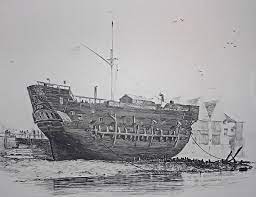
Current Home Office proposals to use barges and disused cruise ships to house asylum seekers, to placate racists who object to refugees being housed in hotels, include packing 500 people into a barge off the Dorset coast, though other ships are apparently being considered.
During the Conservative leadership campaign last summer, Rishi Sunak proposed putting illegal immigrants on cruise ships moored around the country but was warned it could be illegal under the Human Rights Act and the European convention on human rights. The idea was said to have been dropped, but it has since been revived. It is suggested that the cruise ships could be registered as hotels rather than detention centres to get around possible legal challenges.
Imprisoning people for fleeing war or looking for a better life obviously has a long and grim history in the UK.
So does locking people up on ships. The current government seems determined to take us all back a couple of centuries socially…
But as with most repressive urges, the need and desire to resist also has a long tradition…
Prison hulks
In the 18th and 19th centuries prisoners were imprisoned on ships, known as ‘hulks’, many moored in the river Thames, especially in the section from Gallions Reach and Woolwich east round to the Erith Marshes. Most were held waiting to be transported to penal colonies, though some were held pending trial.
The first British use of a prison ship was the privately owned Tayloe, engaged by the Home Office in 1775 via contract with her owner, Duncan Campbell.
In 1776 an Act was passed legalizing turning ships into floating prisons. The rapid increase in the prison population at the time was compounded by the rebellion of the North American Colonies (shortly to declare independence from Britain), for 150 years the dumping ground of choice for British courts ,who would sentence offenders to transportation to penal servitude (either for a fixed term or for life).
Deprived of this, and before newly discovered Australia became available, overcrowding in the existing prison system was rife.
Old ships, usually dismasted navy warship hulls, were the solution. Between 1776 and 1857 they housed a floating prison population – in grim and dangerous conditions, rife with death, disease and despair.
Tayloe owner Duncan Campbell was named Overseer of Convicts on the Thames and awarded a contract for the housing of transportees and use of their labour. Campbell provided three prison ships for these purposes; the 260-ton Justitia, the 731-ton former French frigate Censor and a condemned East Indiaman, which he also named Justitia. Collectively, these three prison ships held 510 convicts at any one time between 1776 and 1779.
The use of the hulks was initially seen as a temporary measure, and so was first authorised by Parliament for only two years. But in fact the hulks lasted for 80 years. The Act was regularly renewed, ‘for the more severe and effectual punishment of atrocious and daring offenders’.
The first hulks were moored on the Thames off Woolwich and the opposite shore, an area where marshes stretched along the shore and few people lived. On the southern shore, Woolwich was then a maze of workshops, warehouses, wood-yards, barracks, foundries and firing ranges.
The authorities were always keen to keep down the cost of the prisons, if possible to make life on the hulks worse than the poor had outside, to deter people from crime… (Since life outside was shite, and the vast majority of convicts had committed petty economic crime to survive amidst extreme poverty, this was generally a non-starter)
So prisoners were fed food as crap and disgusting as possible, often ox-cheek, either boiled or made into soup, pease, and bread or biscuit, the latter often mouldy and green. On two days a week the meat was replaced by oatmeal and cheese. Each prisoner was served two pints of beer four days a week, and badly filtered water, drawn from the river, on the others.
Sometimes, the captain of a hulk, if a particularly charitable individual, would allow the convicts to plant vegetables in plots near the Arsenal.
Housing convicts on the hulks was expensive, despite the clothing, food and accommodation supplied being of the worst quality. To cover the cost, convicts were put to work: mostly dredging the Thames’ main channel (getting gradualklky narrower, so that only the centre of the river was navigable), and in building the Woolwich Arsenal (arms factories) and nearby docks. Prisoners dug canals, built the walls around the Arsenal, and hammered in posts to protect the riverbanks from erosion. The convicts worked long hours on the banks of the Thames and at the dockyards at Woolwich: 10 hours during summer, 7 in the winter. The prisoners were chained up at night in manacles.
James Hardy Vaux was a prisoner on the Retribution, an old Spanish vessel, at Woolwich during the early 1800s.
While waiting to be transported for a second time to New South Wales, he recalled:
Every morning, at seven o’clock, all the convicts capable of work, or, in fact, all who are capable of getting into the boats, are taken ashore to the Warren, in which the Royal Arsenal and other public buildings are situated, and there employed at various kinds of labour; some of them very fatiguing; and while so employed, each gang of sixteen or twenty men is watched and directed by a fellow called a guard.
 These guards are commonly of the lowest class of human beings; wretches devoid of feeling; ignorant in the extreme, brutal by nature, and rendered tyrannical and cruel by the consciousness of the power they posses..
Conditions on board the floating gaols were appalling. Hygiene was poor, such that disease spread quickly. The sick were given little medical attention and often not separated from the healthy. Only two months after the first convicts had been sent to the hulks, an epidemic of gaol fever (a form of typhus spread by vermin) spread among them, which affected 100s of prisoners for over three years.
Convicts were given river water to drink, so dysentery was also widespread.
The living quarters were very bad. The hulks were cramped and all prisoners slept in fetters, on one deck barely high enough to let a man stand up. It was regarded as a major concession when sick prisoners were given straw mattresses – previously all cons slept on the bare floor.
During the first 20 years of the hulks (1776 – 1796), some 8000 convicts did time on the ships, of which a quarter died on board. Hulk fever, a form of typhus that flourished in dirty, crowded conditions, was rife, as was pulmonary tuberculosis. Most of the deaths on board were caused by neglect. Many of the convicts sent to New South Wales in the early years were already disease ridden when they left the hulks, resulting in serious typhoid and cholera epidemics on many of the vessels heading for Australia.
Healthcare was so appalling and so many dies, that it was long obscured that some hulk doctors were in fact encouraging sick convicts to pop their clogs early.
For much of the 18th century, surgeons had the legal right to take the corpses of the executed from Tyburn for dissection in medical schools – a practice which outraged much of the general populace, and led to riots and pitched battles. No other legal method for onbtaining bodies was available, so a brisk trade in bodysnatching grew up. The 1832 Anatomy Act tried to rectify this by giving surgeons access to the dead from workhouses hospitals and prisons that were unclaimed 48 hours after death.
One result of this was an increase in bodies of the dead convicts from hulks being either cut up on board a hulk, or supplied to medical schools. Some hulk doctors seem to have deliberately neglected patients, to as to add to the tally of available bodies – for which there was a lot of cash to be made.
This led to a minor scandal – and to the 1847 Inquiry into General Treatment of Convicts in Hulks at Woolwich, which publicly exposed the prison hulk system as one that used, used, mistreated, and trafficked convict corpses. This contributed to the eventual decommissioning of the proison hulks in the 1850s.
As with most of the British prison system at the time, a semi-private structure operated, so that private ship owners not only got paid for housing inmates, but cons were also exploited routinely by keepers.
From 1776 until around 1817, convicts who died in these terrible conditions were buried in unmarked graves, on the marshes, or inside the Woolwich Warren. Great quantities of human bone were unearthed when the new gun factories were built in the late 1850s.
An account of life on a hulk, from “Old Convict Days” by William Derricourt.
After sentence I was condemned, previous to being sent to the hulks, to the treadmill in Stafford Goal. There being no corn to grind and no opposing friction to the weight of the steppers on the wheel, if ever mortal boy walked on the wind I did then. The turns were so rapid that should anyone have missed his footing a broken leg might have been the consequence.
This time came to an end, and orders were received for my being passed on with others to the hulks at Woolwich.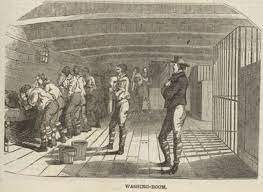 Quarters were assigned me on board the Justitia Hulk. Before going on board we were stripped to the skin and scrubbed with a hard scrubbing brush, something like a stiff birch broom, and plenty of soft soap, while the hair was clipped from our heads as close as scissors could go. This scrubbing we endured until we looked like boiled lobsters, and the blood was drawn in many places. We were then supplied with new ‘magpie’ suits — one side black or blue and the other side yellow. Our next experience was being marched off to the blacksmith, who riveted on our ankles rings of iron connected by eight links to a ring in the centre, to which was fastened an up and down strap or cord reaching to the waist-belt. This last supported the links, and kept them from dragging on the ground. Then we had what were called knee garters. A strap passing from them to the basils and buckled in front and behind caused the weight of the irons to traverse on the calf of the leg.
In this rig-out we were transferred to the hulk, where we received our numbers, for no names were used. My number was 5418 — called ‘five four eighteen’. I was placed in the boys’ ward, top deck No. 24, and as turf-man’s gang our first business was repairing the butts, a large mound of earth against which the guns were practiced. After completing this we were employed some days at emptying barges, and then at a rocket-shed in the arsenal cleaning shot, and knocking rust scales from shells, filling them with scrap iron, etc., as great preparations were going on for the China war. At other times we would be moving gun carriages or weeding the long lanes between mounted guns. One particular job I had was cleaning ‘Long Tom,’ a 21-foot gun at the gate. During all this time I was never for a moment without the leg irons, weighing about twelve pounds, and indeed, so used to them had I become that I actually should have missed them had they been removed. Though our work was constant, we did not fare badly as regards victuals. Our mid-day meal often consisted of broth, beef and potatoes, sometimes of bread or biscuit and cheese and half a pint of ale. One custom of the times was that for each prisoner one penny per week was laid aside by the Government, with the object of securing the workers from the disgrace of being simple slaves. This money, any man, on recovering his freedom, could claim by proving to the proper authorities who he was; but it is hardly necessary to say that, for personal reasons, very few cared to go to this trouble.
On board the Justitia Hulk there were about 400 of us, and occasionally the ‘Bay ships’, or transports, would come up the river to take off drafts from the different hulks. We always knew the transports by the number of soldiers on their decks. The drafts were, of course, for transportation to the various penal colonies.
At the distance of about a mile from our hulk lay the hospital ship, which I only once had the misfortune to visit. While at work one day I was seized with a paralytic stroke, entirely disabling one side, and making me almost speechless. After three days in hospital I nearly recovered the use of my side, also of my voice; but I was kept on board a short time longer, engaged in light duties among the patients.
In the berth next to me was an old man employed in the same way. I once found him in one of the funniest fixes I can ever remember. One day when I was at work in another part of the vessel I lost sight of the old fellow and, upon seeking for him, found that he had actually buried himself. The thing happened in this way: On board, stowed away in one corner, were a number of empty coffins. The day being hot, the old man got into one of these and fell asleep, not knowing that his resting-place had been used to hold pitch. The weather was warm, and the sleeper, when he woke up, found that he had sunk into the remains of the pitch, which still filled about a quarter of the depth of the coffin, and could by no means get out. The coffin had to be knocked to pieces to deliver him, and he received 25 lashes for neglect of duty and idleness.
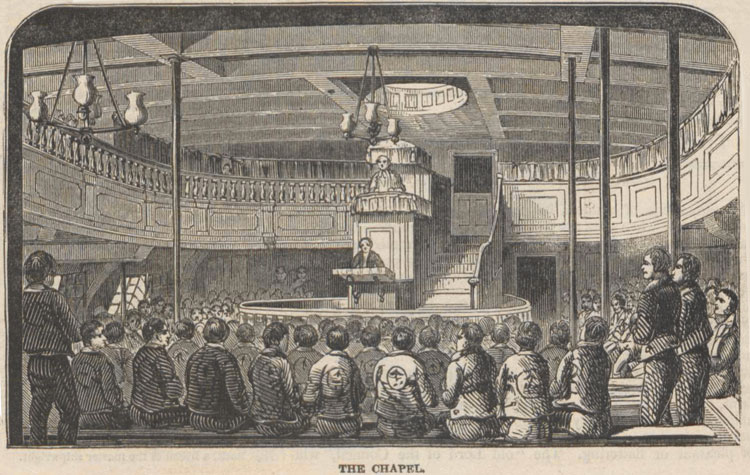 I only remained in hospital one week and was then returned to the Justitia, where, because of my having suffered from paralysis, and my general good conduct, one of my leg irons was struck off. The feeling of having one leg fettered and the other free was very curious. On one leg was twelve pounds of iron and the other seemed as light as cork, and, do what I would, I could not get them both to act together. I wished over and over again to have my fetters arranged as before, instead of having all the weight on one leg. I actually asked the captain to have this done, but he only laughed at me and told me I should soon get accustomed to the change, as I shortly did.
Between 1793 – 1815 about 200,000 prisoners of war were held on hulks and in depots. During the Napoleonic Wars, French prisoners could be held in prison ships at Chatham, Portsmouth and Plymouth.
The Morley, a hulk moored in Gallion’s Reach, held women prisoners in the 1830s. Prisoners who died – many did in the inhuman conditions – were often dissected by surgeons, & buried in Plumstead marshes in unmarked graves. Near the Woolwich Arsenal, a red-flowered nettle called ‘convicts flower’ grew on the graves.
Locking up 100s of people in such conditions was bound to produce desperate resistance, and did.
The most common reaction was to try to leg it.
Prisoners used to try and escape the Gallions Reach hulks, across the marshes, to Charlton, ‘towards Cox’s mount & the gravel pits’.
On 23 April 1777 convicts staged a mass escape, from a prison hulk at Woolwich.
Escape carried risks – it was a punishable offence in itself. Attempts by any prisoners to file away or knock off the chains around their waists and ankles led to frequent floggings, extra irons and solitary confinement in tiny cells with names like the ‘Black Hole’. Floggings with a cat o’nine tails were a common occurrence on board the hulks. In 1785, Patrick Dudley was hanged for escaping from a hulk for the second time.
In 1832, 3 cons, Bartel, Wallace & Dalton, rushed the sentinel while doing convict labour in the Woolwich Dockyard.. they broke into London road, legged it to the brickfields & up the hill to Charlton sandpits – there they were trapped, caught & flogged.
One group of prisoners held on board the Fortitude at Chatham attacked quarter-master Hillier in a ‘ferocious manner’ leaving him severely wounded on the head. The ‘ruffians’ then seized some oars and dashed for the boat lying alongside the hulk. A violent conflict broke out between guards and the prisoners while other prisoners tried to assist the guards who acted in a ‘very praiseworthy and gallant manner’. Seven prisoners managed to escape and were pursued by the dock-yard guard and police as well as a crew from the Winchester frigate anchored nearby. Other people in nearby boats who had witnessed the escape also joined in the pursuit but the prisoners had made a good start. They dispersed into the marshes on the opposite shore. The hunt was strengthened by military guards from Upnor Castle and two men were captured. The remaining five succeeded in getting to the fields but were finally caught in a hollow in the woods.
A more reliable method of escape was to employ local groups willing to take risks and who knew the surrounding areas well: local smugglers were a top option… especially from the hulks moored in Chatham, on the Kent coast, where smuggling was still popular.
The likelihood of armed mutiny was also forever present.
In September 1778, the Gentleman’s Magazine reported a riot by 150 convicts in the Woolwich hulks, which led to the death of two convicts and the wounding of seven others. Riots continued into the nineteenth century.
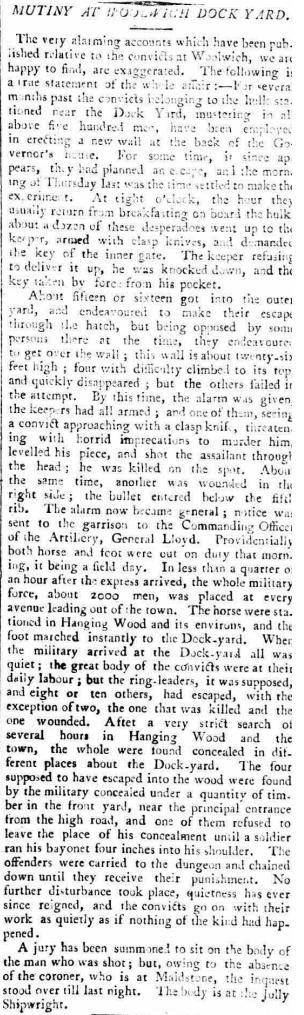 In August 1802, again at Woolwich, there was onboard rioting: “Several of the convicts who are to be transported to New South Wales formed a plan for an escape, which they endeavoured to carry into execution this day. They were all on shore, to the number of about 170, and were confined within a building near to the waterside, where they are accustomed to work, and which is fenced round with a high wall. On a sudden they rushed out and seized some of their keepers, and others they knocked down. The ringleader had armed himself with a large knife, and on finding that the convicts had secured the keepers, proceeded to the outer gate, where a centinel [sic] was placed. To him the armed convict, with several others, addressed himself, and insisted upon the gate being opened, or he would instantly run him through. The soldier fell back a few paces, and shot the ringleader through the head. At the instant he saw the centinel about to fire, he turned away his head, but the ball entered the back part of it, and he died immediately. Another of the convicts was attempting to scale the wall, and was shot by an other soldier. – it was their intention to have seized those boats which are generally in waiting to take the convicts on-board the hulks; when many of them would have got clear off. “
In November 1823, three prisoners escaped from Ethalion prison hulk moored on the Thames, which launched a series of revolts, disorder and attempted escape from this ship and others which went on for some months. i
By the 1850s, such rioting and onboard communal disobedience had taken an ironic tone. The London News of 3 January 1852 reported under the heading ‘Convict Demands for Transportation to Australia’ that “news of the gold discoveries in Australia had penetrated to the wretched inmates of the hulks who have risen en masse on board the Warrior at Woolwich, and, armed with knives and other weapons, have mustered together in one part of the ship in a body numbering upwards of 100, and demanded to be immediately conveyed to the ‘diggins’ . . .”
@@@@@@@@@@@@@@@@@@@@@@@@@@@@@@@@@@@@@@
The abolition of the hulks in the 1850s did not end the practice of locking people up on ships.
During the 1920s, the vessel Argenta was used by the British government as a military base and prison ship for holding Irish Republicans as part of Britain’s internment strategy following the partition of Ireland. In the spring of 1922 the Irish Republican Army (IRA) launched an offensive in Northern Ireland resulting in the internment of many Irish Republicans on the Argenta.
50 years later, Irish republicans were again imprisoned in Northern Irish waters. The Maidstone, a transport ship which had brought troops to the North to intervene as it spiralled into rebellion and sectarian war, was used to hold 100s of men from ‘nationalist’ communities rounded up in mass internment.
More recently, a ship was fitted out as HM Prison The Weare, moored off Dorset and used as a prison between 1997 and 2005.
 LONDON RADICAL HISTORIES
Leave a comment