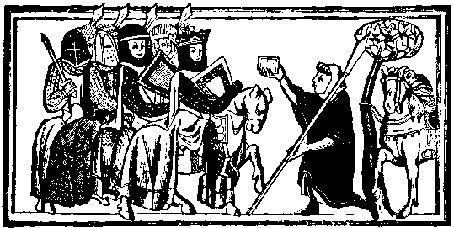
The Peasants’ Revolt of 1381 played out on a ‘national level’ – that is, huge armies gathered, marched on the capital, and caused a brief crisis and threat to the power of the feudal system and the aristocracy, monarchy and church establishment, who benefitted from the feudal labour of serfs all over the land.
But the revolt also found local focus all across the south-east of England. The grievances that led to the revolt were not uniform; many and varied oppressions sparked anger and rebellion, and outbreaks of trouble generally saw particular hated lords targeted. Some bands of rebels erupted at the poll tax collectors trying to extort cash from them; some sorted out some local grievances before marching on London; many never marched to London at all but busied themselves with the local powers-that-be.
Major targets of local action were the manor rolls and the court rolls – basically, the records of the feudal services local villeins and serfs ‘owed’ to their lord, and the records of disputes, refusals, fines and arguments over the extraction of these obligations. Long before 1381, these unpaid duties towards your feudal superior caused constant friction; the labour shortages resulting from the Black Death of 1348-9 gave the serfs a greater power to negotiate, despite royal action against their freedom to leave home to look for better situations.
When the 1381 rebellion broke out, many manor houses were attacked, and the manor rolls seized and burned, both as a symbolic gesture and a practical attempt to erase the record of what the lord could demand of his tenants.
One local example: the men of Chipping Barnet played a rowdy role in the area of Middlesex around St Albans and Barnet; this is captured by the horrified St Albans chronicler.
The Abbey of St Albans was the most powerful landowner in the area; successive abbots’ attempts to maintain the rolls and demand the full duties ‘owed to them’ had increasingly got the Abbey’s tenants’ backs up. The revolt provided inspiration and opportunity to even up the scores…
According to his account, on entering London on 13 June, the Kent and Essex rebels sent a message to St Albans via men from Barnet, and the next day Barnet men were again prominent in the St Albans contingent which headed to the capital and returned with the message that ‘there would no longer be serfs but lords’.

During the following week the rebels attacked the symbols of the abbot’s lordship, broke into his prison, woods and warrens, and burnt the hated court rolls. They also engaged in what sounds like some provocative and near-blasphemous agitprop, staging a mock mass, but placing torn-up documents instead of communion bread on the tongues of the (un?)faithful.
The rebels forced the abbot to issue charters for each village; not only in St Albans itself, but also areas further afield where the Abbey’s writ ran. ‘The people of Barnet came with bows and arrows, two-edged axes, small axes, swords and cudgels and obtained a similar charter of liberties as those of the people of St Albans, including free hunting rights, fishing rights, and rights of erecting hand mills’ (milling was the lord’s monopoly).
After this they demanded’ a certain book made from the court rolls’ so they could burn it because it contained evidence that’ almost all the houses of Barnet were held by the rolls’. The abbot prevaricated’, promising it within three weeks, and thus saved the book for posterity.
The revolt was over in London by 15 June, but total suppression further afield took longer.
On 28 June royal commissioners arrived in St Albans, but there was still some resistance: ‘300 bowmen from the surrounding villages, especially from Barnet and Berkhamsted’ gathered in arms to continue to assert their demands.
On 15 July king Richard II arrived in St Albans and annulled all the abbot’s enforced concessions, and on 20 July received oaths of fealty from all the inhabitants of Hertfordshire.
The defeat of the Revolt was far from the end of resistance to the power of the Abbey locally. The abbot’s tenants had concentrated on specific grievances, but since these were suppressed, not addressed, tensions soon began to rebuild. Illegal land transfers continued, and in 1417 there was another violent revolt; royal justices eventually had to be sent to intervene, because ‘the bondmen and tenants in bondage of the abbot of St Albans at Chipping Barnet have leagued together to refuse their due customs and services’.
Many of those involved in 1381 were not peasants at all, but men of substantial property. The Barnet rebels in 1417 included twelve freemen, among them a citizen of London. During the 15th century, serfdom and the associated services and indignities – which had provoked the fierce struggle between abbot and tenants at Barnet – was gradually phased out.
 LONDON RADICAL HISTORIES
Leave a comment