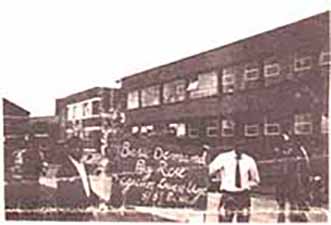
In June 1968, 85 machine operators were locked out of the Injection Moulders factory in Queensberry, North-west London, as a year-long struggle for better wages and conditions came to a climax.
Here’s an account of the dispute, reprinted from an article from Solidarity’s west-London newspaper from 1969
…………………………………………
This article is an answer to those dockers (and other workers) misguided enough to swallow the racialist nonsense of Enoch Powell. It is about a dispute in which a bulk of those involved were Pakistanis and West Indians. It should help explode the myth that immigrant workers are prepared to accept wages and conditions that British workers wouldn’t touch.
The article also shows how a relatively ‘new’ labour force, unfamiliar with the tortuous and time consuming channels of ‘official procedure’ (and lacking cynicism bred of repeated ‘betrayals) can immediately resort to radical methods of action and – through sustained solidarity – achieve worthwhile results.
The lock-out involving 90 men at a small factory in Queensbury should be studied by socialists and industrial militants. It illustrates a rather neglected feature of monopoly capitalism.
We are all too familiar with the usual results of takeover bids: closures and sackings. But in other cases smaller units swallowed up by the Big Boys are in fact kept open. Having studied this article the reader will know why.
It is taken for granted by those with scant knowledge of industry that certain standards are adhered to regarding working conditions and hygiene. Many believe that wages, if not generous, are at least adequate. This dispute should be an eye-opener to them.
Injection Moulders Ltd. is part of the giant Guest Keen and Nettlefold (GKN) empire (total capital £240 million!). It is situated on the small Queensbury (Middx) Industrial Estate. The factory produces plastic mouldings for a variety of industrial products (switches, insulators, etc.). It became a subsidiary of GKN’s last year (1967). The firm held a long reputation for being anti-union. Prior to the takeover, it had been engaged in recruiting immigrant labour to such an extent that Asians and West Indians comprised over 90% of the labour force. Tis recruitment has been continued by GKN. One would like to think that this was a philanthropic gesture by a liberal management, eager to prove itself a pioneer in industrial race relations. However, it is more likely to reflect the firm’s experience with ‘cheap labour’ in South Africa and Rhodesia. Incidentally, GKN is one of the biggest contributors to the Tory Party funds.
Language difficulties and lack of industrial experience limit the area of work open to Asian immigrants. To shrewd managements, these men appear ‘attractive propositions’. But capitalists frequently fall for their own lies: the cheap labour myth was the one Injection Moulders management swallowed. This illusion and many others have taken a knock during this dispute. Workers, irrespectively of race, have to pay the same prices in shops. Asian and West Indian immigrants often fork out a lot more for rent. Therefore acting as cheap labour just wasn’t on.
’Something out of Dickens’
At 5/5.5 an hour for machine operators, the wages at Injection Moulders are among the lowest in the area. In order to take home sufficient to live on the men often exceed a 70-hour week! At the rates GKN are paying, they can afford any amount of overtime.
Only the management can understand the bonus scheme. Errors are often made. The chargehands say ‘We’re only human’ – a claim that no one who has worked for them would endorse.
The working conditions remind one of a story out of a Dickens novel. The shop floor is dusty and hot. Sanitary arrangements are primitive: filthy wash basins, no proper drinking water, only four W.C.s (one of these had to be used as a urinal). Any operator wishing to visit the toilet had to get someone to ‘stand in’ for him. Several workers have been refused permission. The discomfort and indignity caused by such callousness can be imagined. There are no tea-breaks at Injection Moulders. If you do have tea, you drink it while you work. Operators often work from 7pm to 2am without a break. It isn’t surprising that some of them decided things couldn’t continue like that.
The factory has never been trade union organized – and it seemed unlikely that Asian and West Indian immigrants could manage to do what their white colleagues had failed to do in 25 years. Yet this is precisely what they did. It is a remarkable achievement considering the difficulties they faced. Several Pakistani and West Indians had some trade union experience. Several were well educated but due to the colour bar in the jobs they had entered industry – poetic justice indeed! It was extremely difficult to organize openly, but despite this some men were recruited into the AEF. Encouraged by this, the North London Area Organizing Committee of the AEF leafletted the factory.
The management sacked one man who was active in the union – for breaking a moulding pin valued at 6d! Stewards were victimized by being forbidden to talk to their fellow workers. One steward was told not to talk to the men because ‘it could reduce output’. As the number of men joining the union grew to 50% the management decided to use the age-old ‘divide and rule’ policy. They conferred staff status on the setters. Despite this, by March 1968 95% of the machine operators were in the union. They prove to be no mere card holders, but men determined to struggle for better pay and conditions.
Speed-up began after the Time and Motion people had visited the machine shop, The ‘experts’ would study a machine and its operators for 30 minutes (the machine had to be operated 12 hours!). Machine rates were increased and so were the minimum job rates necessary to earn a bonus. One machine set at 65 cycles an hour was speeded up to 90. Not surprisingly, no one could make it pay.
The ‘granulating’ question
Excess plastic from mouldings is trimmed off and re-processed by granulating. This job has always been done in a separate room. The management decided to fit each machine with a granulator. Each operator would have to run this machine as well as his own. Quite apart from the extra work involved, the men objected to the health hazards. The grinders were dusty and anyone drinking or eating would be lucky if he didn’t swallow the dust. Many got sore throats and lost their voices.
The management refused to discuss with the shop stewards using the pretext that they hadn’t been officially informed of the stewards’ names. Negotiation eventually began but one steward was excluded because his name had been misspelt. The management appeared to concede that granulating was a separate job and that lack of space was their problem. But they didn’t seem in any hurry to solve it!.
On June 18, 1968, the steward informed the bosses that their members were no longer willing to operate the granulating machines – until talks began. The management made no reply. The lads worked normally – i.e. refused to do the granulating. On June 24 a Works Conference was held. The bosses refused to negotiate unless the operators did granulating.
That afternoon the manager called one of the day shift stewards into his office (the other steward was ill at home). While the manager and steward were talking, the supervision were busy in the machine shop. They approached the operators and tried to get them sign a book – this would commit them to operating the granulators. This crude attempt to cut off the men from their stewards failed. The lads refused to be intimidated. They wouldn’t discuss anything in the absence of their elected representatives. The management told the men to go out and informed them that they were sacked.
Solidarity
The locked-out workers sent for a night shift stewards, then waited until 7pm for the night shift men to appear. A meeting was held and it was decided that the night shift would go in and work as usual. On entering the factory the night shift workers found no clock cards in the rack. The stewards told the bosses that the men would be willing to work but not to granulate. Within minutes the police arrived and ejected the workers. They came from Wembley, some miles away. It looked as though the whole operation was planned.
Two weeks later the locked-out men received a letter informing them that they were dismissed. They refused to collect their cards. The bosses then sent them to the Labour Exchange.
The North London District Committee of the AEF met on July 1st and decided to support the Injection Moulders workers. Eight days later the Union Executive gave official backing. This encouraged the men – their loyalty and faith in the union is fantastic (it will no doubt take a knock in the future). The slow machinery of officialdom churned into action, soon overtaken by the solidarity of local militants. Collections were held in nearby factories. Workers from Simms Motor Units, Hoovers, Rotoprint, Phillips and Ford, Hilger and Watts joined the marches in solidarity. They also put pressure on to ensure that products from Injection Moulders were ‘blacked’. Students joined the picket lines and were present every day of the dispute.
Many of the locked out men had purposely saved some money for such a dispute. The not so well off were taken care of. Stewards would gather the men around them and ask if any of them had a pound note. Two groups would merge: the haves and have nots. The money was the shared out without a murmur either of protest or gratitude. There was a silent understanding between them.
‘Integrated’ scabbing
The blacking wasn’t extensive and the factory continued some production. The management succeeded in persuading some other workers to do the operators’ jobs. Chargehands would operate fork lift trucks in the road, although they had no license. Alf Payne, local brach AEF branch secretary, got onto the local police. They ‘checked’… but the work continued. The quality of the work produced by the scabs wasn’t up to much. Frigidaires, Fords and Rotoprint rejected much of it.
An American firm called ‘Manpower Ltd.’ supplied 30 scabs. They were a cosmopolitan crowd: white, Asian and Negro. Some were students. One drove his Union-Jack-bedecked motorcycle right through the picket line. Policemen standing nearby ignored the incident. ‘Manpower’ received 11/6 per hour for each scab supplied, out of which the scabs received 7/6 an hour. Obviously Injection Moulders could well afford to give its operators a rise.
Does the P.I.B. know about scab rates which involve less productivity – and bad quality at that? It was nauseating to hear student scabs rationalizing their disgusting behaviour. Another nasty taste was the fact that two white workers who had at first supported their colleagues took money from the strike fund and then went in and scabbed! It was a bizarre situation: black and white students and workers were inside the factory scabbing; black and white workers and students were outside – manning the picket line!
Drivers would be stopped by pickets and told that an official strike was on. TGWU card holders would ring their district officials and were told ‘we know nothing about a dispute’. So much for official help. A sympathetic driver would sometimes be persuaded to come into management’s office ‘to use the phone’. After a few seconds, he would emerge and proceed to unload his lorry. It is not known what passed between them in the office – but it is unlikely to have been a discussion on business ethics!
No mention of the workers’ case appeared in the local rag. It referred to Injection Moulders and peddled lies about the role of ‘professional demonstrators’ (the people referred to were industrial workers and students of International Socialism and Solidarity who were able to assist workers). The article also referred to the coloured workers’ who remained loyal’. White legs?
The bosses start to crack
The AEF officials put pressure on manpower Ltd. who withdrew their men. This was one of the first signs of victory. The bosses no doubt surprised at the assistance the immigrants received from other workers and perturbed at the phenomenon of political groups helping their employees started to talk with the union. Bill MacLaughlin (a dissident CPer) and his assistant Les Elliot met the management who offered 1/- an hour rise but declared that they reserved the right to exclude persons they considered ‘undesirable’. A meeting was held outside the factory and this ‘magnificent’ offer was turned down flat.
The spirit of solidarity had to be seen to be believed. Unlike other groups of workers these immigrants had little choice of jobs – they couldn’t afford to chuck a job in and move on. They had their backs to the wall. They were determined to fight and win. At one meeting in the Queensbury swimming baths the Brent C.A.R.D. people attempted to recruit the locked out men, but were unlucky. The locked out men wanted practical help – they seemed unimpressed by C.A.R.D. claims that 9 out of 10 problems could be solved by union officials or local MPs. C.A.R.D. could have assisted by dealing with the black scabs, or picketing, rather than by trying to recruit members.
Political groups
For a considerable period political groups have joined picket lines (Shell Mex House, the Barbican, etc.). This has often either been resented by strikers or has taken an artificial character – substitution for the lack of real working class support (May day March). The Injection Moulders lock-out saw the emergence of a different kind of student. These were comrades who have now considerable experience of factory leafletting, etc. – they had access to valuable information and time to assist. I.S. comrades and one or two Solidarity members who weren’t on holiday turned up to join the picket line. Leaflets were produced informing local factory workers of the dispute and appealing for funds. Shop stewards were contacted. Posters were made. For a change these comrades formed part of a team: too often students seem to ‘know better’. This time they listened and offered help.
Victory!
On Wednesday, August 14, the management conceded defeat. Tea breaks would be allowed. Improved amenities for meal breaks were promised. A rise of 1/7d per hour was offered (with bonus a rate of 8/6 hour was this guaranteed) and accepted.
The men had planned to resume work on Monday 19th. But on Thursday 15th the stewards discovered that the management had decided to put the machine operators on a 3 shift system (the scabs and setters were to remain on a 2 shift basis). This was rejected by the men as another way of dividing them. Despite the gains already made they decided to stay out until this idea was dropped. It was. A weary and utterly defeated management caved in. The men went back on Thursday, August 22.
This is a victory for rank-and-file trade unionism. It is also a victory against the lies of racialist who spread the bilge about immigrants undercutting British workers. In this dispute a small number of men fought against tremendous opposition. They thought perhaps that they would be alone in their struggle; so apparently did the Injection Moulders management. They both proved wrong.
@@@@@@@@@@@@@@@@@@@@@@@@@@@
The strike at Injection Moulders also helped to inspire a dispute a year later at the nearby Punfield Barstow Works.
Nicked from the excellent Angry Workers
 LONDON RADICAL HISTORIES
Leave a comment