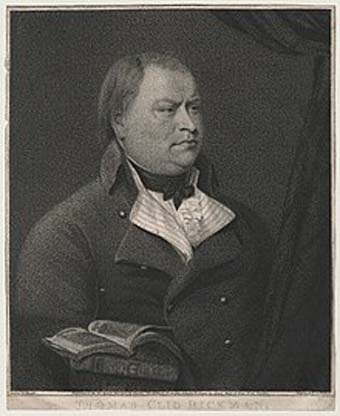
Thomas ‘Clio’ Rickman (1761–1834), bookseller and reformer, was born in Lewes, on 27 July 1761. Both his parents were quakers. He was originally apprenticed to an uncle practising as a doctor at Maidenhead, with a view to a career in medicine.
But when he was about seventeen years old, there came meeting that was to set his life on a different course. Revisiting his old home of Lewes, he met Thomas Paine, the freethinker, who was living in the town, working as an exciseman, in the late 1760s.
Both men joined the Headstrong Club, a debating society, which met at the White Hart Inn in Lewes. Due to Rickman’s precocious penchant for poetry and history, he acquired the nickname of ‘Clio’, which he used as a pseudonym in his later writing. Rickman, like Paine, also dabbled in invention and mechanical innovation…
His friendship with the by-then notorious Paine, as well as his marriage to a non-quaker, got Rickman expelled from the Society of Friends in 1783. He left Lewes and moved to London, setting up as a bookseller, at first at 39 Leadenhall Street, in the City, and later at 7 Upper Marylebone Street, where he spent the remainder of his life. (This building was demolished, but stood on the site of what is now 148 New Cavendish Street.)
Tom Paine stayed at Rickman’s house in 1791 and 1792; it was there that he completed the second part of his classic book, ‘The Rights of Man.’ (Rickman later fixed a small commemorative plaque on the small table at which Paine wrote; the desk was exhibited, with many other relics of Rickman, at a Paine exhibition, in December 1895). Rickman mingled in the London radical, reforming and literary circles that Paine also moved in around this time, and his house hosted dinners and discussion that attracted figures such as Mary Wollstonecraft, Romney, and John Horne Tooke, William Godwin, Joseph Priestley, and William Blake…
Rickman later wrote an account of Paine and his associates at this time:
‘Mr. Paine’s life in London was a quiet round of philosophical leisure and enjoyment. It was occupied in writing, in a small epistolary correspondence, in walking about with me to visit different friends, occasionally lounging at coffee-houses and public places, or being visited by a select few. Lord Edward Fitzgerald [supporter of the United Irishmen rebellion]; the French and American ambassadors, Mr. Sharp the engraver, Romney the painter, Mrs. Wollstonecraft, Joel Barlow [American diplomat and poet], … Mr. Christie [Scottish republican pamphleteer], Dr. Priestly [scientist and dissenting preacher],…the walking Stewart [so named for having walked from India to Europe via Russia], Captain Sampson Perry [editor of The Argus, a Republican journal], … Mr. Horne Tooke [leader of the Society for Constitutional Information] &c. &c were among the number of his friends and acquaintance…
… at a dinner party with several of the above, and other characters of great interest and talent, Horne Tooke happened to sit between Mr. Paine and Madame D’Eon [French transvestite and spy]; for this character was, at this time, indisputably feminine. Tooke, whose wit and brilliant conversation was ever abundant, looking on each side of him, said, “I am now in the most extraordinary situation in which ever man was placed. On the left of me sits a gentleman, who, brought up in obscurity, has proved himself the greatest political writer in the world, and has made more noise in it, and excited more attention and obtained more fame, than any man ever did. On the right of me sits a lady, who has been employed in public situations at different courts; who had high rank in the army, was greatly skilled in horsemanship, who has fought several duels, and at the small sword had no equal; who for fifty years past, all Europe has recognised in the character and dress of a gentleman.” – “Ah!” replied Madame D’Eon, “these are very extraordinary things, indeed, Monsieur Tooke, and proves you did not know what was at the bottom.”
— Thomas ‘Clio’ Rickman Life and Works of Thomas Paine 1819
Rickman was later to include biographical notes on many of these characters in his ‘Life of Paine,’ which he published in 1819, the major work of his life.
But his association with Paine continued to get him into trouble, especially as Paine became more notorious and his ideas more suspect, in the context of the French Revolution (which Paine had both supported and later helped to inspire/worked for) accelerated and became more radical. Rickman was often in trouble for selling Paine’s books. At the close of 1792, he was forced into hiding as he was targeted for this.
In 1794 he was again in trouble with the authorities, for publishing and selling the ‘Rights of Man’; in 1802, he was forced to flee to France for a while.
Paine was by then living in Paris; Rickman accompanied him to Le Havre, as Paine set off on his final trip to America. This was in September 1802: they would never meet again.
In 1804 Clio was arrested once again; although he was bailed, all his books and papers were confiscated.
In 1812, Clio was again involved in the publication of Daniel Eaton’s edition of Paine’s “Third Part” of The Age of Reason, in 1812, a book which directly questioned the place of organised religion in any civilised society, and provided an introduction to the publication by Eaton, for which he went to prison in 1812. In 1822 he was again arrested on a charge of selling subversive literature, and spent a week in the Fleet prison.
Rickman possessed a vein of satirical humour, and from the age of fifteen wrote much in verse and prose. Some pieces later appeared in the ‘Black Dwarf’ newspaper (1817-19) and other weekly journals. He also wrote republican songs, which were published as broadsides, often with music.
Rickman also influenced Shelley’s radicalism. Shelley may have been drawn to him by his eagerness for information on Paine, as Rickman was then preparing his life of his former lodger, and was well-known to have been his friend. In September 1812 Shelley was writing his first major work, the Spenserian allegory: Queen Mab. His background reading for the poem was prodigious. To obtain some of it he called upon the services of the veteran radical, poet, singer and bookseller. In a letter to Rickman, Shelley told him; “I prefer employing a countryman, and a man of liberal and enlightened mind to a stranger”.
Rickman fathered several children from his two marriages – they were named Paine, Washington, Franklin, Rousseau, Petrarch, and Volney, testifying to his enthusiasm for liberal ideas.
Rickman died at 7 Upper Marylebone Street on 15 February 1834. He was buried as a quaker at Bunhill Fields cemetery in Finsbury. He was twice married, but outlived both his wives and most of his children.
Part of his biography of Paine can be read here
@@@@@@@@@@@@@@@@@@@@@@@@@@@@@@@
An entry in the
2018 London Rebel History Calendar
 LONDON RADICAL HISTORIES
Leave a comment