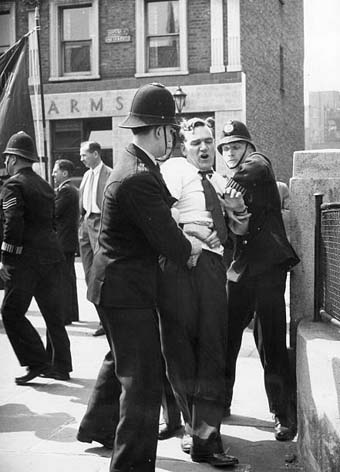
In 1957, leftwing Labour councillors who had taken control over St Pancras Borough council, North London (now part of the London borough of Camden) refused to co-operate with the Conservative government over measures for civil defence – routine preparations for local measures to be taken in the event of a (then presumed to be nuclear) war. Led by longtime communist John Lawrence, the council opposed civil defence on the grounds that nuclear war was not survivable and thus the preparations were a waste of time and money.
Tensions between the US and the Soviet Union had produced a hysterical arms race, with nuclear weaponry being stockpiled and deployed on a massive scale around the world. The potential of the rival camps’ destructive arsenals threatened casualties on a scale which would dwarf the death toll of World War 2. Opposition to nuclear armament was just really beginning in the mid-1950s, but was given a boost by the development of the hydrogen bomb in the late 1950s. A general sense began to develop that a nuclear war would be largely unsurvivable, especially for people living in large cities which would be heavily targeted by missiles from ‘the other side’.
St Pancras as a borough was generally run by Labour, although the Conservatives gained power between 1949-53 and again 1959-62. In the mid-1950s, the Labour council became dominated by a leftwing group, led by John Lawrence, who had previously been a member of the Communist Party and then of several small Trotskyist groups, and remained a committed leftwinger with some sympathies towards the Soviet Union. His political career was to follow many and diverse turns and oscillations, but he was to achieve national notoriety in 1956-58 as he led the council in the adoption of leftwing policies, as well as staging high profile stunts which attracted media controversy…
Lawrence had been elected a Labour councillor in 1952, and was elected leader of the majority Labour group in 1956. From the start the group took a leftwing stand that alarmed not only the conservatives and rightwing press, but also the ‘moderate’ elements of the Labour Party. Under Lawrence’s leadership the Labour controlled administration fought the Conservative government’s legislation of 1955-56 which ordered the restoration to the private sector of any remaining housing requisitioned by councils for the homeless during and after World War 2 and imposed a means test for rent subsidies. The council defied this, cut rents for all council tenants, and refused to apply the means test to subsidies. As a delegate at the 1957 Labour Party conference, Lawrence spoke passionately against the 1957 Rent Act which decontrolled the private sector. Lawrence also negotiated a hundred per cent trade union membership agreement for municipal employees, and slashed the mayor’s allowance, confiscated the mayor’s council car and told him to travel to functions by bus.
The next action by St Pancras Labour Group to hit the headlines was the decision at a council meeting on 1 May 1957 to repudiate the local authority’s statutory obligation to organise Civil Defence.
Since 1948, local councils had been under a duty to organise for the provision of civil defence in the event of an attack. With the huge destructive power of the hydrogen bomb, many in local councils had begun to wonder what the point of civil defence was, as there would be very little left to defend after a nuclear exchange. Training a Civil Defence Corps in emergency procedures and basic first aid techniques was both a waste of money and a conscious attempt to deceive the civilian population as to the horrific consequences and chances of living through a nuclear attack.
Labour-controlled Coventry City Council had refused to implement Civil Defence (CD) for these reasons in 1954, though they backed down in the face of councillors being threatened with being personally surcharged for the cost of the government stepping in to administer CD in the borough.
That same year, growing apprehension about resolutions calling for St Pancras Borough Council to follow the example of Coventry had been passed by the general management committees of both the North and South St Pancras Labour parties. But because a majority of the then Labour Group was opposed to this, the decision had never been carried out.
In 1956, St Pancras councillors together with local trade unionists and some churchmen, organised a conference around the issue of the H-Bomb. Even under the most conservative under-estimates, all of St Pancras was likely to be completely flattened in the event of a nuclear strike on central London. The conference resolved to refuse to put on a ‘Civil Defence Week’ planned nationally by the Home Office. John Lawrence articulated the general feeling: the exercise would be ‘a complete waste of time and money’; fellow councillor Clive Jenkins: ‘in the sort of world we are going to be living in after a nuclear attack, there won’t be many people left to rescue’. The conference was rapidly followed by a decision to abandon all Civil Defence in the borough completely. While opting out of the CD Week was one thing, refusing to organise any CD at all put the councillors beyond the law. At the debate on the issue, the Town Clerk issued a formal warning that the resolution was effectively illegal.
However, the councillors quoted the government’s own White Paper, ‘Defence: Outline of Future Policy’, just recently published in Spring 1957, which openly admitted that ‘It must be frankly recognised that there is at present no means of adequate protection for the people of this country against the consequences of an attack with nuclear weapons’ (while insisting that measures should be taken ‘to minimise the effect of a nuclear attack’). The widely ridiculed contradictions in this White paper provided St Pancras councillors with ammunition for their decision, which they hoped would lead the way for other local authorities to follow suit and discredit Civil Defence, with the longer term aim of forcing a rethink on nuclear weapons…
The national press seized on the story immediately. Meanwhile a lengthy correspondence between Home Office officials and the council failed to bring the two any closer, as government insistence on the necessity of CD as the hope for holding the framework of society together in the event of a nuclear strike met with scepticism and determination from councillors. A second debate in the Council re-affirmed the resolution. The councillors moved on from non-cooperation with CD to a critique of government defence policy as a whole:
‘When you state that the only means of preventing war is by a race to create thermo-nuclear deterrents we must register a profound disagreement. The last two major wars were each preceded by a fierce competition in arms manufacture accompanied by protestations on all sides that the object was simply to deter aggression and prevent war. Thus were people deceived, and millions of dead in all countries bear witness to the futility of such a policy. As public representatives of the people we have no tight to believe, or cause others to believe, that an arms race in this nuclear age would have any other result – except that the scale of mass slaughter and suffering will be even greater.’
The letter went on to argue that British aggression in Egypt over Suez the year before had brought the world close to the brink of another war, and that the British government’s agreement to stationing Us missiles in the UK meant the whole country would be targeted by The Soviet Union in the event of conflict with the US… The council argued for a separate neutral defence stance and an abandonment of any involvement in nuclear proliferation.
There was local opposition to the Labour group’s stand, from both Conservative councillors, and from the civil defence volunteers on the ground, (who coincidentally were led to a tory councillor). Bit attempts by the tory group to overturn the decision and restore Civil Defence failed at another debate in May 1957.
At the end of May, the Home Secretary responded to the St Pancras decision, as it had in Coventry, by appointing a commissioner to take over the organisation of Civil Defence. This led to protests from the Labour Group, who had announced that they were going to convert the Civil Defence headquarters in Camden High Street into flats in order to provide housing for the homeless; they hoped to leave the commissioner with no office to move into. The government then requisitioned the building under emergency powers left over from the war.
On 4 June, when the commissioner was due to arrive, the Labour Group held a demonstration outside the building, and John Lawrence chained himself to the gates in an attempt to prevent the commissioner entering the premises. Anti-nuclear campaigner and local resident & councillor Peggy Duff, who was ill with jaundice at the time, recalls that she was dragged out of bed by a telephone call asking her to organise press coverage of the event:
‘So I arrived in the High Street to find a small group of John’s supporters, including several councillors, parading up and down outside the CD HQ with suitable banners: “Ban the Bomb”, “Destroy the Bomb or it will Destroy You”, “Stop the Tests”. It was, of course, 1957, and the British tests at Christmas Island were imminent. After some time a policeman arrived and plodded up and down the street beside the paraders. Now and again a very disapproving member of the WVS, who shared the building with Civil Defence, pushed her way through the gate. Then, when the copper was standing, half asleep, some way up the road, John produced a rather large and ostentatious padlock and chain and attached himself to the bars of the gate. For a time nothing happened. Nobody noticed. Shoppers hurried by and never turned to look. The policemen went on plodding up and down. Buses passed to and fro. No press arrived. There was the leader of the council chained to the CD gates – and nobody had turned to look. I had a horrible feeling that nobody ever would.
‘Then at last the policeman as he passed saw that something was amiss. He stopped. He stared. “Why, sir”, he said, “who did that to you?” “Nobody”, said John. “I did it myself.” “But why did you do that, sir?” the simple copper asked. “I did it as a protest against nuclear weapons”, John simply replied. The policemen hurried off to telephone a higher authority. Shoppers continued to pass by, unconcerned. Then, at last, a press photographer. Then another. Then a police car with more important, peak-capped coppers. Then gradually a crowd, at last.
‘Lawrence shouted to the crowd: “We want these premises for housing, not for useless Civil Defence purposes. There is no defence against the H-bomb. There are 6,000 people on our housing list and we want to provide homes for four families to live here.” The police, however, produced a large pair of bolt-cutters and released Lawrence from his chains. They forced the crowd to disperse and took the names of the demonstrators, though no arrests were made. Eventually the police car drove off, unwittingly bearing a “Ban the Bomb” placard which had been stuck behind its back number plate.’
On 14 June the Labour Group held a public meeting to explain its case against Civil Defence. First the audience watched a 20-minute film, Shadow of Hiroshima, which revealed what had happened to those who had survived the nuclear attack on the Japanese city in 1945. The meeting was chaired by Councillor Jack Redman who, evidently undaunted by the prospect of travelling on a 68 bus, had recently succeeded Alfred Hurst as mayor. Introducing John Lawrence, who was the main speaker, Redman stated: ‘I have never met a young councillor with so much pluck, so much guts and so much fighting spirit. It is a pleasure to serve under him’.
Lawrence spoke for an hour justifying the council’s stand. He told the meeting: ‘Normally the borough council is a very homely body of people, a very practical body of people who spend most of their time cleaning your dustbins, getting rid of your bugs and building your houses. Now we are asked to carry out the government’s essential defence policy and we say that is a complete waste of ratepayers’ money.’ He continued: ’Our Civil Defence Corps consists of wardens with whistles and one telephone box. It is clear that if an H-bomb dropped here, most of London would be destroyed. Even if you can patch up a broken leg, the amount of radioactivity floating around the area is such that people will go on dying for years and no CD Corps will be able to stop that. CD is a deception of the people and we want no part of it.’
The North London Press reported: ‘Councillor Lawrence pointed out, in answer to a question, that CD in the past had cost the council just under £2,000. The government had paid the rest of the cost – about £5,000. “The bill will be at least £7,000”, he said. “It might be very much more.” He paused, chuckled, and said: “But we haven’t paid it yet.” A voice at the front of the hall: “What happens if you don’t pay?” Councillor Lawrence: “If we don’t pay it, the government comes and takes it out of us somehow. But as we haven’t got much which can be taken from us, presumably we will go to the Scrubs or Pentonville. What I want to know is – if we don’t pay, will you back us up?” There were cries of “Yes” and for more than two minutes the audience cheered their approval of this suggestion. Said Councillor Lawrence: “That’s all I wanted to know”.’
However, the hope of the group around Lawrence that the protest would arouse widespread support in the Labour party and trade union movement was soon dashed. Labour was widely divided on the issue of defence, as it has remained, and even leftwing leaders in the end preferred to not rock the boat on defence in the interests of party unity.
Lawrence’s colourful career in pursuit of socialism in one borough climaxed in the spring of 1958. Lawrence declared 1 May a holiday in St Pancras, and gave council workers the day off. Early that May day morning, he ran down the Union Jack and raised the Red Flag over the Town Hall. At lunchtime he was arrested by the police when he refused to close a trades council public meeting at which he was speaking which was under attack by local fascists who were enraged at the new emblem of socialist St Pancras.
The Red Flag incident sparked a small social panic. It became a cause célèbre, broadcast across the media, and Lawrence became briefly a national figure of renown or notoriety, according to your political persuasion. But it represented a turning point. The Labour Party apparatus which had been monitoring Lawrence now moved decisively against him. The right wing finally organised, and some on the left backed away from supporting him. In late May, after he had survived an attempt to expel him by the St Pancras South constituency, Lawrence was suspended from membership by Labour’s national executive, and was subsequently removed as leader of the council. Despite a vigorous campaign and production of a pamphlet, The St Pancras Story, his expulsion was upheld at the Labour Party conference that autumn.
The Red Flag incident finally resulted in Lawrence being expelled from the Labour Party and, on 17th October 1958, applied to join the Communist Party with around ten of his supporters, stating that he had been seriously considering joining the CP for three or four years.
In 1959, together with 22 other councillors who had supported the decision not to pass on to tenants the increases required under the 1957 Rent Act, he was surcharged £200 by the District Auditor.
However, this issue was to erupt again locally very shortly. In January 1960, the tenants of St Pancras implemented a mass withholding of rent increases imposed by St Pancras Council, now controlled by the Conservatives. This was met by firm action from the Council, who immediately issued notices to quit. On 28 June, eviction notices were granted in the Bloomsbury County Court against three tenants.
On 21 September 1960, the day before the evictions were scheduled, 500 tenants demonstrated outside the Town Hall where the Housing Committee was meeting. They were told to move along and then charged by mounted police and protesters forcibly dispersed. John Lawrence, who had been heavily involved in the Rent Strike, was jailed for three months arising from charges coming out of the melee.
Lawrence’s mercurial political wanderings were to take him back out of the Communist party in 1964, and eventually to become a syndicalist. He died in 2002. A good short account of his life is here
And here’s a longer account
And here’s a more detailed account of Lawrence’s expulsion from Labour over the red flag incident.
@@@@@@@@@@@@@@@@@@@@@@@@@@@@@@@
An entry in the
2018 London Rebel History Calendar
 LONDON RADICAL HISTORIES
Leave a comment