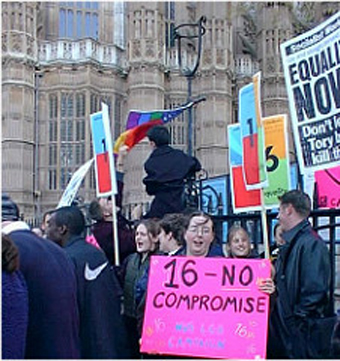
On February 21st 1994, the House of Commons voted to reduce the gay male age of consent from 21 to 18. The crowds gathered outside were bitterly disappointed that it had not been reduced to 16, and a riot ensued in the precincts of Parliament for the first time for 150 years.
This came just a few years after the tory government had introduced Section 28, severely restricting local authorities’ right to ‘promote’ homosexuality (ie to keep anything pro-LGBT in libraries, schools, publish or teach anything positive about alternative sexualities or suggest that the straight missionary position wasn’t all there is to sex). The huge resistance to the imposition of Section 28, coming on the heels of the AIDS crisis and the massive community solidarity dealing HIV had created, had helped create a large and multi-faceted lesbian and gay movement (all the other initials BT etc were pretty much yet to be added…). But the horrors of AIDS, links of lesbian and gay activists to other movements in the 1980s, had also contributed to a groundswell of mass support for at the very least basic equality under the law.
The campaign for the age of consent to be reduced had been building for several years. However, the challenge it faced was a large bloc of MPs, mostly tories but not entirely, who either blatantly would have liked to bring back imprisonment for gay sex entirely, or expressed their prejudice more subtly as ‘concern for the safety of young people’. In the parliamentary debate, many evocative arguments were brought up, such as ‘Putting your penis into another man’s arsehole is a perverse…’ (Nicholas Fairbairn MP, who was, er, cut off, by the Speaker before he could finish his sentence)
There was general consensus on the ground in gay communities that the male age of consent for sex should be equalised with everyone else, at 16. But 18 was seen in some quarters as a fall back position, a compromise that could be agreed with more cautious or reactionary MPs. The campaign was based largely on Parliamentary lobbying, and there was a noticeably lower level of mass mobilisation / direct action than had been the case in anti-Section 28 movement, around AIDS provision with ACT-UP, or even in the recent OutRage actions…
18 was proposed in legislation – but tory MP Edwina Currie in fact introduced an amendment to change this to 16.
Many Tories who backed 18 were content to follow the lead of John Major and Michael Howard, the Home Secretary, but some Labour MPs were staggered that frontbench Labour spokespeople on the key areas of health and education – David Blunkett and Ann Taylor – did likewise, instead of going for 16.
It would have taken just 14 more Labour MPs supporting Edwina Currie’s amendment to have won the day. Instead, the provision, which 42 Tories supported, was defeated by 27 votes.
If the opposition parties, not the Tories, were the age 16 lobby’s natural supporters, the Labour Party refused to whip MPs despite a conference policy commitment – 35 voted against 16, including David Blunkett, a heavily moralistic MP (and formerly ‘leftwing’ council leader) for Sheffield Brightside.
The compromise did little to appease thousands of angry gay rights campaigners who had rallied outside of Parliament. The gates into Parliament had to be closed to shut out angry protestors. Many chanted the names of the two rightwing cabinet ministers widely reputed to be closeted gay men and having an affair with each other – Michael Portillo and Peter Lilley. (Not a pretty picture: Gollum and Brideshead Revisited in love tryst…)
At one point, several hundred protesters stormed an entrance, prompting the police to lock the gates. Three protesters were arrested and one police officer was slightly injured in the demonstration. Crowds rampaged to the nearby G.A.Y. disco and owner Jeremy Joseph gave them free entry.
The night was made more emotional for many as the provocative iconic gay film maker Derek Jarman had died the night before, from AIDS, news which was still filtering through the crowd on the night of the vote, adding poignancy to the protest. Ian McKellen, a leading figure in gay reform group Stonewall, and now seen as a kind of radical gay elder statesman, came out from Parliament to address the crowd after news of the vote for 16 being defeated had sparked agro, and lambasted them: ‘When it came out that they’d voted to lower the age of consent to 18 and not equality, there was basically a riot. I felt that this was the dignified response. McKellen came out and made this speech scolding the crowd and blaming us for the vote going the wrong way. I thought that was disgraceful and told him at the time.’ (Paul Burston). Thus confirming Derek Jarman’s previous criticisms of McKellen, among other lesbian and gay figures, for being profoundly conservative and working for gay assimilation, not liberation.
It wasn’t until 2001 that the age of consent was finally equalised. It was two MORE years before Section 28 was finally repealed.
@@@@@@@@@@@@@@@@@@@@@@@@@@@@@@@
An entry in the
2018 London Rebel History Calendar
 LONDON RADICAL HISTORIES
Leave a comment