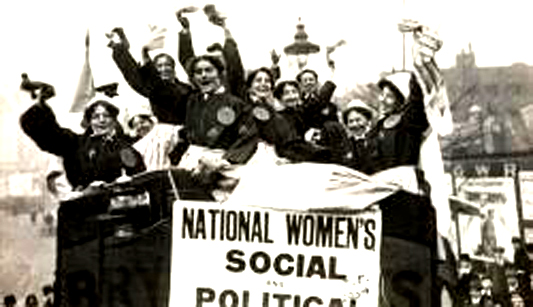
The Women’s Social & Political Union (WSPU), as part of their campaign to pressure the British parliament into extending the vote to women, held a ‘Women’s Parliament’ at Caxton Hall at the beginning of each parliamentary session from 1907, with a subsequent procession to the Houses of Parliament and an attempt (always unsuccessful) to deliver a petition to the prime minister in person.
The WSPU completed plans to march from the Caxton Hall to Parliament on 13 February [1907], the day after the King’s Speech. In the north of England, WSPU organizers sought out women willing to go to prison, and arrangements were made for their brief stay in the homes of London suffragettes. Two days before the demonstration the WSPU held secret meetings at which 200 delegates were divided into fourteen groups, and each group was provided with a leader.
On 13 February the `Women’s Parliament’ met at 3 p.m. Tickets for the Caxton Hall had been sold out well in advance… Amidst great excitement, a resolution condemning the omission of women’s suffrage from the King’s Speech was passed, as was a motion that the resolution be taken to the Prime Minister. Then Mrs Pankhurst’s cry `Rise up, women!’ was answered by shouts of `Now!’ and a procession of about 400 women was formed. Mrs Despard led the marchers out into bright sunshine, and some of them sang, to the tune of `John Brown’:
Rise up, women! for the fight is hard and long;
Rise in thousands, singing loud a battle song.
Right is might, and in its strength we shall be strong,
And the cause goes marching on.
When the first contingents reached the green beside Westminster Abbey, the police announced that the procession could continue no further. The women refused to halt. As they went forward, mounted policemen began to ride through their ranks, in an attempt to break up the march, and constables on foot seized women and shoved them down side streets and alleys. The struggle continued for several hours, as bedraggled women hurled themselves again and again against the police. Fifteen women managed to reach the lobby, where they were promptly arrested.
The disturbance lasted for hours; only around 10 p.m. did the melee end. For the first time, arrests had not been confined to a handful of WSPU leaders – fifty-one women had been arrested in addition to Mrs Despard, Sylvia, and Christabel.
Most of the women arrested were given 14-day prison sentences in court the next day.
Caxton Hall’s central role in the militant suffrage movement is now commemorated by a bronzed scroll sculpture that stands nearby in Christchurch Gardens open space.
Check out: A list of those arrested.
(though only 47 are listed there… there seems to be discrepancies in the number nicked).
http://www.alicesuffragette.com
a site dedicated to Alice Hawkins who was imprisoned for her actions on this day.
@@@@@@@@@@@@@@@@@@@@@@@@@@@@@@@@
An entry in the 2016 London Rebel History Calendar – check it out online
 LONDON RADICAL HISTORIES
Leave a comment