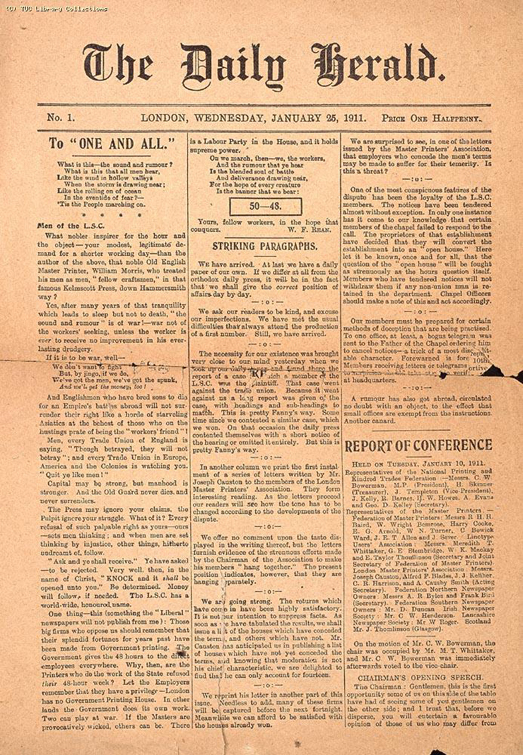
Compositors (type-setters) working on London newspapers were locked out by employers in January and February 1911, after demanding a 48 hour working week. The printers’ union, the London Society of Compositors (LSC), had in December 1910 begun an industrial struggle to establish a 48-hour week and started a daily strike bulletin called The World. Will Dyson, an Australian artist in London, contributed a cartoon. From 25 January 1911 it was renamed the Daily Herald and was published until the end of the strike in April 1911. At its peak it had daily sales of 25,000.
At the present time we are still trying to find out how the strike and lockout went down… more soon…
The Daily Herald was later re-founded as a new socialist daily paper. After the lockout a committee including dockers’ leader Ben Tillett and TE Naylor of the London Society of Compositors took it over in an attempt to create a permanent socialist daily newspaper and the Daily Herald emerged in April 1912 with a working capital of £200. “It saw itself as a forum for the whole range of radical causes, from industrial unionism to the women’s movement, and it attracted to itself support from activists within all these fields.” It covered strikes, union issues, the fight for women’s suffrage, the campaign for Irish home rule and much more.
@@@@@@@@@@@@@@@@@@@@@@@@@@@@@@@@@@@@@@
An entry in the 2016 London Rebel History Calendar – check it out online
 LONDON RADICAL HISTORIES
Leave a comment